


You've scrolled the listings at midnight. You've zoomed in on the shutters. You've said "it's got potential" about a barn with no roof. Now it's time to actually buy a house in France - and that means talking to two people: the estate agent and the notaire.
Good news: you don't need legal French. You need the right words to follow what's happening, ask good questions and not nod politely at something you'll regret.
This post gives you that French, step by step. (It's a language guide, not legal advice - your notaire and your own advisers handle the law. You handle the conversation.)
First, learn the cast
French house-buying has a small cast of characters. Know who's who before the first visit.
| French | Who they are |
|---|---|
| l'agent immobilier / l'agence immobilière | the estate agent / agency |
| le vendeur / la vendeuse | the seller |
| l'acheteur / l'acquéreur | the buyer (acquéreur is the formal word on documents) |
| le notaire | a public legal officer who prepares and authenticates the sale |
| le banquier / le courtier | the bank / the mortgage broker |
| le diagnostiqueur | the professional who carries out the property surveys (diagnostics) |
The big one: the notaire isn't "just a lawyer". In France, a property sale must be made official by a notaire in a document called the acte authentique. Buyer and seller can each have their own notaire - and it's perfectly normal to ask.
Your takeaway: notaire ≠ estate agent ≠ bank. If you know who you're talking to, you know which questions to ask.
The visit: the French that stops you falling for a pretty kitchen
Viewings are called visites. You'll book one like this:
- Bonjour, je vous appelle pour l'annonce de la maison à [ville]. Est-ce qu'elle est toujours disponible ?
- Est-ce qu'on pourrait organiser une visite ?
Then, on site, the words that actually matter:
- Quelle est la surface habitable ? - What's the living area?
- Il y a combien de chambres ? - How many bedrooms?
- Le terrain fait combien ? - How big is the land?
- C'est mitoyen ? - Is it semi-detached / attached?
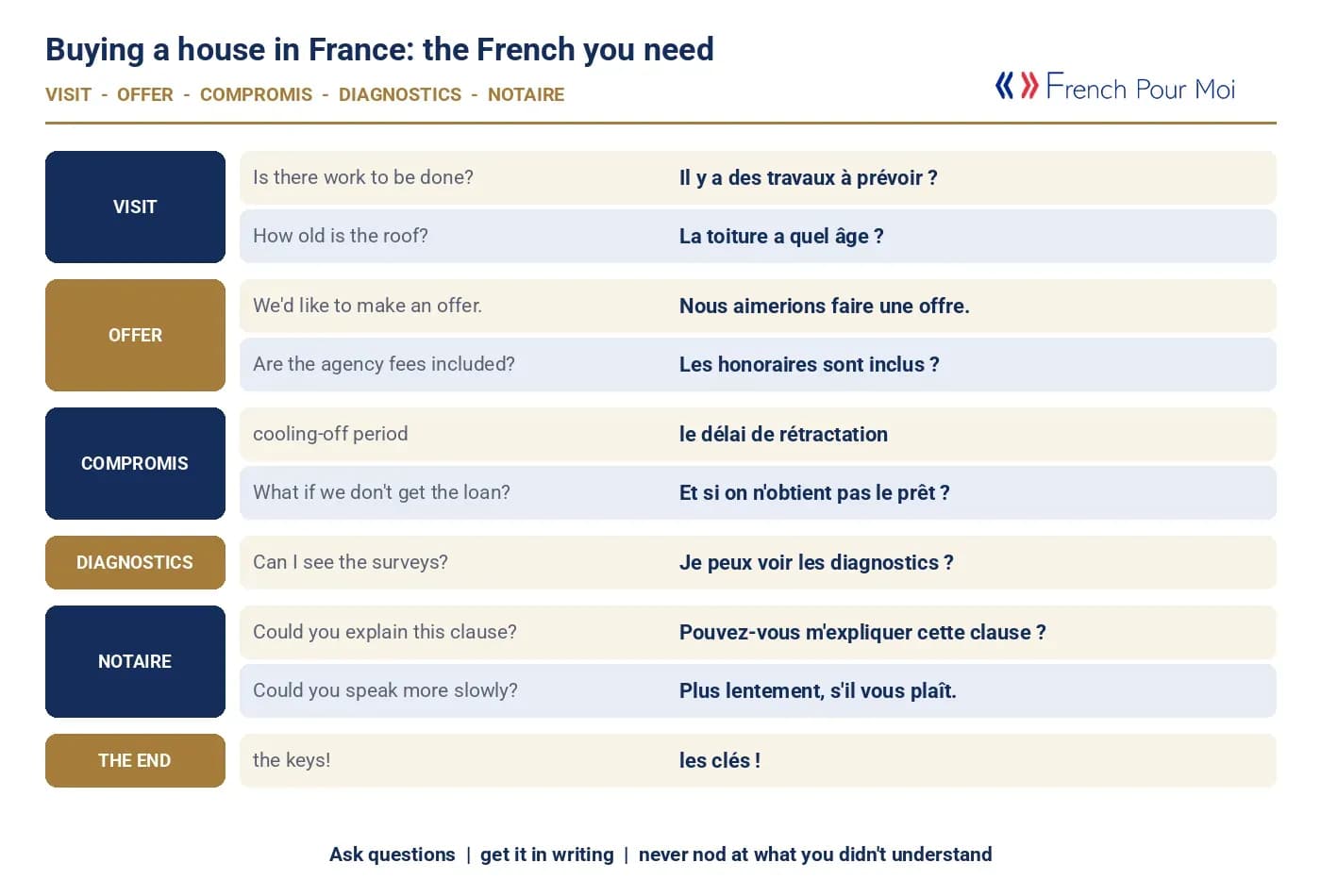
- Il y a des travaux à prévoir ? - Is there work to be done?
- Le chauffage, c'est quoi ? Fioul, gaz, électrique, pompe à chaleur ?
- La toiture a quel âge ? - How old is the roof?
- C'est raccordé au tout-à-l'égout ? - Is it connected to mains drainage?
- Pourquoi les propriétaires vendent ? - Why are the owners selling?
A word of warning: in listings, beaucoup de charme can mean beautiful beams. It can also mean the beams are holding up more than they should. Travaux à prévoir is French for "bring your wallet".
Your takeaway: write your ten questions in French before the visit, and ask every one. The charm will still be there afterwards.
The offer: polite, clear, in writing
Once you love a place, you make an offre d'achat - an offer to buy. It's usually made in writing through the agent.
- Nous aimerions faire une offre. - We'd like to make an offer.
- Nous proposons [prix] euros. - We're offering...
- Le prix est-il négociable ? - Is the price negotiable?
- Les honoraires de l'agence sont inclus ? - Are the agency fees included?
- Notre offre est valable jusqu'au [date]. - Our offer is valid until...
- Nous aurons besoin d'un prêt. / Nous achetons sans prêt. - We'll need a mortgage / We're buying without a mortgage.
Listen for FAI in prices: frais d'agence inclus, agency fees included. It matters when you compare listings.
Your takeaway: offre, négociable, honoraires - three words that can save you a very awkward phone call later.
The compromis: the big signature before the big signature
If your offer is accepted, the next step is usually the compromis de vente (sometimes a promesse de vente instead). This is the preliminary contract: buyer and seller commit to the sale, on agreed terms.
Words you'll meet in it:
- le dépôt de garantie / le séquestre - the deposit, held by a third party
- une condition suspensive - a condition that must be met for the sale to go ahead
- la condition suspensive d'obtention de prêt - the "subject to mortgage" condition
- le délai de rétractation - the cooling-off period
That last one is important. As a private buyer of a home, you have a legal cooling-off period after signing the compromis - currently ten days - during which you can withdraw. Your notaire will confirm the exact dates for you.
Useful lines:
- Pouvez-vous m'expliquer cette clause ?
- Qu'est-ce qui se passe si on n'obtient pas le prêt ?
- À partir de quand court le délai de rétractation ? - When does the cooling-off period start?
- Est-ce qu'on peut ajouter une condition suspensive ?
Your takeaway: never sign what you can't explain back in your own words. Pouvez-vous m'expliquer ? is the most valuable sentence in this post.
The diagnostics: the house's medical file
The seller must provide a set of surveys called diagnostics - together, the dossier de diagnostic technique (DDT). Which ones apply depends on the property: its age, location and equipment.
Common names you'll see:
- le DPE (diagnostic de performance énergétique) - the energy rating, from A to G
- l'amiante - asbestos
- le plomb - lead (in older buildings)
- les termites - in areas where they're a known risk
- l'électricité / le gaz - safety of older installations
- l'état des risques - natural and other risks for the area (flooding, for example)
- l'assainissement - the drainage system, including non-mains septic systems
Questions worth asking:
- Est-ce que je peux voir les diagnostics ?
- Que veut dire ce résultat ? - What does this result mean?
- Est-ce que c'est grave ? Il faut faire des travaux ?
Your takeaway: a G on the DPE isn't a grade for your French. It's a heating bill. Ask about it.
Chez le notaire: the final signature
The sale becomes final when buyer and seller sign the acte authentique (also called the acte de vente) at the notaire's office. The notaire reads through the deed - yes, often out loud, page by page - before everyone signs.
If your French isn't strong enough to follow a legal document in detail, tell the notaire in advance. They'll tell you what's required - for example, having a translator present. Don't just hope for the best and nod.
Words for the big day:
- la signature de l'acte - the signing of the deed
- les frais de notaire - the "notary fees" (in practice, mostly taxes collected by the notaire)
- les clés - the keys (the best word in this whole article)
- Félicitations, vous êtes propriétaires ! - Congratulations, you're owners!
Useful lines:
- Pouvez-vous parler un peu plus lentement, s'il vous plaît ?
- Est-ce que je peux relire ce passage ?
- Est-ce qu'un traducteur doit être présent ?
Your takeaway: the notaire expects questions. Asking is professional, not embarrassing.
Five mistakes that cost you calm (and sometimes money)
- Nodding when you didn't understand. Say Pardon, je n'ai pas compris - every time.
- Mixing up offre and compromis. One is a proposal. The other is a signed contract.
- Ignoring the diagnostics. They're boring. So is a new septic tank.
- Forgetting the cooling-off period. Know when it starts and ends.
- Doing it all on the phone. Ask for things par écrit - in writing: Vous pouvez me l'envoyer par e-mail ?
Your takeaway: "in writing, please" is fluent French for "I'm a careful buyer".
How to practise before your first visit
- Day 1: learn the cast table. Say each role out loud.
- Day 2: write your ten visit questions in French.
- Day 3: role-play the offer with a friend, a tutor or your bathroom mirror.
- Day 4: read one real French listing online and underline every word you don't know.
- Day 5: practise the three magic lines: Pouvez-vous m'expliquer ? / Plus lentement, s'il vous plaît / Par écrit, s'il vous plaît.
At French Pour Moi, we can role-play your visits, your calls with the agent and your appointment with the notaire - in 1-to-1 or 2-to-1 lessons, online, in Bristol or in Paris. Couples buying together love the 2-to-1 format: one asks, one takes notes.
FAQs
Do I need to speak French to buy a house in France?
Not necessarily fluently, but the process, documents and signing are in French. The more you understand, the more confident you'll be - and if you can't follow the deed, talk to the notaire about a translator.
Is the notaire on my side?
The notaire is a public officer who must make sure the sale is legal and properly recorded. Buyer and seller can each choose their own notaire at no extra cost to the sale overall - ask your notaire how it works in your case.
What's the difference between a compromis and a promesse de vente?
Both are preliminary agreements. In a compromis, both sides commit to the sale. In a promesse unilatérale de vente, the seller commits and the buyer gets an option to buy. Your notaire or agent will explain which one you're signing.
One last thing
Buying a house in France is a big adventure - with a fair amount of paperwork attached. The right French won't make the paperwork disappear. It'll make it yours.
Know the cast. Ask your ten questions. Say Pouvez-vous m'expliquer ? without blushing. And enjoy the moment someone hands you les clés.
Not sure if your French is ready for the notaire yet? Take our free French level test - it takes a few minutes and tells you where to start.
À bientôt, Lucie - French Pour Moi