


Salut, I'm Lucie.
Let me guess. You can read a French email without much trouble. You know the words for your job, your course, your new flat. Then you open your mouth, and the questions start.
Le or la? J'ai mangé or je mangeais? And why did je aller just come out - again?
Here's the thing: if you learn French as a Chinese speaker, these mistakes aren't random. They're logical. French insists on marking things on every verb and every noun that Chinese has never bothered to mark. Your brain isn't failing. It's being efficient - in Chinese.
So let's look at what's really going on, and what actually helps.
Two languages, two ways of packing a sentence
Think of a sentence as a suitcase. Chinese packs light. French packs everything, just in case.
Chinese verbs never change. 去 is 去 - for me, for you, for them, yesterday or tomorrow. French gives you je vais, tu vas, nous allons, ils vont, je suis allé(e), j'irai.
Chinese shows time with words and aspect markers. Time words (昨天, 明天, 小时候) and particles like 了 (completion or change), 过 (experience) and 着 (ongoing state) do the work. French puts time inside the verb.
Chinese has no grammatical gender and no articles. 书 is just 书. In French, it's le livre - and the table is la table. Don't ask why. Nobody knows.
Chinese doesn't mark plural on the noun. 三本书: the number and the classifier carry it, and 们 is only for people (and often skipped). French marks plural on the article, often on the adjective - and in speech, sometimes only on the article: le livre and les livres differ by one tiny word.
Your takeaway: when French feels "fussy", it's not you. You're adding luggage Chinese never asked you to carry. Pack one item at a time.
Verbs: stop memorising tables, start collecting sentences
Because Chinese verbs never move, French verbs tend to freeze in your mouth. Il aller au bureau. Nous parle français. Very understandable. Still wrong.
The fix isn't a bigger conjugation table. It's smaller, real chunks.
- Je vais au bureau.
- On va déjeuner ?
- Ils vont arriver demain.
Each one is a ready-made phrase you can grab mid-conversation, with the right form already attached.
Start with ten verbs: être, avoir, aller, faire, pouvoir, vouloir, devoir, prendre, venir, savoir. They carry a huge share of everyday French.
And a little gift: in spoken French, on often means "we", and it uses the same form as il or elle - on va, on fait, on est. One less form to juggle.
Your takeaway: learn ten verbs as five real sentences each. Fifty sentences beat fifty tables.
Past tenses: 了 is not your translator
This is the big one.
In Chinese, a past sentence often needs no special marking at all - the time word does the job:
- 我小时候住在北京。 → Quand j'étais petit(e), j'habitais à Pékin.
- 昨天下雨了。 → Hier, il a plu.
Both are past. Only one has 了. In French, they need two different tenses: imparfait for the background (j'habitais), passé composé for the event (il a plu).
It's tempting to decide "了 = passé composé". Sometimes it works:
- 我昨天去了巴黎。 → Je suis allé(e) à Paris hier.
But 了 also marks a change of state - 我饿了 is "I'm hungry now", J'ai faim, not a past tense at all. And plenty of Chinese past events have no 了 anywhere. 过 often lines up with déjà + passé composé (我去过法国 → Je suis déjà allé(e) en France). 着 describes something ongoing (他看着书), which in a past story is often imparfait: Il lisait.
So don't translate the particle. Ask one French question: is this the scenery, or is this the action?
| Ask yourself | Tense | Example |
|---|---|---|
| What was the situation? What did I usually do? | Imparfait | Il faisait froid. Je travaillais à Shanghai. |
| What happened? What changed? | Passé composé | J'ai reçu une offre. J'ai démissionné. |
| Both at once | Imparfait + passé composé | Je travaillais à Shanghai quand j'ai reçu une offre à Paris. |
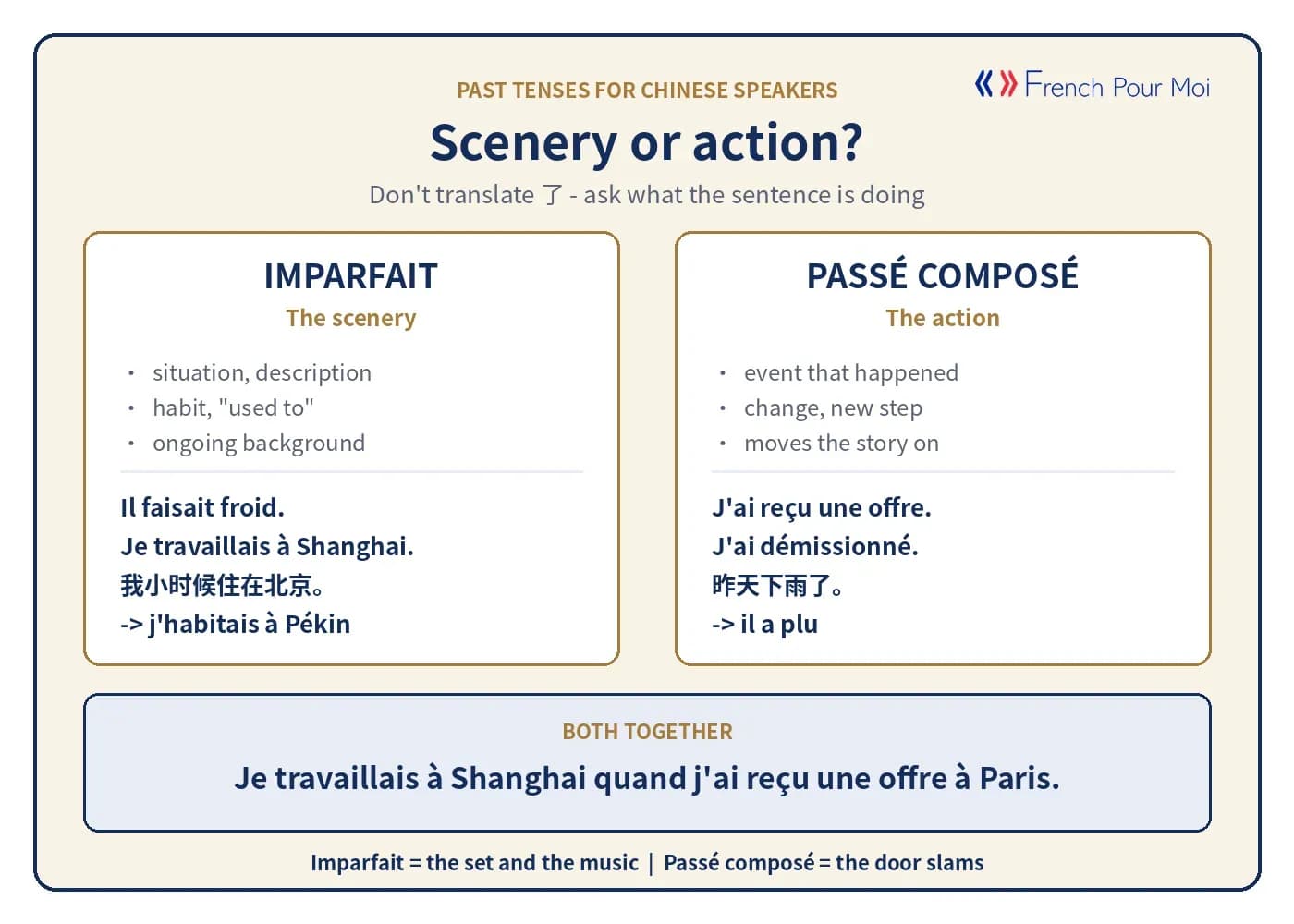
Picture a film. The imparfait is the set and the music. The passé composé is someone walking in and slamming the door.
Your takeaway: tell the story of your move abroad in five sentences - two for the scenery, three for the action. Then tell it again tomorrow.
Gender and articles: never let a noun travel alone
French gender is partly logical and partly pure whim. Le soleil, la lune. Fine.
There's a hidden trap too. In spoken Mandarin, 他 and 她 are both tā. So even if you know perfectly well your manager is a woman, il can slip out when you speak fast. Your French colleagues will understand. They may also look briefly confused.
Then there are articles. Chinese happily uses a bare noun where French refuses to:
- 我喝咖啡。 → Je bois du café. (not Je bois café)
- 我喜欢咖啡。 → J'aime le café. (general taste takes le)
- 我买了一本书。 → J'ai acheté un livre.
What helps:
- Write every noun with its article: une réunion, un rendez-vous, la banque, le loyer.
- Use two colours in your notes - one for masculine, one for feminine. Your visual memory will do some of the work.
- Lean on patterns: -tion, -sion, -té are usually feminine (la situation, la décision, la société). -ment, -age are usually masculine (le logement, le fromage). Exceptions exist. Patterns still beat guessing.
- Before il or elle, take half a second. Accuracy now, speed later.
Your takeaway: a French noun without its article is like a passport without a photo. Don't let it in your notebook.
Sounds: you have more advantages than you think
Good news first.
You already own the French u. It's pinyin ü: 女 (nǚ), 绿 (lǜ), and the u in 去 (qù) or 鱼 (yú). The French ou is close to the u in 不 (bù) or 五 (wǔ). The tricky part is spelling, because French writes these differently from pinyin. Drill pairs: tu / tout, rue / roue, dessus / dessous.
The French R lives near your Mandarin h. It's not the curled-tongue r of 人 (rén). It's made at the back of the throat. Many learners get closer by starting from the h in 喝 (hē) or 好 (hǎo) and adding a bit of voice: rue, Paris, merci.
Nasal vowels: no landing. Mandarin syllables can end in -n or -ng, so bon easily becomes "bong". In French, the vowel goes through your nose and the n never really arrives. Try vin / vent / vont - three different vowels - slowly.
Final consonants: some loud, many silent. Mandarin syllables end only in a vowel, -n or -ng, so avec, sept, sac tend to get clipped. Meanwhile petit, grand, vous keep their last letter silent. If you speak Cantonese, with its final -p, -t, -k, the first part may come more easily. The silent letters still need learning.
Liaison: words that hold hands. Les amis sounds like "lé-z-amis". Vous avez like "vou-z-avez". That's why listening feels slippery - word boundaries move. Start with the common ones after les, des, nous, vous, ils, elles, un, mon, très.
Tones off, melody on. French has no word tones - pitch doesn't change meaning. Instead, it leans on the last syllable of a group and rises at the end of a yes/no question (Tu viens ?). Giving every syllable equal weight can make French sound choppy. Speak in smooth chunks: Je voudrais / un café / s'il vous plaît.
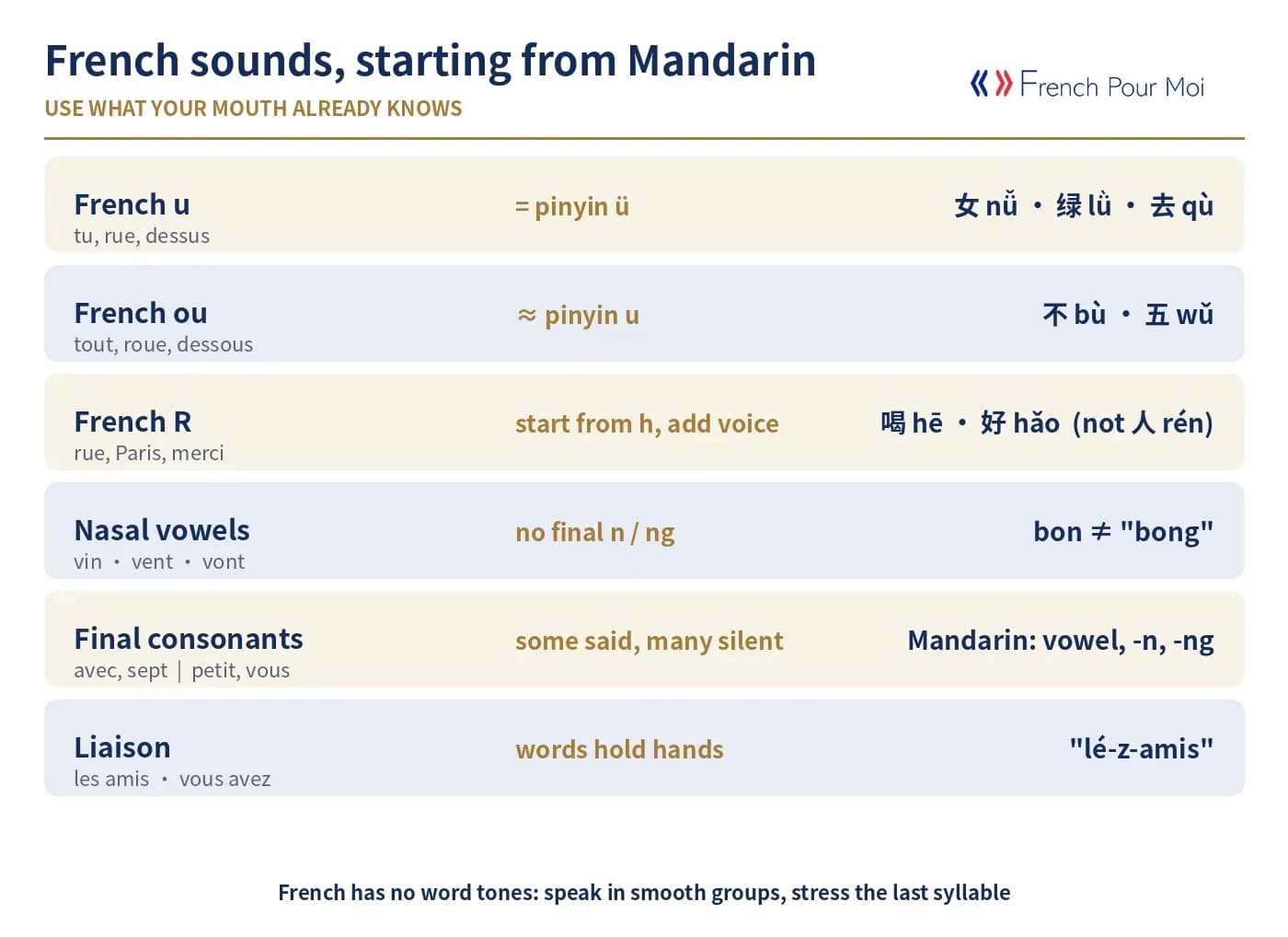
Your takeaway: when you meet the French u, think 绿. When you meet the French R, start from 喝. Use what your mouth already knows.
A ten-minute week
No heroic study plans. Ten to fifteen focused minutes, five days.
- Monday - nouns. Ten nouns you need this week, each with its article, each in a short sentence.
- Tuesday - verbs. Two of your top ten verbs, five sentences each, changing the person: je, on, vous, ils.
- Wednesday - the past. Record your five-sentence story. Listen back. Scenery in imparfait? Action in passé composé?
- Thursday - sounds. u / ou pairs, nasal vowels, the R. Record yourself next to a native audio clip.
- Friday - real conversation. A tutor, a language partner, a brave colleague. Write down the three mistakes you made most.
Those three mistakes go on your personal mistake list. Not a grammar book - just your five or six repeat offenders. Reviewing that list is worth more than rereading every rule.
Your takeaway: your mistakes are a map. Follow it.
How French Pour Moi can help
At French Pour Moi, we work with adults from all over the world - professionals, expats, students heading to France - on the French they actually use.
In lessons, we can work on exactly what this article covers: making core verbs automatic, choosing between passé composé and imparfait in your stories, fixing gender in your daily vocabulary, and polishing the sounds that make you harder to understand.
Curious? Get in touch to book a lesson. Or check where you are first with our free French level test, or read What is my level in French? A1, A2, B1, B2?
FAQs
Is French hard to learn as a Chinese speaker?
Some parts are, yes - mainly verb forms, past tenses and gender, because Chinese doesn't mark them. Other parts are easier than you'd expect: you already have the French u sound from pinyin ü. With targeted practice, the hard parts become routine.
Does 了 mean passé composé?
Sometimes they overlap, for a finished action (我昨天去了巴黎 → Je suis allé(e) à Paris hier). But 了 can also mark a change of state, and many Chinese past events have no 了. Ask instead: scenery (imparfait) or action (passé composé)?
How do I remember if a noun is masculine or feminine?
Never learn it alone. Learn la banque, le bureau, use ending patterns like -tion (feminine) and -ment (masculine), and use the noun in sentences. Gender sticks through use, not lists.
Should I learn French through English or through Chinese?
Both work. English shares a lot of vocabulary with French (information, important, restaurant), which helps your reading. Comparing French with Chinese, like we did here, is the fastest way to understand why tenses and gender feel strange.
One last thing
French asks you to notice things Chinese never asked you to mark: who's acting, when, masculine or feminine, one or many. That's a real shift in how you build a sentence. It's also completely learnable.
Collect sentences, not tables. Keep every noun with its article. Tell your story in the past. And trust the sounds you already have.
À bientôt, Lucie - French Pour Moi