


Hi everyone - it's Sophie here.
If you've got a teenager in GCSE French this school year - Year 10 starting the course, or Year 11 heading for summer 2027 - you've probably heard the same advice I used to give without thinking: "Add more fancy phrases. Stretch the writing. Show off."
The reformed GCSE Writing paper had its first full outing in summer 2026. That old advice can still quietly cost marks.
What the paper rewards now is control: accurate French you can retrieve under pressure, not creative risk that wobbles halfway through a sentence.
In everyday terms, control means your child can still use the French they already know when the clock is running. They cover every bullet, keep the message clear, move between past, present and future without the verb falling apart, and translate English ideas into French that actually means that - not a fancy guess that wobbles halfway. The opposite is creative stretch: showing off with long or flashy sentences they cannot finish accurately.
That's good news, actually. It means practice can be clearer, calmer, and a lot more useful than stuffing essays with phrases nobody would ever say.
A quick note: exam boards publish their own papers and mark schemes, and small details can be updated. Treat this as practical coaching for AQA-style Writing (the pattern most UK families ask me about), then check your child's exact board booklet.
What Writing looks like after the 2026 reform
Paper 4 is still 25% of the GCSE. The shape depends on the tier:
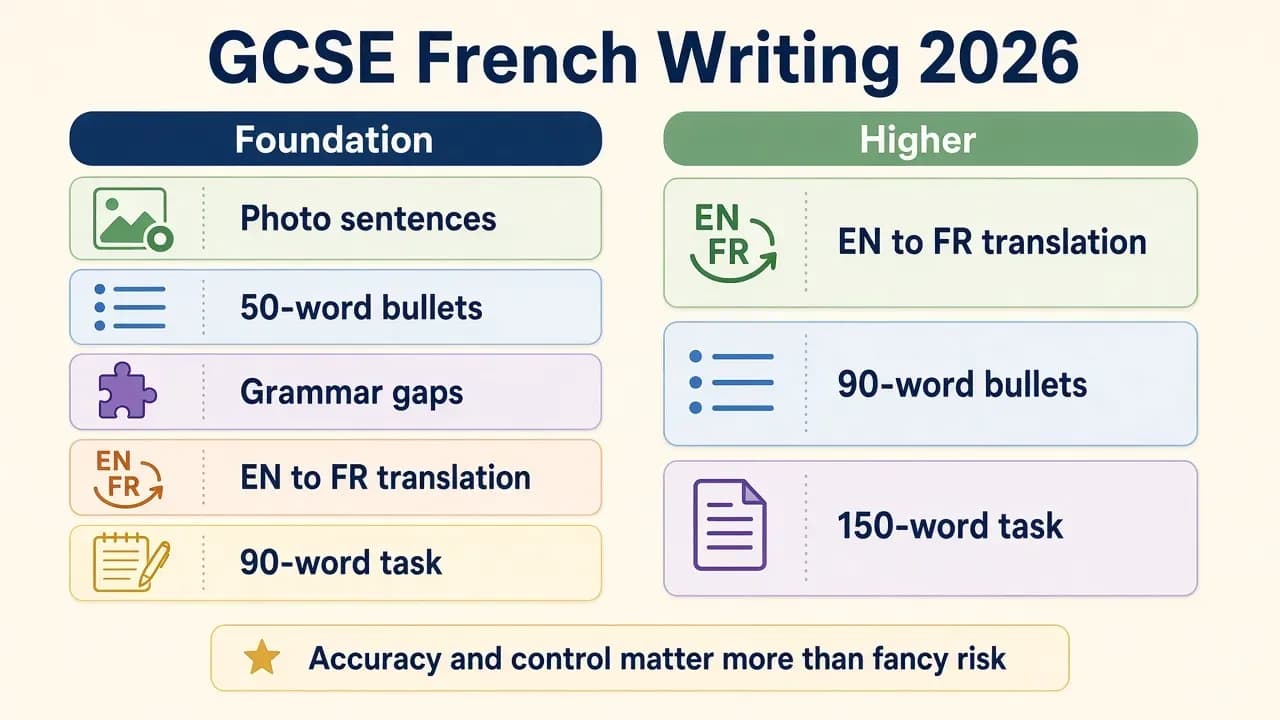
| Tier | Rough shape of the paper | What really decides the grade |
|---|---|---|
| Foundation | Photo sentences, short bullet writing, grammar gaps, EN to FR translation, then a longer ~90-word task | Clear messages + accurate core grammar |
| Higher | EN to FR translation first, then ~90-word bullets, then an open ~150-word task | Accurate retrieval across time frames, then controlled complexity |
Two things jump out when I look at this with parents.
First, translation into French is no longer a side dish. On Higher it opens the paper. On Foundation it sits in the middle. Either way, students who only ever write freestyle paragraphs are under-practised for the skill that now sits in plain sight.
Second, the longer tasks still want development and range - but the mark schemes keep punishing ambition that breaks communication. A clean past/present/future answer that hits every bullet usually beats a glittering paragraph that collapses on verb endings.
If speaking is the skill that keeps your child awake at night, I've written a companion piece on that here: How to prepare for the GCSE French Speaking Exam.
What "control" actually means in a mark scheme
When I say control, I don't mean boring French.
I mean your child can do these things reliably:
- Cover every compulsory bullet (missing one is an expensive own goal)
- Keep messages clear enough that a French speaker wouldn't need to guess
- Switch between time frames without the tense falling apart
- Translate English into French that is "good enough" on meaning, then accurate on grammar
- Use familiar structures under time pressure instead of inventing brand-new ones mid-exam
On translation especially, examiners are looking for two layers: did the meaning come across, and is the grammar/vocabulary sound? If the meaning fails badly, the grammar marks often follow it down. That is why wild guessing in translation feels brave and scores poorly.
This is also why the old "just write more" instinct backfires. Extra sentences only help if they stay controlled.
A practice plan that matches the paper
Here's the weekly rhythm I like for Year 10 and Year 11 through the autumn term and beyond. It works whether your child is Foundation or Higher - you simply change the length and ambition of the tasks.
Weekly rhythm (about 2.5-3.5 hours beyond school)
- 2 short translation drills (10-15 minutes each): English sentences into French from the topic list
- 1 bullet-point write-up under mild time pressure (Foundation ~50 or ~90 words; Higher ~90 then later ~150)
- 1 accuracy autopsy with a tutor or careful parent: rewrite only the broken verbs, agreements, and time frames
- Light vocabulary recycling from the board's defined list - little and often beats weekend cramming
A simple 6-week starter block
Weeks 1-2: bullet coverage + present/past security. No fancy connectors until the basics hold.
Weeks 3-4: add future/conditional where the tier needs them; start timed translation bursts.
Weeks 5-6: full mini-papers, then a ruthless rewrite of the same answers. The rewrite is where grades move.
I always ask students to keep a tiny "error bank": the five mistakes they keep making (agreement, perfect tense helper, adjective endings, question forms, false friends). That bank becomes the warm-up for every session.

How parents can help without turning into a second teacher
You don't need fluent French to coach this paper well. You need a checklist.
Before your child hands work in, ask:
- Did every bullet get an answer?
- Can I underline one clear past, one present, and one future idea?
- Are there three places where the sentence suddenly gets vague?
- In the translation, does each English idea appear in French, even if it's simple?
If the answer to the last one is "sort of," send them back to meaning first. Pretty French that misses the message is still a miss.
And please don't correct every accent in week one. Prioritise communication killers: wrong person, wrong tense, missing bullet, invented words that change the meaning.
Three myths that waste autumn
1. "Fancy phrases will get them a 9"
Complex language helps only when it's accurate. On this paper, unstable complexity is expensive.
2. "Translation is just vocab"
It's vocab plus grammar under retrieval pressure. Practise it as a skill of its own, not as an afterthought.
3. "More words always means more marks"
Length without control creates more places to lose clarity. Hit the approximate word guidance, then polish.
For the bigger picture of high grades across the subject, this older guide is still useful: How to Get a Grade 9 in GCSE French. Pair it with the Writing habits above rather than treating a grade 9 as a mystery personality trait.
How we help with GCSE Writing at French Pour Moi
At French Pour Moi, our native tutors work one-to-one with GCSE students who need Writing that holds up on the day - translation control, bullet coverage, tense security, and calm timing.
In practice that means short targeted drills rather than endless vague essays, feedback that names the exact habit to fix next, and sessions that fit around school and clubs.
If you'd like a clearer starting point, take our GCSE French level test, then tell us your child's year, board if you know it, and target grade. We can build a Writing plan that matches the paper they will actually sit.
FAQ
Is this only for AQA?
The control-over-chaos principle travels well across boards. Exact task order and timings differ, so always check your child's specification and sample papers.
Should Foundation students bother with translation practice?
Yes. It's a dedicated task on the Foundation paper, and it trains the same accurate retrieval Higher students need later.
How early should we start timed Writing practice?
If mocks are coming up this year, start light timing now. Waiting until spring usually means practising panic instead of control.
My child already sat the 2026 exams. Is this still useful?
Yes - for younger siblings, for Year 10s starting the reformed course, and for Year 11s aiming at 2027. The paper shape and the mark-scheme habits above are what the reform settled on.
Can apps replace a tutor for Writing?
Apps help with vocabulary. A tutor (or a very disciplined feedback loop) is what catches the repeated grammar leaks that cost marks in Writing.
A final thought
The reformed Writing paper is less romantic than the old "express yourself" myth - and much fairer once you understand it.
Train the skills the mark scheme actually pays for: clear bullets, secure time frames, honest translation, and French your child can still control when the clock is running.
Do that steadily through the school year, and Writing stops feeling like a personality test. It becomes a craft.
Quand vous voulez un plan clair pour le Writing, on est là.