


If you're in Year 13, October is the month your IRP stops being an idea and starts becoming a commitment. Teachers are asking for titles, sources are being bookmarked, and somewhere a very capable student is writing La colonisation française en Afrique at the top of a page and feeling rather pleased with it.
I understand the instinct: a big, serious topic looks like an A* topic. But I've sat through enough mock IRP discussions to know what usually happens next. The two-minute presentation goes beautifully, because it was rehearsed. Then the examiner asks a simple, curious question - Et pourquoi est-ce que c'est important aujourd'hui ? - and the whole thing starts to wobble. Not because the student isn't clever. Because the topic was chosen to impress on paper, not to be discussed out loud for ten minutes by a seventeen-year-old with nothing but a short form in front of them.
This post is about that choice: how to pick an IRP topic you can actually talk about, how to turn it into a real question, and how to practise so the discussion feels like your ground. If your bigger worry is freezing in the oral in general, my post on practising A-Level French speaking so the freeze doesn't win covers recovery phrases and the stimulus card. This one stays firmly with the IRP.
What the IRP actually asks of you
Boards differ in the detail, so always check your own specification and your teacher's guidance. In broad terms, though, the shape is similar.
With AQA, your IRP is Part 2 of the speaking exam. You give a presentation of your findings for up to two minutes, followed by a discussion of about nine to ten minutes. You fill in a Candidate Record Form in advance with headings (in English, apart from the names of published sources) and your sources: at least two, and at least one of them online. That form is the only thing you're allowed to have with you. The presentation is worth 5 marks; the discussion is worth 30. Read that again: almost all of your IRP marks live in the conversation, not in the speech.
With Edexcel, the IRP is Task 2. You open with a two-minute presentation in which you summarise at least two written sources you read and give your personal response, then the examiner moves into questions on your presentation and a wider discussion of your research, using the key findings on your RP3 form. The whole task is recommended to run to around ten to eleven minutes.
On both boards, the examiner isn't checking whether you memorised a nice paragraph. AQA's own guidance talks about drawing out your views and asking you to explain, justify, illustrate and defend them, with questions about importance, impact, value and significance - and about what the research has meant to you. In other words: can you think in French about this topic, under gentle pressure?
Why impressive topics collapse in the discussion
When an IRP falls apart, it's almost always for one of these reasons.
It's a territory, not a question. La laïcité, l'immigration en France, la Révolution - these are whole libraries. You can describe a corner of them for two minutes, but when the examiner steps sideways into a part you didn't read, there's nothing under your feet.
It's all facts and no tension. A topic like "the history of the Tour de France" gives you dates. Dates are lovely, but you can't defend a date. The discussion rewards opinions supported by evidence, so you need something people could reasonably disagree about.
The sources are too hard, or secretly in English. If your best material is an English documentary and a dense French academic article you skimmed once, you'll have nothing to quote in your own French. Your sources need to be in French, readable for you, and rich enough to produce findings you can talk about.
There's no "why me?" One of the friendliest and most dangerous questions is Qu'est-ce qui vous a attiré vers ce sujet ? If the honest answer is "my teacher suggested it", you'll hear yourself go flat.
The three-question topic test
Before you write anything on your form, try this test out loud, in French, to a friend, a parent or your phone.
- Can I say what I'm arguing in one sentence? Not "I'm doing la francophonie", but "I want to find out whether..." If you can't finish that sentence, you have a topic, not a project.
- Can I name two French sources I have actually read? Not "I'll find some". Two real ones, with titles, that you understood.
- Can I imagine the examiner disagreeing - and answer? Think of the most obvious objection. If you have no idea how you'd respond, either the question is too vague or you haven't read enough yet.
If a topic passes all three, keep it. If it fails one, narrow it. If it fails two, it's probably time to choose again - and October is the cheapest month to do that.
A reusable IRP architecture
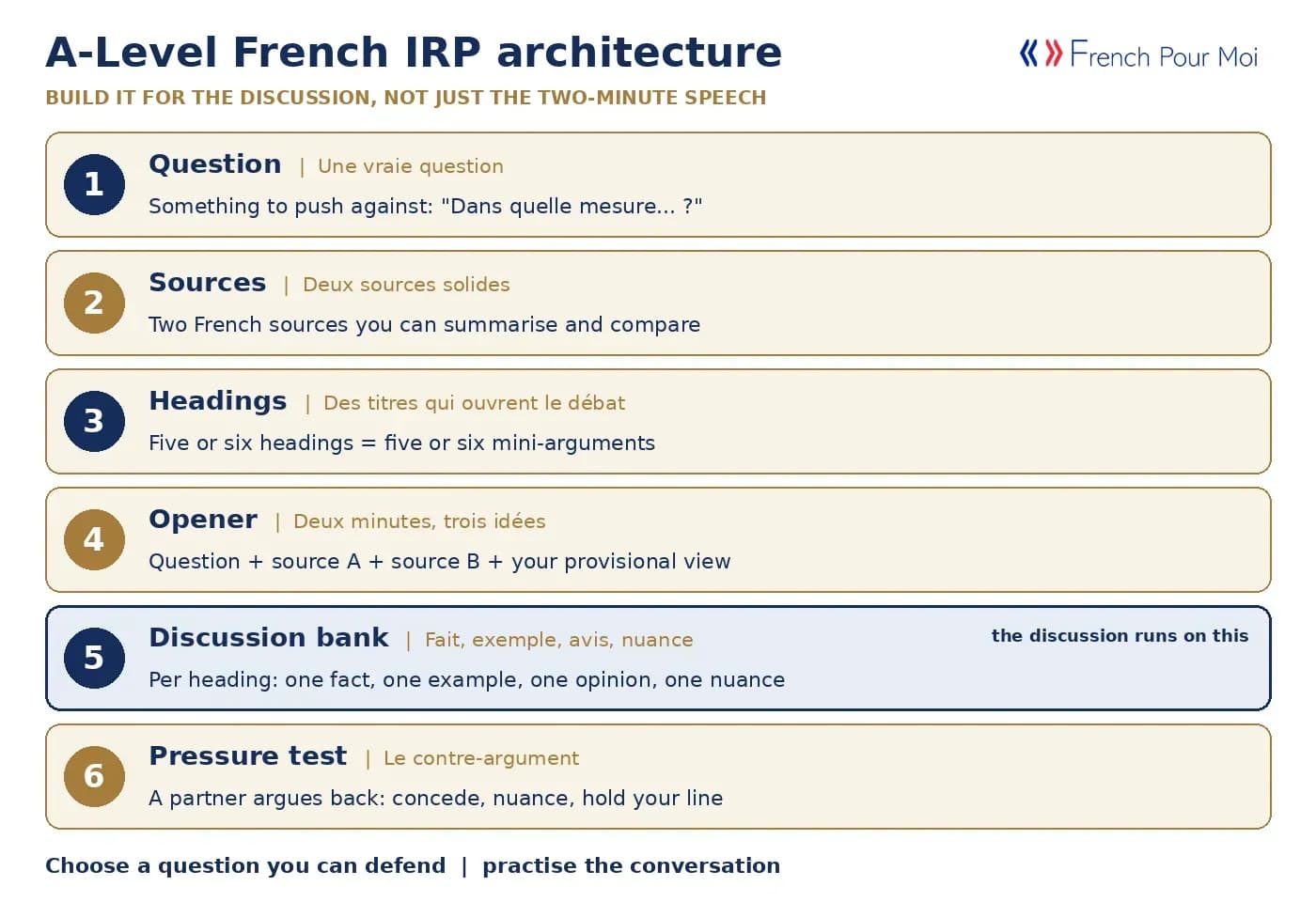
Once you have a question you like, build the project in layers. This shape works for almost any topic and board, and it keeps your practice pointed at the discussion rather than at a polished speech.
| Layer | What it does | What it looks like |
|---|---|---|
| 1. Question | Gives the examiner something to push against | Dans quelle mesure... ? or Est-ce que... ? with a real "it depends" |
| 2. Sources | Proves you researched in French | Two core sources you can summarise and compare, plus a few supporting ones |
| 3. Headings | Maps your form to the discussion | Five or six headings, each one a mini-argument you can talk about for a minute |
| 4. Opener | Two minutes, three findings, one view | Question, source A, source B, what surprised you, your provisional answer |
| 5. Discussion bank | Prepares you for "why?", "so what?" and "but..." | For each heading: one fact, one example, one opinion, one nuance |
| 6. Pressure test | Trains you to defend under challenge | A partner argues against you; you concede, nuance, and hold your line |
The magic is in layer 5. Most students over-prepare the opener and under-prepare the bank. Flip that ratio and the discussion suddenly feels smaller.
A worked example: from big topic to defendable question
Let's take a student I'll call Maya, who loves languages and social media.
- Too broad: La langue française
- Still broad: La loi Toubon (the 1994 French law on the use of the French language)
- Defendable: La loi Toubon peut-elle encore protéger le français face à l'anglais à l'ère des réseaux sociaux ?
Now Maya has a real tension: protection versus everyday reality. Her headings on the form might be: why the law was introduced; where it applies in daily life; official French alternatives to English words; young people and English online; my conclusion - real protection or a symbol?
For sources, she might use the official text of the law, the Académie française's Dire, ne pas dire pages on anglicisms, and a French news article about how young people really talk online. She can point to official alternatives like courriel for email or mot-dièse for hashtag - and to the fact that, in real life, many French teenagers still say hashtag.
Her two-minute opener might start like this:
Ma question de recherche est la suivante : la loi Toubon peut-elle encore protéger le français face à l'anglais ? D'après le texte de la loi, l'objectif est de garantir l'usage du français dans la vie publique. Cependant, l'article que j'ai lu montre que les jeunes utilisent l'anglais tous les jours sur les réseaux sociaux. Ce qui m'a le plus surprise, c'est que les mots officiels comme "mot-dièse" existent, mais que presque personne ne les utilise...
Then the examiner pushes:
Mais si personne ne dit "mot-dièse", la loi ne sert à rien, non ?
And because Maya has practised her discussion bank, she doesn't panic:
C'est un argument valable, mais je nuancerais un peu ce point. La loi ne peut pas contrôler la façon dont les jeunes parlent entre eux. En revanche, elle protège le français dans des domaines importants, comme le travail ou la publicité. Donc, à mon avis, c'est moins une barrière qu'un symbole - mais un symbole utile.
That's a strong A-Level answer: she concedes, nuances, uses a finding and lands on a view. None of the language is exotic - the structure does the work.
Phrases that carry an IRP discussion
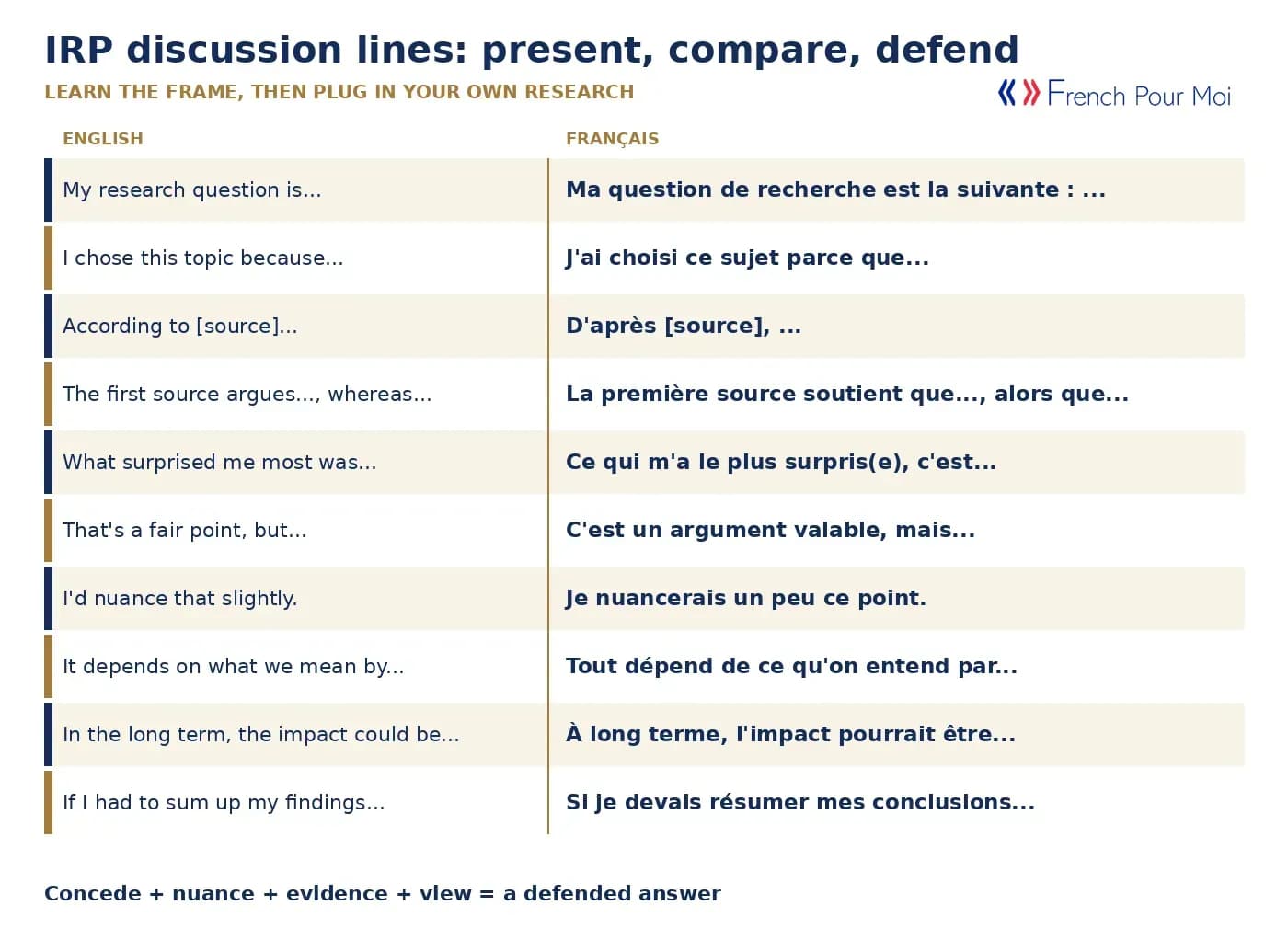
You don't need fifty fancy connectives. You need a small set of lines that let you present a source, compare, push back politely and conclude. Practise these until they come out without thinking, then plug in your own content.
| English | French |
|---|---|
| My research question is... | Ma question de recherche est la suivante : ... |
| I chose this topic because... | J'ai choisi ce sujet parce que... |
| According to [source]... | D'après [source], ... |
| The first source argues that..., whereas the second... | La première source soutient que..., alors que la seconde... |
| What surprised me most was... | Ce qui m'a le plus surpris(e), c'est... |
| That's a fair point, but... | C'est un argument valable, mais... |
| I'd nuance that slightly. | Je nuancerais un peu ce point. |
| It depends on what we mean by... | Tout dépend de ce qu'on entend par... |
| The evidence I found suggests that... | Les éléments que j'ai trouvés montrent que... |
| In the long term, the impact could be... | A long terme, l'impact pourrait être... |
| This research changed the way I see... | Cette recherche a changé mon regard sur... |
| If I had to sum up my findings... | Si je devais résumer mes conclusions... |
How to practise between now and the exam
Speaking exams usually take place in a window around April and May, so you have time - but only if you use autumn for the right things.
October: lock your question and your two core sources. Run the three-question test every time you're tempted to change direction.
November: build your discussion bank. For each heading, write one fact, one example, one opinion and one nuance - as notes, not paragraphs. Then speak each heading for sixty seconds without looking.
December: start pressure tests. Ask someone to fire Pourquoi ?, Et alors ? and Mais... at you. Record it on your phone. Listen back for the moments you went quiet, and rebuild just those.
January onwards: keep the opener at two minutes (time it - the examiner will stop you), and keep the discussion fresh by changing who questions you. Familiar questions make you comfortable; unfamiliar ones make you ready.
One important point about rules. On AQA, for example, your teacher can help you choose and refine a title, suggest sources and advise on planning, but they mustn't give you feedback on your drafts or your practice presentation beyond telling you if it runs over two minutes. That's to keep the work genuinely yours - which is exactly why the practice has to be designed by you. If you work with a tutor, the same spirit applies: the research, the opinions and the wording should be your own. A good tutor trains the skills - justifying, nuancing, holding your line under challenge - rather than writing your IRP. If you're unsure what's allowed, check with your teacher.
A quick word for parents
You don't need to speak French to help. Ask your child to explain their research question to you in English in one sentence. Then ask "why does that matter?" and "what would someone who disagrees say?" If they can answer those clearly in English, they're well on the way to answering them in French. If they can't, that's useful information in October - and much better than discovering it in April.
If you'd like a wider view of the A-Level course alongside the IRP, our pre-study guide to A-Level French for students and parents is a good place to start.
Choosing well now makes April feel smaller
The students who do best in the IRP aren't always the ones with the most impressive titles. They're the ones who chose a question they genuinely care about, read two French sources properly, and practised being challenged until it felt almost normal. Ce n'est pas magique, c'est de l'entraînement.
At French Pour Moi, I work one-to-one with A-Level students on exactly this: testing whether a topic will hold up, building the discussion skills, and running realistic mock discussions with unfamiliar questions - always on the student's own research and in their own words. Lessons run online or in person, and 2-to-1 lessons are available if two students would like to prepare together.
If that sounds helpful, get in touch to book a 1-to-1 lesson and tell me your exam board and your current IRP idea. And if you'd like a quick snapshot of where your French is right now, try our free French level test first. Bon courage with your research - choose the question you'll enjoy defending.