


If your Year 12 or Year 13 is strong on paper French and still freezes in the oral, you're not imagining it. I see this every autumn: bright students who can write a polished essay, then go quiet the moment a teacher-examiner asks something that wasn't on the card.
The problem usually isn't a thin vocabulary list. It's that they've trained memory, not recovery.
A-Level speaking rewards students who can keep a conversation alive when the plan wobbles. That is a different skill from finishing a textbook chapter. And September is the best time to start building it, before mocks turn every practise session into panic.
A quick note: speaking formats differ slightly by exam board (AQA, Edexcel, OCR and others). Treat the timings below as a practical AQA-style map, then confirm the exact rules with your teacher and the current board materials.
What the oral actually asks of you
For many UK A-Level French candidates, Paper 3 looks roughly like this:
| Part | What happens | Typical timing |
|---|---|---|
| Stimulus card | Choose one of two cards, prepare, discuss the sub-theme, answer printed questions, ask two questions of your own | About 5 minutes prep + 5-6 minutes discussion |
| IRP | Short presentation of your individual research project, then a longer discussion of your findings | Up to 2 minutes presentation + about 9-10 minutes discussion |
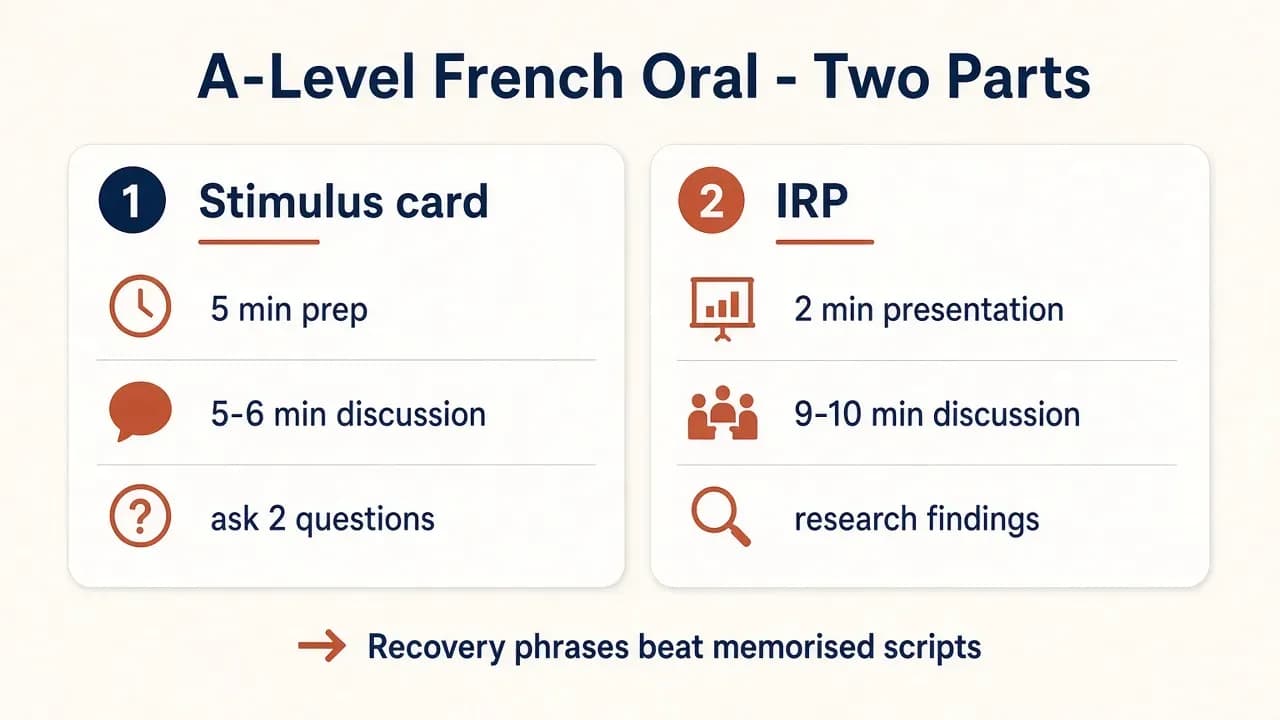
Two parts. One shared demand: stay in French when the next question is not the one you rehearsed.
Part 1 - the stimulus card
You get preparation time, printed prompts, and notes. That can feel comforting. Then the follow-ups arrive.
What examiners are listening for is not a perfect monologue. They want:
- Clear answers to the printed questions
- Development beyond the card (examples, opinions, contrast)
- Two genuine questions from you, with conjugated verbs
- Enough accuracy and range to keep the discussion moving
If your child only practises reading prepared answers aloud, the first unexpected follow-up can empty the room.
Part 2 - the IRP
The individual research project is where strong students often lose marks for the wrong reason. They research brilliantly... then deliver a Wikipedia-shaped two minutes and hope the discussion will somehow save them.
A good IRP presentation is short, clear, and designed to open discussion. The long section afterwards is where the marks live: explaining findings, comparing sources, defending a view, and recovering when a question lands outside your comfort zone.
Why bright students freeze
I hear the same pattern from parents and students:
"She knows it. She just goes blank."
Usually, one of these is underneath:
1. Script dependency
If practise means memorising full answers, any change of wording feels like failure. Real conversation always changes the wording.
2. Silence as the only strategy
When a student doesn't understand a question, they wait. Waiting feels safer than asking for reformulation. In an oral, silence costs more than a short repair phrase.
3. IRP as a mini-essay
Students write a dense mini-essay, then try to speak it. Spoken French needs signposts, shorter units, and room for the examiner to interrupt.
4. Too little timed speaking under mild pressure
Quiet weekly speaking is useful. Timed speaking, with unexpected questions, is what transfers to exam day.
A recovery toolkit worth memorising
Before fancy linking phrases, I want every A-Level student to own a small set of repair lines. Write them on a card. Practise them until they feel automatic.
Useful starters:
- Pouvez-vous reformuler la question, s'il vous plaît ?
- Si je comprends bien, vous me demandez...
- Je n'ai pas bien saisi. Vous parlez de... ?
- Donnez-moi un instant pour réfléchir.
- En d'autres termes...
- Ce que je voulais dire, c'est que...
- Pour préciser mon idée...
- J'aimerais ajouter un point.
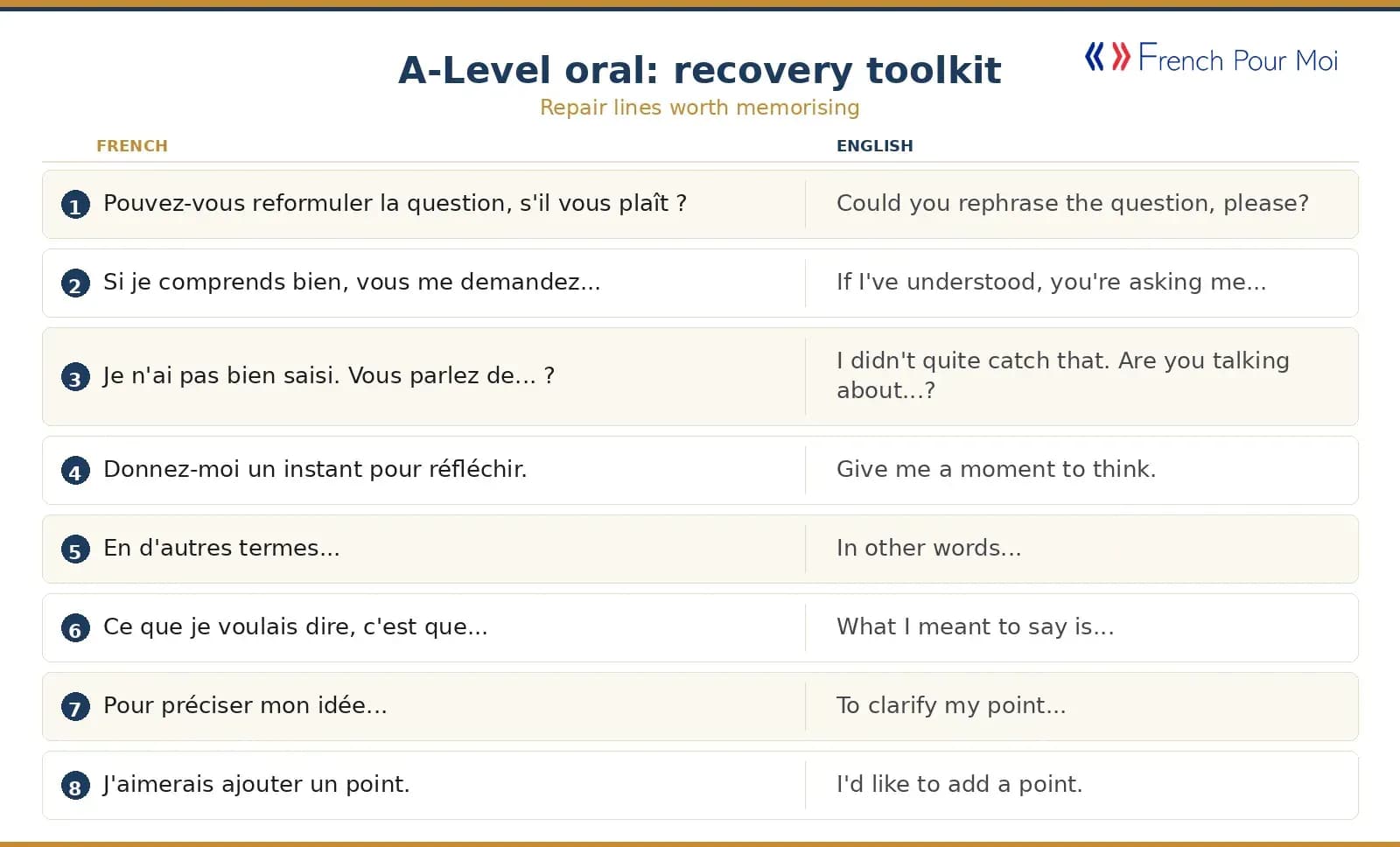
These are not cheats. They are conversation skills. Native speakers use versions of them constantly.
How I'd structure stimulus-card practise
For the card section, stop practising "perfect answers" and start practising moves.
In the 5 minutes of prep
Train a fast routine:
- Underline the task words on each printed question
- Jot 3 bullets per question (not full sentences)
- Add one example and one contrasting point
- Write your two candidate questions now, with conjugated verbs
- Note one opinion phrase and one linking phrase you will force yourself to use
In the discussion
Aim for this shape on each printed question:
- Answer the question directly in the first sentence
- Add a reason
- Add an example from French-speaking society, culture, or current issues
- Offer a short alternative view
- Stop. Leave space for the next question
That last point matters. Students who keep talking forever often dig into grammar holes. Clean, developed turns beat endless hedging.
How I'd rebuild an IRP for speaking
Pick a topic your child can actually discuss, not just summarise.
Strong IRP habits:
- One clear research question
- At least two solid sources (often including one online source, depending on board rules)
- Headings that map to discussion, not chapter titles
- A 90-120 second spoken outline, not a written essay read aloud
A simple spoken outline:
- Topic + why it matters
- Two or three key findings
- One tension or disagreement between sources
- Your provisional conclusion
- One open question you still find interesting
Then practise the discussion separately: definitions, causes, consequences, comparisons with the UK, and "what would you change?" questions. If every practise session only repeats the presentation, the long discussion will still feel like freefall.
A four-week practise plan for September
This is a rhythm I like at the start of Year 13 (or late Year 12 if the oral is already on the radar).
Weekly rhythm
- Two 45-60 minute one-to-one speaking sessions
- Three short 10-minute solo drills (voice notes on phone)
- One timed mini-oral each week
Week-by-week focus
Week 1: Recovery phrases + stimulus-card prep routine. No IRP polish yet.
Week 2: Stimulus follow-ups. Teacher or tutor asks only unexpected questions for half the session.
Week 3: IRP presentation cut to two minutes. Record it. Cut filler. Rebuild headings.
Week 4: Full timed run-through: card + IRP discussion. Note where silence appears, then drill those exact moments.
If school lessons are mostly content coverage right now, this speaking layer still needs its own slot. Content knowledge does not automatically become oral fluency.

Three mistakes that waste autumn revision
-
Only practising with the same teacher script every time Comfortable partners are lovely. An oral needs unfamiliar wording.
-
Choosing an IRP topic that is too broad "La laïcité en France" can become a fog. A tighter question gives cleaner findings and better discussion.
-
Leaving speaking until after the writing papers feel "done" Writing and speaking feed each other, but speaking needs earlier, uglier practise. Waiting until spring is how blank-outs get baked in.
How we can help at French Pour Moi
At French Pour Moi, we work one-to-one with students who need French that holds up under real questions - including A-Level speaking, IRP discussion, and the awkward moments after a follow-up they didn't expect.
In practice, that means lessons built around timed oral tasks, recovery language, IRP clarity, and feedback that is specific enough to change the next attempt. Parents often tell me the biggest shift is confidence: not perfection, just the ability to keep going in French.
If that would help, start with our free French level test, then tell us whether you're aiming at stimulus-card fluency, IRP discussion, or both. I'd love to help you build a plan that feels doable before mocks stack up.
For GCSE families, our guide to GCSE French writing after the 2026 reform pairs well with this if you have siblings in different years. And if you're still mapping CEFR levels more broadly, start here: What is my level in French? A1, A2, B1, B2?
Is the A-Level French oral mostly memorisation?
No. Prepared material helps, especially for the IRP opening. Marks come from developing ideas, responding to follow-ups, and sustaining discussion.
How early should Year 13 start oral practise?
I'd start structured speaking in September. Little and often beats a March panic block.
What if my child understands questions but can't answer quickly?
Train short first sentences. Direct answer first, development second. Speed comes from a clear opening move, not from thinking harder in silence.
Do recovery phrases sound unnatural?
Used briefly, they sound competent. Used endlessly, they sound evasive. Teach both the phrase and the exit back into content.
A final thought
A-Level French speaking is less about sounding "perfect" and more about sounding resilient. The students who do well are not the ones who never get stuck. They're the ones who notice they're stuck, repair it in French, and keep the conversation alive.
So if autumn revision currently means more notes, more essays, and the same safe speaking script, change the mix. Put recovery on the card. Put unexpected questions on the timetable. And practise the oral as a conversation, not a recital.
Quand l'oral fait peur, on peut l'entraîner autrement. On est là.