


The DALF C1 synthèse is the one exercise where knowing a lot about the topic can lower your mark. I'll call her Mariana: a 34-year-old pharmacist from Bogotá who needs the DALF C1 for a master's programme in France. Her French is rich and confident, and she reads Le Monde for pleasure. In her first mock exam she was given the two documents from the official sample paper, one about how a threatened language dies out and one called "6 000 langues : un patrimoine en danger". She knew the subject well. Colombia has dozens of Indigenous languages, and she had strong views about protecting them.
So she wrote with feeling. Her synthèse opened with "La disparition des langues est, à mon avis, l'une des tragédies de notre époque." Her second paragraph explained what was happening to Indigenous languages in Colombia. Then came a neat summary of the first document, followed by a neat summary of the second. One sentence was lifted almost word for word from the text: "le danger qui pèse sur le multilinguisme est analogue à celui qui concerne la biodiversité". She finished with "Il est donc urgent que chacun d'entre nous agisse." It came to 287 words.
Every one of those choices cost her marks. The opinion, the example from Colombia and the call to action were all éléments étrangers, ideas that aren't in the documents. The two summaries side by side are exactly what the grid describes as below the level. The copied sentence showed she could copy, not reformulate. And at 287 words she was well over the limit before anyone had read a line.
I see this with strong candidates everywhere: engineers from India, lawyers from Brazil, teachers from Vietnam, researchers from Germany or Nigeria. At C1 your instinct is to show what you think, and the synthèse is the one place where you mustn't. This post looks at how the exercise is marked, the four rules that catch most people out, and a simple method, the grille de lecture croisée, that turns two documents into one text with your own plan.
What the synthèse is (and what it isn't)
DALF C1 production écrite - the official format
- Time: 2 hours 30 minutes for the whole written paper, in the group part of the exam.
- Exercise 1, the synthèse: a summary built from several written documents, about 1,000 words in total, usually two texts. 200 to 240 words.
- Exercise 2, the essai argumenté: an argued text on the same theme, at least 250 words. This is where your opinion goes.
- Marks: 25 points for the paper, with the synthèse worth about half. You pass the diploma with 50/100 overall and at least 5/25 in each of the four papers.
The instructions on the paper are very precise, and they are worth reading slowly. In French they say you must dégager les idées et les informations essentielles, les regrouper et les classer en fonction du thème commun, and present them avec vos propres mots, sous forme d'un nouveau texte suivi et cohérent. Then come three warnings: write one text in an order of your own, not two summaries end to end; add no other ideas and no personal comments; and reuse the documents' mots-clefs but not whole sentences or passages.
That's the whole exercise in four lines. A synthèse isn't a summary of document 1 followed by a summary of document 2. It isn't a commentary, and it isn't a short essay. It's a new text that puts the documents in conversation with each other, from the outside, like a neutral reporter.
How the synthèse is marked
The current DALF C1 grid for the synthèse has six criteria, and the first two have nothing to do with how good your French is:
| Criterion | What the examiner checks |
|---|---|
| Respect de la consigne de longueur | Between 200 and 240 words, yes or no |
| Respect de la règle d'objectivité | Nothing that isn't in the documents, no personal comments, no distortion of what they say |
| Réalisation de la tâche : synthèse | The common theme is introduced clearly, and the key information from every document is there |
| Cohérence et cohésion | A personal plan that crosses the documents, not summaries side by side, with logical paragraphs |
| Lexique | A wide vocabulary that lets you reformulate the documents, with accurate spelling |
| Morphosyntaxe | Accurate, flexible grammar with varied complex sentences |
Underneath the grid there's a list of "anomalies", and this is where Mariana's marks disappeared:
- Over-length: at 300 words or more, the examiner can't put you at C1 for the task, however good the content. Outside 200 to 240, you also lose the length point.
- Not enough to mark: 99 words or fewer and the exercise scores 0.
- Copying: if more than three-quarters of your text is passages taken from the documents without reworking them, you get 0 for vocabulary and for grammar. There's nothing left to judge your own French on.
- Wrong kind of text: if you write something other than a synthèse, a commentary or an essay say, you can't reach C1 for the task or for coherence.
The four rules that catch strong candidates
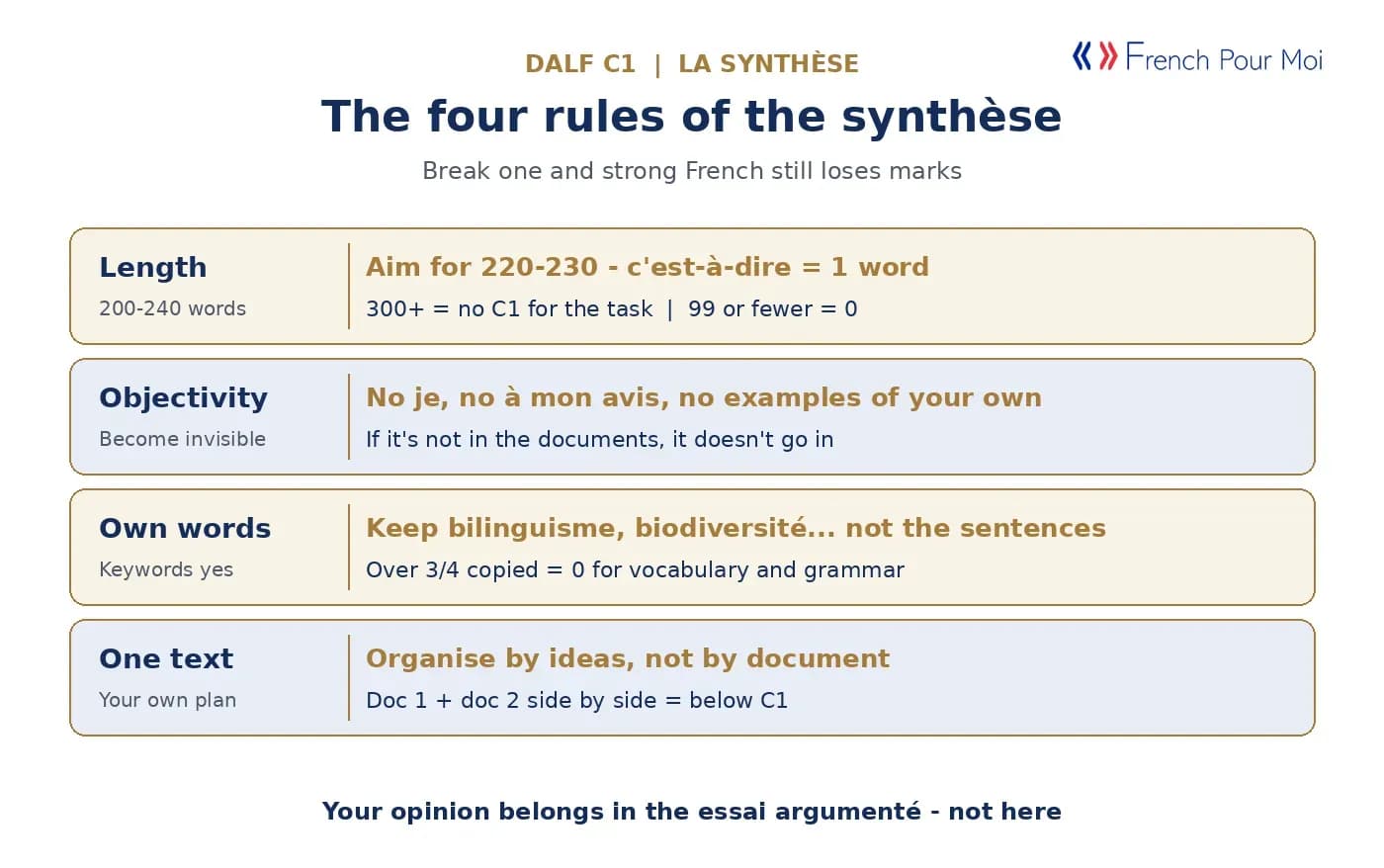
1. Count, and count properly. The paper tells you how: est considéré comme mot tout ensemble de signes placé entre deux espaces. So c'est-à-dire is one word, and "je ne l'ai pas vu depuis avant-hier" is seven. Write the total in the box on the answer sheet and be honest about it, because examiners do count. I tell my students to aim for 220 to 230. That leaves room for a last-minute sentence without crossing 240.
2. Become invisible. No je, no à mon avis, no il me semble, no heureusement or malheureusement that slips your feelings in. No examples from your own country, however relevant. This also rules out the quiet distortions: turning "may" into "will", or writing tous les experts when the document says les linguistes estiment. If you can't point to the line in the document where an idea comes from, it doesn't belong in your synthèse.
3. Keep the keywords, change the sentences. You may keep bilinguisme, langue dominante or biodiversité. You need those words, and the instructions allow them. What you can't do is lift the sentence around them. Mariana's copied line could become "L'auteure compare la menace qui pèse sur les langues à celle qui touche la biodiversité". The keyword stays, but the sentence is hers.
4. One text, your plan. This is the rule that separates a C1 synthèse from a B2 summary. Instead of "document 1 says..., document 2 says...", you organise the text by ideas, and each paragraph draws on both documents.
The grille de lecture croisée
This is the method I teach, and it takes about 35 minutes the first few times. With practice it comes down to 25.
Step 1: find the common theme. Read both documents once, all the way through, without a pen. Then write one sentence on your rough paper: what question do these texts answer together? For the sample paper it might be: Pourquoi les langues disparaissent-elles, quelles en sont les conséquences et peut-on les sauver ?
Step 2: read again and fill the grid. Draw a table with one column per document. Each time you find an essential idea, write it in your own words, in note form, in the row it belongs to. Rows are ideas, not paragraphs. For the official sample, Mariana's second grid looked like this:
| Idea | Document 1 | Document 2 |
|---|---|---|
| Causes | Political, social or economic pressure to speak the dominant language; three stages leading to the old language being abandoned | Colonisation, nation-states imposing one language, industrialisation, globalisation and the Internet |
| Scale | (nothing) | Around 6,000 languages, half with fewer than 10,000 speakers; about 10 lost per year |
| Consequences | Shame, families using the language only at home | A lost worldview and lost knowledge of nature, compared to the loss of biodiversity |
| Remedies | Revitalisation is possible if the community wants it, if it is respected and if there is funding | Preservation is urgent |
Look at the empty box. That's normal. Documents rarely cover the same points, and the grid shows you at once where they agree, where one adds something and where they differ.
Step 3: turn the rows into a plan. Two or three parts are enough. Here: causes, then consequences, then remedies. Notice that this order is yours, not the order of either document.
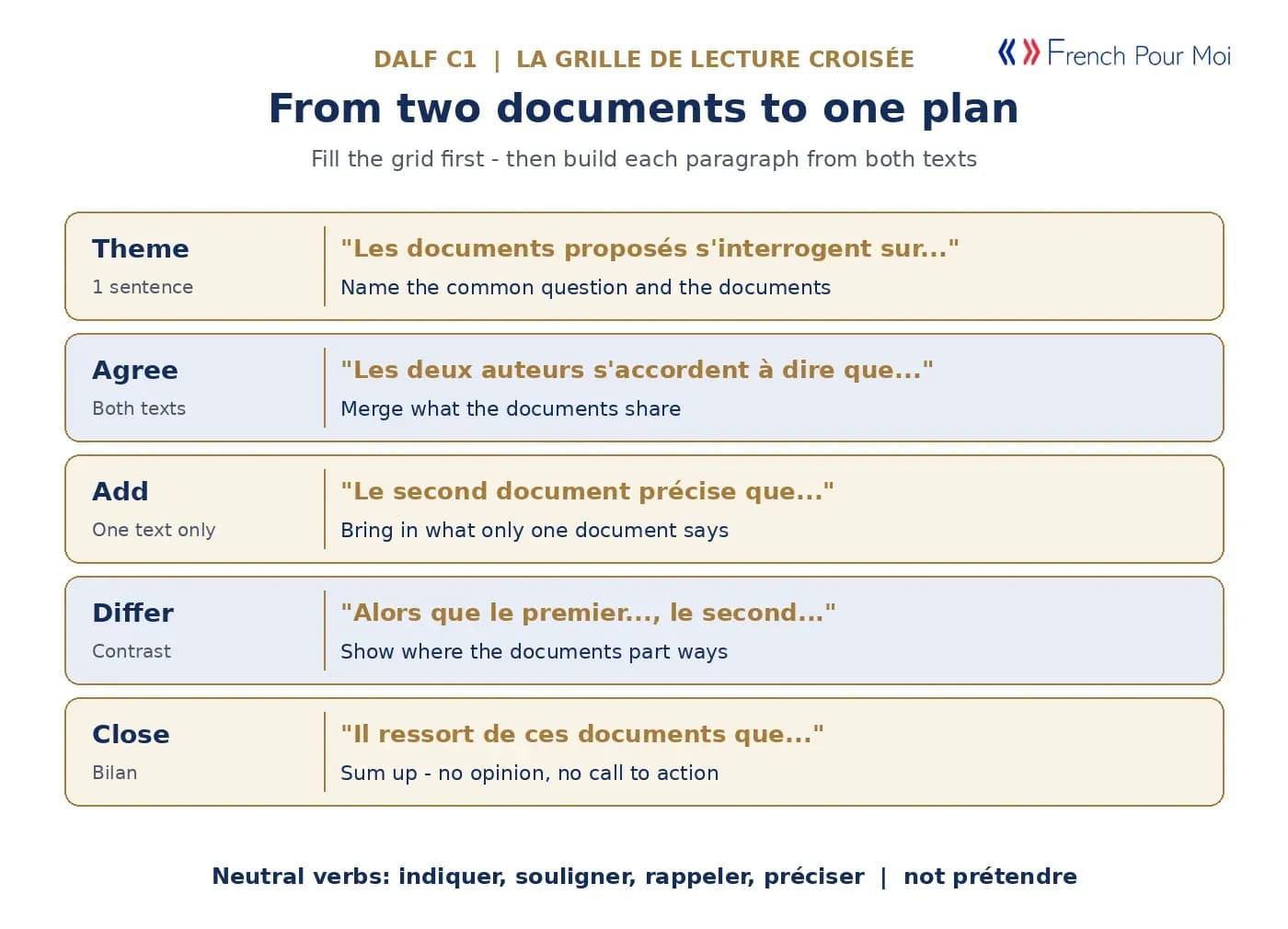
Step 4: write. An introduction of one or two sentences that names the common theme and the documents, then one paragraph per part, then a short closing sentence that sums up. It's a bilan, not an opinion.
What a crossed paragraph looks like
Here's how Mariana's second attempt began:
Les deux documents proposés, consacrés à la diversité linguistique, s'interrogent sur la disparition des langues, sur ses conséquences et sur les moyens d'y remédier.
Selon les deux auteurs, ce déclin s'explique d'abord par des pressions extérieures. Le premier texte décrit un processus en trois étapes : contraints par des raisons politiques, sociales ou économiques, les locuteurs adoptent la langue dominante, traversent une période de bilinguisme, puis délaissent leur langue d'origine. Le second document replace ce phénomène dans l'histoire : la colonisation, la construction des États-nations, l'industrialisation et, aujourd'hui, la mondialisation ont accéléré la marginalisation des langues minoritaires.
There's no je, no Colombia and no copied sentence. Both documents appear in the same paragraph, linked by an idea, and the vocabulary is her own: délaissent, replace ce phénomène dans l'histoire, marginalisation. Her knowledge of Indigenous languages didn't go to waste either. It went into the essai, which comes next, where she was asked to argue her point of view and where an example from her own country was exactly what the examiner wanted.
Phrases that keep you neutral
Learn these by job, so you can cross documents without slipping into commentary:
Introducing the theme: Les documents proposés traitent de... / s'interrogent sur... / Ces deux textes abordent la question de...
Showing agreement: Les deux auteurs s'accordent à dire que... / Tous deux soulignent...
Adding a point from one document: Le second document précise que... / Le premier texte ajoute que...
Showing a difference: Alors que le premier texte insiste sur..., le second met l'accent sur... / En revanche, ...
Reporting without judging: Selon l'auteure... / D'après ce document... / L'article rappelle que...
Closing: En somme, ... / Il ressort de ces documents que...
One small trap: verbs like prétendre or affirmer à tort sound sophisticated, but they carry a judgement. Prétendre suggests the author is wrong. Stick to indiquer, souligner, rappeler, préciser and constater.
Managing your time
The two exercises share 2 hours 30 minutes, and the synthèse tends to swallow more than its share. A plan that works for most of my students:
- 0-10 minutes: read both documents once, then write the common theme in one sentence.
- 10-35 minutes: fill the grid and choose your plan.
- 35-65 minutes: write the synthèse straight from the grid, without a full draft first. Your notes are already in your own words, which is half the reformulation done.
- 65-75 minutes: count the words, then reread once for objectivity, hunting down every je, every adjective that judges and every idea you can't find in the documents, and once for grammar.
- 75-150 minutes: the essai argumenté. Now your opinion is welcome.
A practice routine that works
- Twice a week (20 minutes): take two short press articles on the same subject, in any French newspaper or magazine you like, and only fill the grid and the plan. Don't write the text. This trains the hardest skill, which is spotting ideas across two documents.
- Once a week (1 hour 15): do a full synthèse under exam conditions, using the official sample papers or a prep book, and count your words honestly.
- After each synthèse: go through it with two highlighters. Use one for every word that is copied from the documents (beyond keywords) and another for anything that isn't in them. Both colours should be close to empty.
- Keep a reformulation log: each time you catch yourself copying, write the document's phrase on the left and your own version on the right. "Les locuteurs subissent une très forte pression" becomes "les locuteurs sont contraints de...". Reread it before the exam.
Common mistakes to avoid
- Opening with your opinion, or closing with a call to action.
- Adding an example from your own country, your job or the news. It's a good idea for the essai and a foreign element in the synthèse.
- Writing document 1 dit... document 2 dit... in two separate blocks.
- Forgetting one document, or giving it two lines while the other gets a full paragraph.
- Copying whole sentences because they "say it perfectly".
- Writing 260 words "to be safe". Over 240 is not safe.
Where to go next
The essai argumenté uses the same skills as the DELF B2 written paper, only at a higher level. If you're coming up from B2, my post on the DELF B2 writing exam and why well-argued letters still lose marks covers structure, register and connectors that carry straight over to the essai. If you're not sure whether to aim for B2 or C1, What is my level in French? A1, A2, B1, B2? explains what each level really means, and our free French level test gives you a quick starting point. And if the DALF is your ticket to a French university, our guide Insider Tips for Studying Abroad in France helps you prepare for life once you get there.
If you'd like someone to mark your synthèses against the official grid, count your words with you and point to the exact sentences where an opinion or a copied line crept in, get in touch with us. Lessons run 1-to-1 or 2-to-1, online or in person - get in touch to ask about in-person lessons near you. 2-to-1 works well for two candidates preparing the DALF together: you can fill your grids on the same documents and compare them, which is often where the real learning happens.
À bientôt,
Sophie