


A well-argued DELF B2 letter can still come back with a disappointing mark, and very often the French isn't the problem. The text simply isn't the one the task asked for. I'll call him Kenji: a 30-year-old software developer from Osaka who wants to do a master's in Toulouse. He wrote a mock DELF B2 written paper for me, and his ideas were genuinely good. He had three arguments, real examples and almost 290 words of careful French. Here is the task he'd been given, taken from one of the official sample papers:
Vous vivez en France dans une zone piétonne du centre-ville. Le maire de votre ville a décidé d'ouvrir certaines des rues de cette zone à la circulation des autobus pendant la journée. Comme représentant(e) de votre immeuble, vous écrivez une lettre au maire pour contester cette décision en justifiant votre point de vue. (250 mots minimum)
Kenji's text began: "Aujourd'hui, la pollution est un problème très important dans les grandes villes du monde." It went on to compare public transport in Osaka and in Europe. It ended with "Merci beaucoup et bonne journée !" There was no Monsieur le Maire and no subject line. He never said that he was writing for his building or what he was asking the mayor to do. It was a nice little essay about pollution. It was not a letter from a resident contesting a decision.
I see this with candidates from everywhere: Brazil, Vietnam, Poland, Mexico, Nigeria, India, Australia. They work hard on vocabulary and grammar, then lose a third of the paper before a single grammar mistake is counted. This post is about that moment, the first ten minutes with the consigne. I'll show you how the DELF B2 production écrite is marked, how to read the task so you write the right text, and a simple structure, with connectors and register, that works for a formal letter, an article or a forum post. It applies to adults sitting the DELF B2 tout public and to teenagers sitting the DELF B2 junior / scolaire.
How the DELF B2 written paper works
DELF B2 production écrite - the official format
- Time: 1 hour, in the group part of the exam, straight after the reading paper.
- Task: one prise de position personnelle argumentée. That means taking a personal, argued position in a set text type: contribution à un débat (a forum post or contribution to a debate), lettre formelle or article critique.
- Length: 250 words minimum. Fewer than half the expected words (124 or fewer) and the paper scores 0.
- Marks: 25 points, like each of the other three papers. You pass the diploma with 50/100 overall and at least 5/25 in every paper.
The task always gives you a situation, a role, a reader and a goal. In the example above you are a resident, you speak for your building, you write to the mayor and you contest a decision. Another official sample asks a student at a French lycée to write an article for the school newspaper persuading classmates to promote the open day to their parents. Those are two different texts, two different readers and two different tones. The examiner checks whether you noticed.
How it's marked (and where good French isn't enough)
The current DELF B2 writing grid has five criteria. For each one the examiner decides whether your text is below the level (1 point), at B2 (3 points) or at B2+ (5 points). Missing or insufficient work gets 0.
| Criterion | What the examiner is looking for |
|---|---|
| Réalisation de la tâche | A clear argument that matches the task, with reasons for or against and examples that fit the situation |
| Cohérence et cohésion | A well-organised text with a range of linking words, and layout and punctuation that help the reader |
| Adéquation sociolinguistique | A text adapted to the reader and to the register the task requires |
| Lexique | A wide range of vocabulary for everyday society topics, varied wording and fairly accurate spelling |
| Morphosyntaxe | Good control of common complex structures |
Look at the top three rows. Before anyone checks your agreements or your subjunctives, three-fifths of the mark depends on doing the right task, in the right shape, for the right reader.
The grid also lists what happens when a text goes off-topic. If you write about the right subject but in the wrong type of text (an essay instead of a letter, for example), the examiner can't place you at B2 or B2+ for réalisation de la tâche or for cohérence et cohésion. That caps each of those criteria at 1 point out of 5. Kenji's lovely essay on pollution was walking straight into that trap.
Why good arguments lose marks
When I mark B2 mock papers, the same three problems come up again and again:
- The all-purpose essay. The candidate has practised one model, an introduction, three arguments and a conclusion on a general topic, and uses it for every task. The ideas are fine, but the role, the reader and the goal have vanished.
- The register slip. The text starts formally and then drifts: "Franchement, c'est n'importe quoi", "Merci et à plus !", or a switch from vous to tu in the middle of a letter to a mayor or a director. Each slip tells the examiner you've forgotten who you're writing to.
- The connector list. D'abord... De plus... De plus... Aussi... Enfin... Five linking words that all mean "and another thing". At B2 the examiner wants connectors that show how ideas relate: contrast, concession, cause, consequence.
Read the task like a checklist
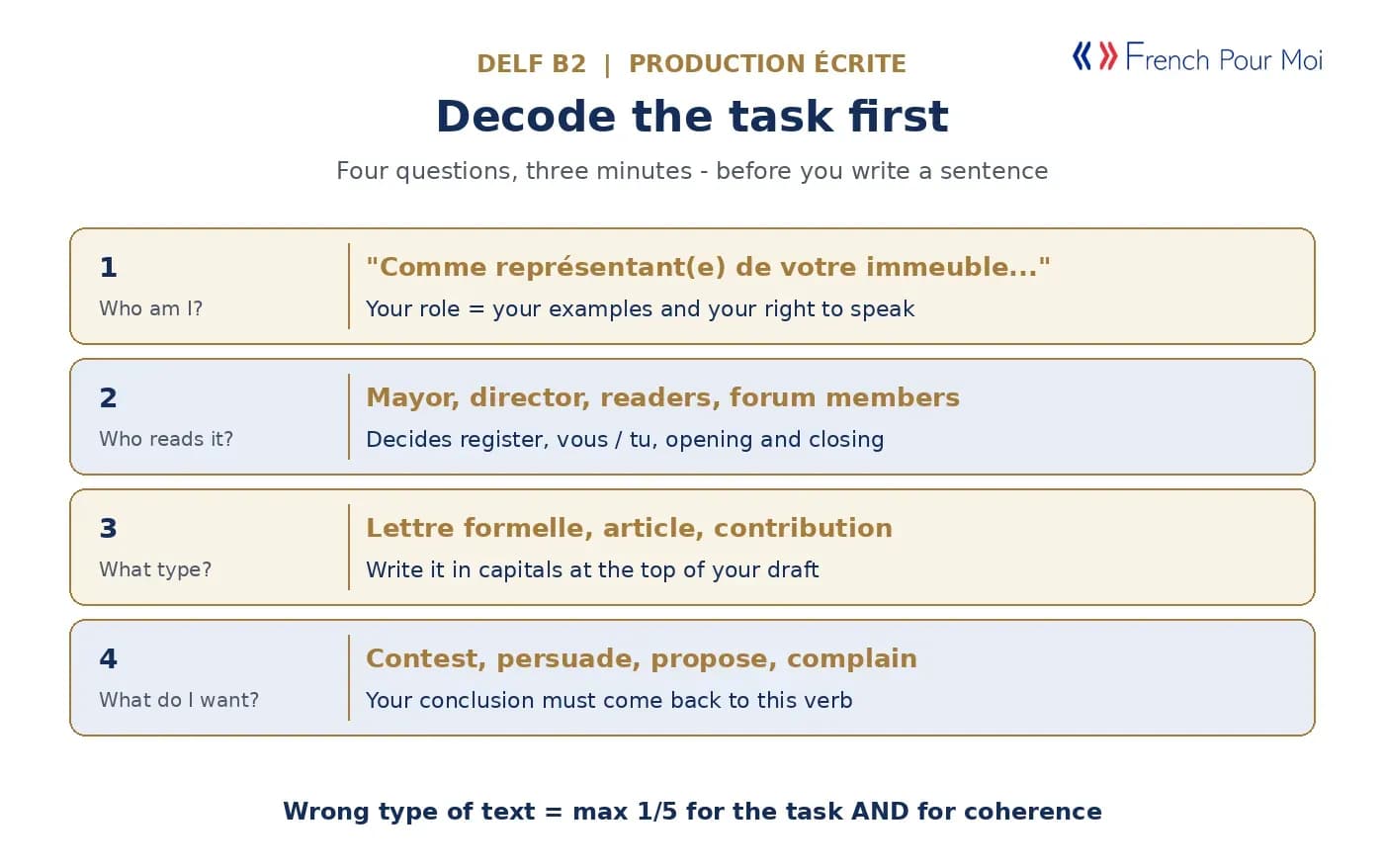
Before you write a single sentence, underline the task and answer four questions in the margin. It takes three minutes, and it's the best investment you'll make all hour.
- Who am I? Représentant(e) de votre immeuble, étudiant(e) au lycée, membre d'une association, lecteur / lectrice du journal... Your role gives you your examples and your right to speak: "En tant que représentant des habitants du 12, rue des Lilas..."
- Who is reading? A mayor, a director, a newspaper's readers, other members of a forum. That decides your register, your vous or tu, and how you open and close.
- What type of text? A lettre formelle needs a date, an objet, a greeting and a closing formula. An article needs a title and a hook. A contribution à un débat needs you to react to the discussion. Write the type in capitals at the top of your draft: LETTRE.
- What do I want? Contest, persuade, propose, complain or recommend? Write the verb down. Your conclusion must come back to it: "Je vous demande donc de revenir sur cette décision."
If you can't answer all four, read the task again. Most "hors-sujet" texts I see come from skipping this step, not from weak French.
A structure that leaves no doubt
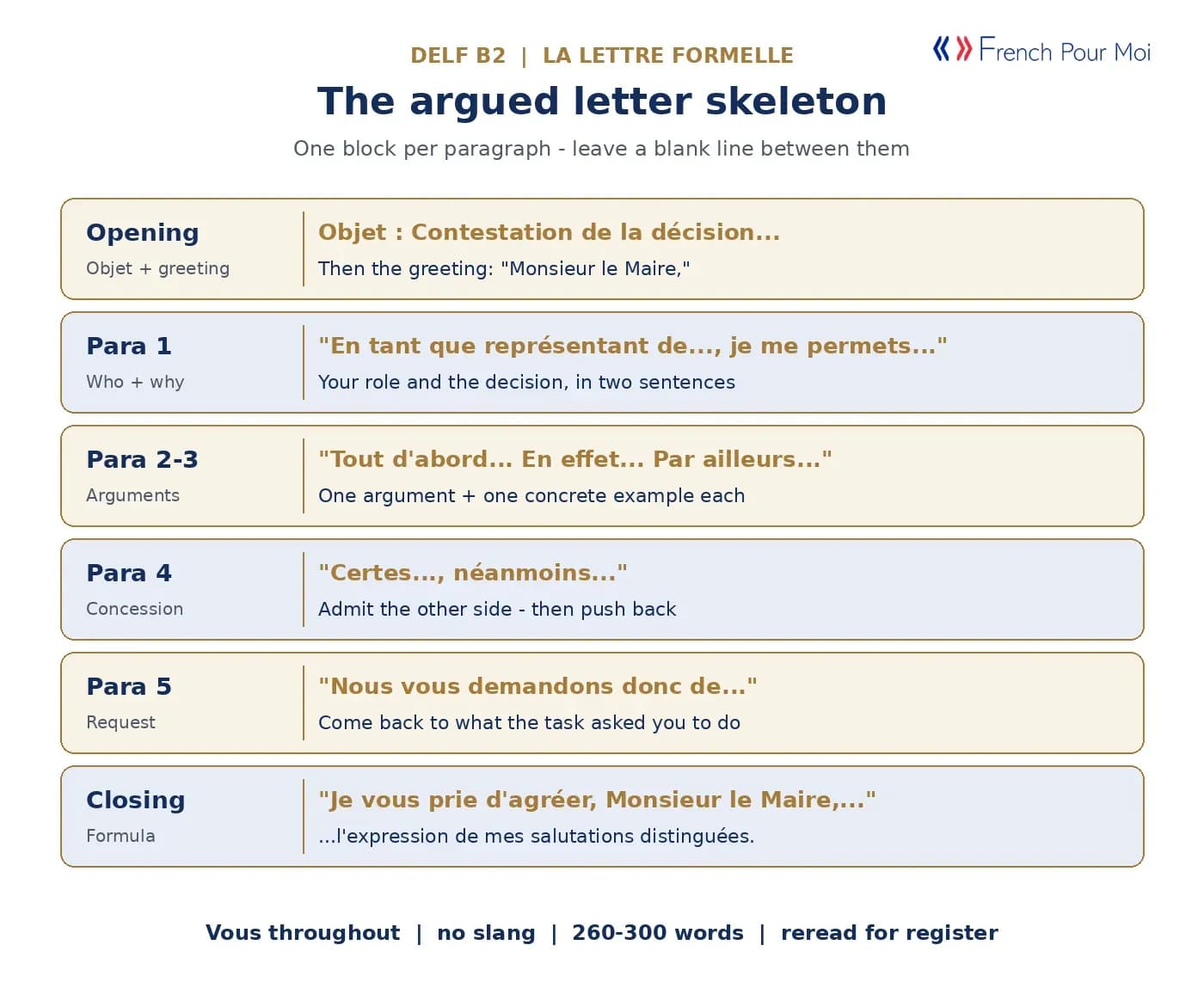
Here is a skeleton for the formal letter, the type candidates find hardest. Each block is a paragraph, and the blank lines between paragraphs count for cohérence et cohésion:
Heading: your name and address, then the reader's, then the place and date: À Toulouse, le + the date of the exam. It takes ten seconds, so don't leave it out.
Objet : Contestation de l'ouverture de la zone piétonne aux autobus
Greeting: Monsieur le Maire, (or Madame la Directrice, / Madame, Monsieur,)
Paragraph 1 - who you are and why you're writing: En tant que représentant des habitants de mon immeuble, je me permets de vous écrire au sujet de votre décision d'ouvrir certaines rues de la zone piétonne aux autobus. Je souhaite vous faire part de notre profond désaccord.
Paragraph 2 - argument 1 + a concrete example: Tout d'abord, ... En effet, ... Par exemple, ...
Paragraph 3 - argument 2 + a concrete example: Par ailleurs, ... C'est pourquoi ...
Paragraph 4 - concession, very B2: Certes, les transports en commun sont indispensables. Néanmoins, ...
Paragraph 5 - your request or proposal: Nous vous demandons donc de revenir sur cette décision ou, à défaut, de ...
Closing formula: Dans l'attente de votre réponse, je vous prie d'agréer, Monsieur le Maire, l'expression de mes salutations distinguées.
For an article you replace the heading and greeting with a short title and a first line that hooks the reader ("Et si vos parents venaient en cours avec vous ?"), then end with an appeal rather than a closing formula. For a contribution à un débat you open by reacting to what others have said ("Je réagis au message de...") and end by summing up your position. The middle stays the same: arguments, examples, a concession, a clear conclusion.
Connectors that actually do a job
Learn them in families, by what they do, not as one long list:
Adding an argument: Tout d'abord... Par ailleurs... En outre... Enfin...
Explaining or proving: En effet... Prenons l'exemple de... C'est notamment le cas de...
Conceding, then pushing back: Certes..., mais... / Il est vrai que... Néanmoins... / Bien que + subjunctive
Showing a consequence: C'est pourquoi... Par conséquent... Ainsi...
Concluding: En définitive... Pour toutes ces raisons...
One small trap: en effet doesn't mean "in fact" in the English sense. It means "indeed, because". It introduces proof of what you've just said, so use it right after a claim. And two connectors from the same family in a row is usually one too many.
Kenji's second attempt
A week later, with the same task, Kenji spent his first three minutes on the four questions and began like this:
Monsieur le Maire,
En tant que représentant des habitants du 12, rue des Lilas, je me permets de vous écrire au sujet de votre décision d'ouvrir certaines rues de la zone piétonne aux autobus pendant la journée. Je tiens à vous faire part de notre profond désaccord.
Tout d'abord, cette mesure met en danger les piétons, en particulier les enfants et les personnes âgées de notre immeuble. En effet, la rue est étroite et les trottoirs sont presque inexistants. Par ailleurs, ...
His French is the same French. But now the examiner knows in two sentences who is writing, to whom, about what and why. His pollution argument survived too. It just became an example about our street rather than "the big cities of the world". His examples from Osaka also found a place, introduced with "Dans ma ville d'origine, au Japon, ..." to support a point instead of replacing the task.
Managing the hour
- 0-10 minutes: the four questions, then a plan in keywords: two or three arguments, one example each, one concession, your request. Don't write the text out twice. There isn't time, and copying out a draft is where tired mistakes creep in.
- 10-45 minutes: write, paragraph by paragraph, following your plan. Leave a blank line between paragraphs.
- 45-60 minutes: reread three times, once for each job. First the task: role, reader, type and request are all visible. Then register: vous throughout, no slang, the right closing formula. Then grammar: agreements, verb endings and accents. Finally, count your words roughly by lines. Aim for 260 to 300 so you're safely over the minimum without leaving yourself no time to check.
A practice routine that works
- Twice a week (15 minutes): take any task from the official sample papers or a prep book and do only the first ten minutes: the four questions and a keyword plan. Then compare plans with a classmate or a tutor. You'll be surprised how often two people read the same task differently.
- Once a week (1 hour): write a full text under timed conditions. Alternate the types, a letter one week and an article or forum post the next.
- After each text: highlight every connector in one colour and every formal formula in another. If one colour is almost empty, you know what to work on next.
- Keep a register log: each time a tutor corrects an informal phrase, write the formal version next to it. "Ça ne va pas du tout" becomes "Cette situation n'est pas acceptable". Reread the log the day before the exam.
Common mistakes to avoid
- Writing a general essay when the task asks for a letter, an article or a forum post.
- Forgetting your role. If the task says you speak for your building, your association or your class, say so in the first paragraph.
- Opening formally and closing with "Bonne journée !" or "Bisous". Yes, I have seen it.
- Ending without a request or proposal when the task asks you to contest, persuade or complain.
- Writing 220 words "because quality matters more". Under 250, you lose marks on the task straight away.
- Spending so long on the draft that there's no time left to reread.
Ready for the rest of the B2?
If you're preparing the whole exam, my post on the DELF B2 speaking exam and how to defend your opinion when the examiner pushes back uses the same logic for the oral: a clear position, concrete examples and a well-placed certes... néanmoins. If you're not sure B2 is the right level for you yet, What is my level in French? A1, A2, B1, B2? explains what each level really means, and our free French level test gives you a quick starting point. And if you need a certificate for a residence application, A2, B1 or B2? Which French Level You'll Need to Live in France and How to Reach It covers which level applies to which situation.
And if you'd like someone to mark your DELF B2 letters and articles properly, with the official grid and with comments you can act on, get in touch with us. Lessons run 1-to-1 or 2-to-1, online or in person.
À bientôt,
Sophie