


Most DELF B2 candidates don't lose their speaking marks in the prepared monologue. They lose them in the ten seconds after the examiner disagrees with them. Last month a student of mine - I'll call her Ana, a 27-year-old engineer from São Paulo applying for a master's in Lyon - did a mock DELF B2 speaking exam with me. Her monologue on remote working was excellent: a clear introduction, two solid arguments, a neat conclusion. Then I played the examiner and asked one simple question:
"Mais le télétravail isole les salariés, non ?"
Silence. Then: "Oui... c'est vrai... je suis d'accord." In ten seconds she had agreed with me, dropped her own opinion, and had nothing left to say for the next eight minutes.
I see this with learners from everywhere - Brazil, India, Germany, Japan, the US, Nigeria. The prepared part goes well. The debate is where marks quietly disappear. This post is about that moment: how the DELF B2 production orale actually works, how it's marked, how to use your 30 minutes of preparation, and four simple moves for when the examiner pushes back. It works the same for adults sitting the DELF tout public and for teenagers sitting the DELF B2 junior / scolaire.
How the DELF B2 speaking exam works
DELF B2 production orale - the official format
- Preparation: 30 minutes. You draw two topics, choose one, then prepare.
- Exam: 20 minutes face to face with the examiner, two parts back to back.
- Part 1 - monologue (5 to 7 minutes): identify the problem raised by a short document and present your opinion "de manière claire et argumentée".
- Part 2 - debate (10 to 13 minutes): no preparation - you defend your point of view in a discussion with the examiner.
- Marks: 25 points, like each of the other three papers. You pass the diploma with 50/100 overall, with at least 5/25 in every paper.
The document is usually a short press extract - a few lines from a French newspaper or website on a society topic. In the official sample papers published by France Education International, the topics include "L'école en demande-t-elle trop aux parents ?", "Est-ce que le travail, c'est le bonheur ?" and "Le télétravail, une solution durable ?". You are not asked to summarise the article. You are asked to find the problem it raises and take a position.
Look at the timings again: the debate (10 to 13 minutes) is longer than the monologue (5 to 7). Most candidates spend their whole preparation on the part that lasts the least.
How it's marked (and why the debate matters so much)
On the current DELF B2 speaking grid, the examiners give marks for five things, each worth up to 5 points:
| Criterion | What the examiner is listening for |
|---|---|
| Task 1 - monologue | A short introduction to the problem, a clear opinion, concrete arguments with relevant examples, linking words |
| Task 2 - debate | You can express, confirm and nuance your opinion with extra examples, and react to questions and counter-arguments |
| Vocabulary | A wide enough range for everyday society topics, without too much repetition |
| Grammar | Good control of common complex structures |
| Pronunciation | Clear sounds and intonation that don't get in the way of meaning |
Two things jump out. First, the debate is its own criterion - a fifth of your speaking mark. Second, the language marks (vocabulary, grammar, pronunciation) cover both parts. If you freeze for eight minutes of debate, the examiner has very little French to give you language marks for.
And notice that word: nuancer. The B2 descriptor doesn't say "never change your mind". It says you can confirm your opinion or nuance it. That's the key to everything below.
Why the debate collapses
When a B2 debate goes wrong, it's almost always one of three things:
- The script trap. The candidate writes the monologue out in full during the 30 minutes, then reads it. When the debate starts, there's no script - and no plan.
- The one-argument opinion. "Le télétravail, c'est bien parce qu'on gagne du temps." One argument can be knocked over by one question.
- Agreeing too fast. Many learners - especially those from cultures where contradicting someone older or in authority feels rude - hear a counter-argument as a correction and give in immediately. In the DELF, the examiner is supposed to challenge you. It's not a correction. It's an invitation to keep talking.
How to use your 30 minutes of preparation
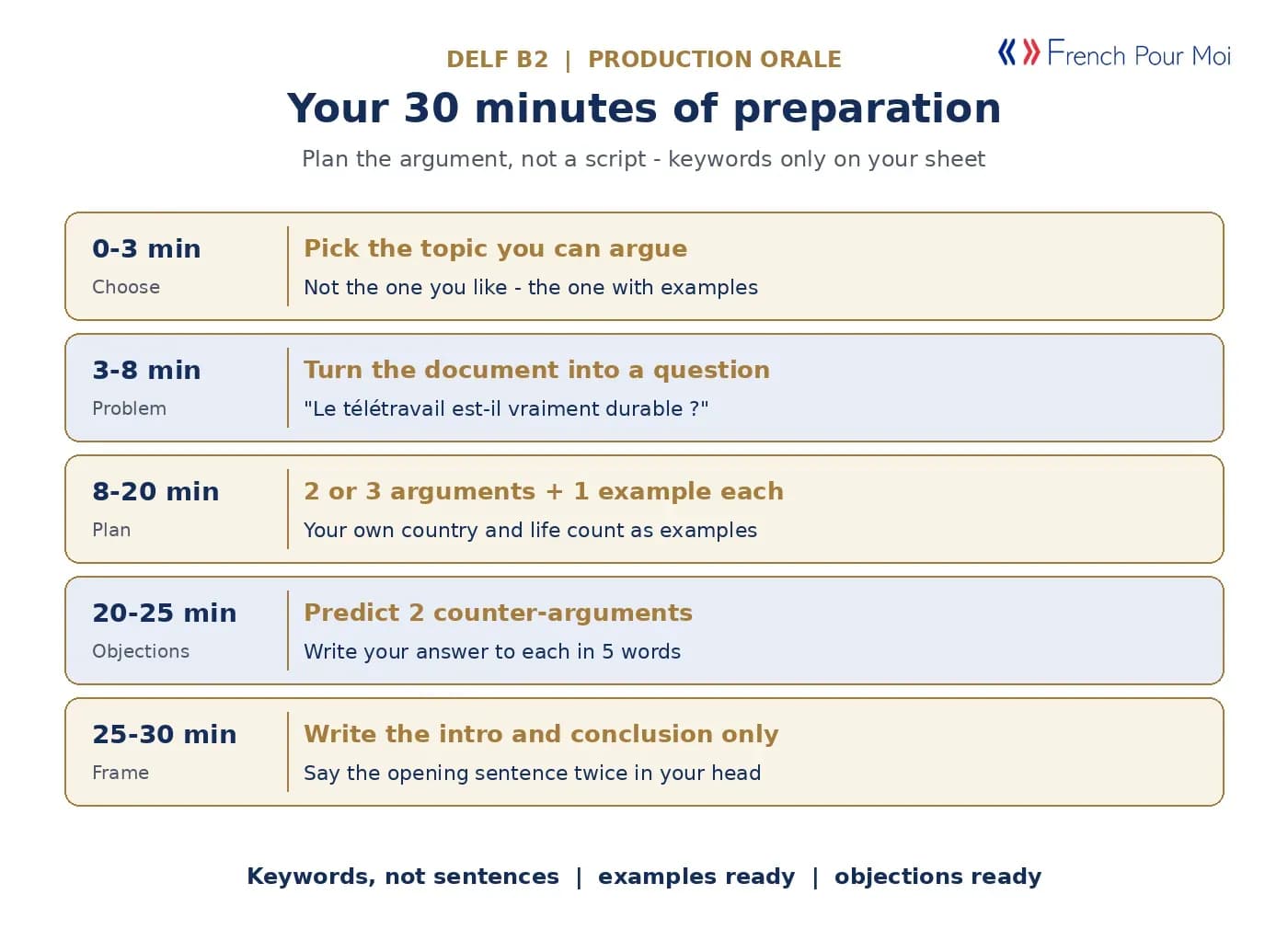
0-3 minutes: choose the topic you can argue
Not the topic you find most interesting - the one where you can already think of two concrete examples. Read both documents once, quickly, and decide.
3-8 minutes: turn the document into a question
This is your problématique. A document about companies introducing remote working becomes: "Le télétravail est-il vraiment une solution durable, pour les entreprises comme pour les salariés ?" Your introduction will be: what the document says in one sentence, then your question, then your plan.
8-20 minutes: two or three arguments, one example each
Write keywords, not sentences. For each argument, add one example - and your own country and life count. "Au Brésil, à São Paulo, certains salariés passent trois heures par jour dans les transports" is a perfectly good B2 example. Examiners want concrete, relevant support, and you are the expert on where you live.
20-25 minutes: predict two counter-arguments
This is the step almost everyone skips, and it's the one that saves the debate. Ask yourself: if I were the examiner, what would I say against me? Write each objection and your answer in five words.
25-30 minutes: frame it
Write only your first sentence and your conclusion. Say the first sentence twice in your head. A confident start calms everything that follows.
A monologue structure that leaves room for the debate
You don't need a fancy plan. This one works for any topic:
Introduction: Le document que j'ai choisi parle de... Cela pose la question suivante : ... Je vais d'abord montrer que..., puis que...
Argument 1 + example: Tout d'abord, ... Par exemple, ...
Argument 2 + example: De plus, ... C'est le cas notamment de...
Limit (optional, but very B2): Certes, ... Néanmoins, ...
Conclusion: Pour conclure, je pense que... à condition que...
That optional "limit" is a small gift to yourself. If you've already mentioned the main objection, the examiner's challenge won't surprise you - you've half-answered it.
When the examiner pushes back: four moves
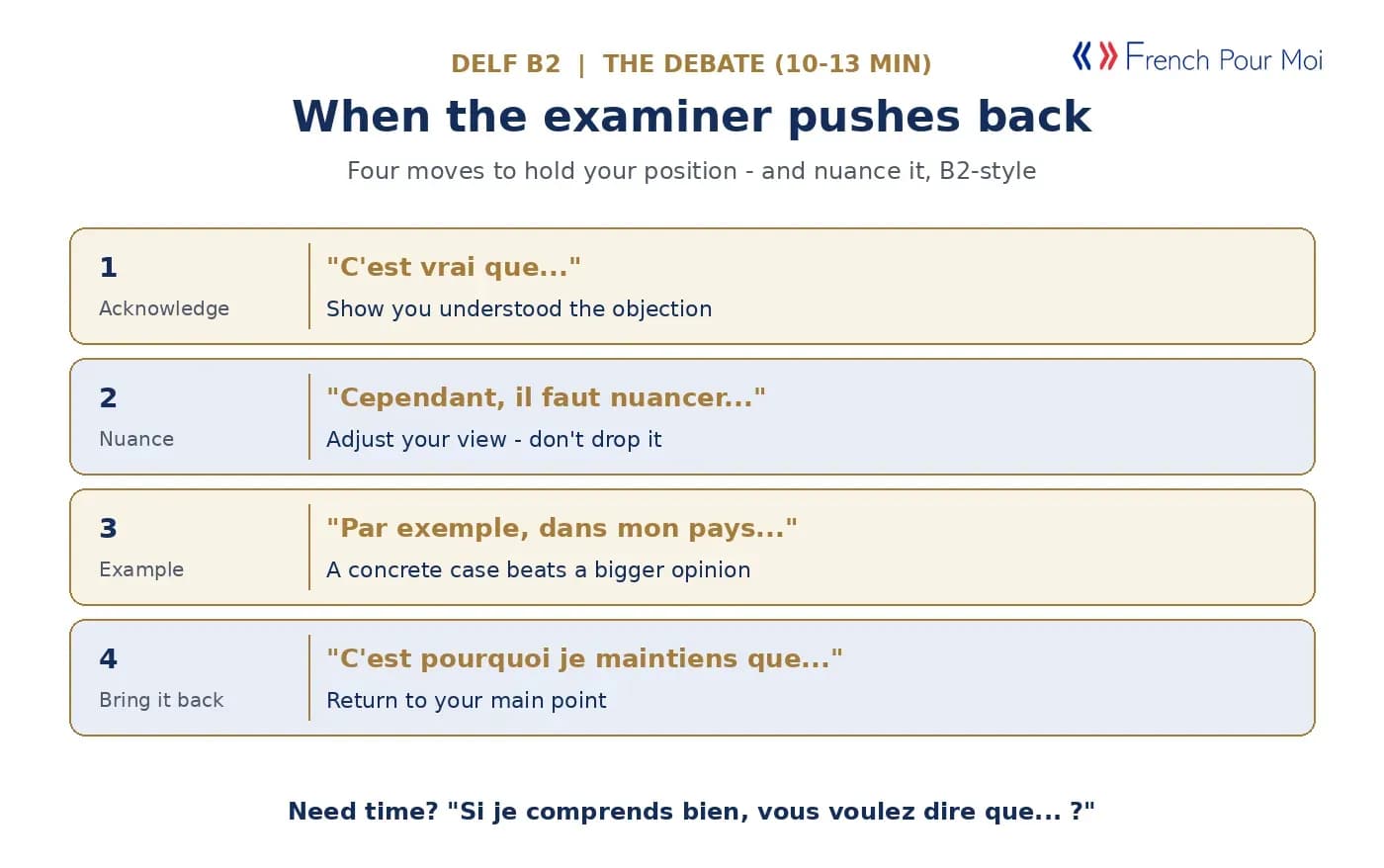
- Acknowledge. C'est vrai que... / Je comprends votre point de vue, mais... It shows you understood, and it buys you two seconds.
- Nuance. Cependant, il faut nuancer. / Tout dépend de... You adjust your position instead of abandoning it. This is exactly what the B2 grid describes.
- Give an example. Par exemple, dans mon pays... / Dans mon entreprise... A concrete case is more convincing than a louder opinion - and easier to say.
- Bring it back. C'est pourquoi je maintiens que... / Donc, à mon avis, ... Finish on your own point, not the examiner's.
And if you didn't understand the question, say so - in French. "Si je comprends bien, vous voulez dire que... ?" or "Pourriez-vous reformuler la question, s'il vous plaît ?" Asking for clarification is real interaction. Silence isn't.
Ana's second attempt
Here's the same moment, a week later, after we practised the four moves:
Examiner: Mais le télétravail isole les salariés, non ?
Ana: C'est vrai que certaines personnes se sentent seules à la maison, surtout les jeunes salariés. Cependant, il faut nuancer : tout dépend de l'organisation. Par exemple, dans mon entreprise au Brésil, nous travaillions deux jours à la maison et trois jours au bureau, et l'équipe restait très soudée. C'est pourquoi je maintiens que le télétravail est une solution durable, à condition de garder du temps ensemble.
Same opinion. Same level of French. But now she has nuanced her view, given a real example, and finished on her own point - and the examiner has something new to ask about.
Phrases to have ready
Giving your opinion: À mon avis... / Selon moi... / Je suis convaincu(e) que... / Il me semble que...
Agreeing in part: Je suis d'accord jusqu'à un certain point. / C'est un argument intéressant, mais...
Disagreeing politely: Je ne suis pas tout à fait d'accord. / Je vois les choses un peu différemment.
Buying time: C'est une bonne question. / Laissez-moi réfléchir un instant.
Learn five or six of these until they come out automatically. In the exam, you want your brain free for ideas, not searching for "however".
A two-week practice routine
- Every day (15 minutes): take one society topic - remote work, social media, screen time, school, the environment, tourism. Give yourself 5 minutes to plan, then record a 3-minute opinion on your phone.
- Every other day: ask a friend, a tutor or a family member to play devil's advocate with three objections - in any language if they don't speak French. You answer in French using the four moves.
- Twice a week: listen back to one recording and count how often you used "c'est vrai" and then stopped. That's the habit to break.
- Once before the exam: do a full timed mock with the official sample papers - 30 minutes of preparation, 20 minutes of speaking - with someone who will really push back.
Common mistakes to avoid
- Reading a full script. Examiners notice immediately, and it falls apart in the debate.
- Summarising the article instead of giving your opinion on the problem.
- Using examples from France you don't really know, when you have real ones from your own country.
- Agreeing with every objection. You can change details - keep your position.
- Speaking for two minutes when the monologue should last 5 to 7.
Not sure you're ready for B2?
If you're still deciding which level to sit, my guide What is my level in French? A1, A2, B1, B2? explains what each level really means, and our free French level test gives you a quick starting point. If you need a certificate for a visa or residence application, A2, B1 or B2? Which French Level You'll Need to Live in France and How to Reach It covers which level applies to which situation.
And if you'd like a tutor to run mock DELF B2 speaking exams with you - and push back, properly - get in touch with us. We work with learners from all over the world, online.
À bientôt,
Sophie