


You've practised your French. A lot. You walk into a lovely little bistro, full of confidence. Then the waiter looks at you, you panic, and out comes: "Er... table? Two? Hello?"
Don't worry. Eating out is one of the best places to use your French - wherever you're from, whether that's New York, Shanghai, Tokyo or Manchester. The phrases are short, the situations repeat, and the reward is right there on the plate.
This post gives you the French you need at the café, the bistro and the restaurant - plus the little habits that make you look less like a tourist and more like a regular.
Rule number one: bonjour before everything
In France, you greet the room before you ask for anything. Walk in, catch someone's eye, and say Bonjour ! (or Bonsoir ! in the evening). Add madame or monsieur for extra polish.
Starting with "A table for two?" without the bonjour can feel abrupt - even if your grammar is perfect. Starting with bonjour buys you goodwill for every mistake that follows.
Your takeaway: Bonjour first. Always. It's the cheapest upgrade on the menu.
Getting a table
In many restaurants and bistros, you wait to be shown to a table. In a lot of cafés, you can simply sit down - if in doubt, ask.
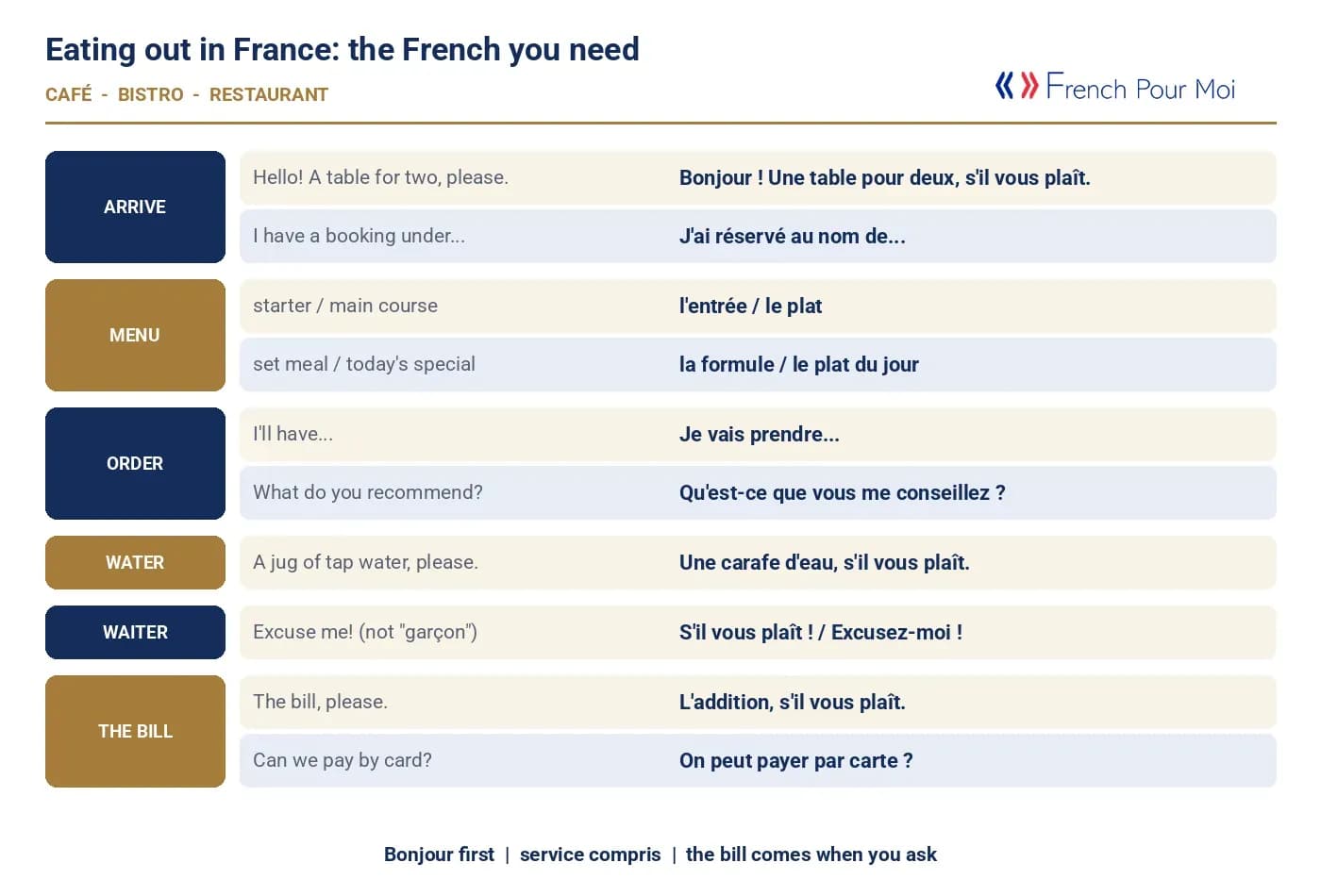
- Bonjour, une table pour deux, s'il vous plaît. - A table for two, please.
- Vous avez une table pour quatre ? - Do you have a table for four?
- J'ai réservé au nom de [name]. - I have a booking under [name].
- On peut s'asseoir en terrasse ? - Can we sit outside?
- On peut s'installer ici ? - Can we sit here?
You'll probably hear: Vous avez réservé ? (Have you booked?) and maybe En salle ou en terrasse ? (Inside or outside?).
One more thing worth knowing: many traditional restaurants serve lunch and dinner at set times, and the kitchen may close in between. If you arrive mid-afternoon and hear La cuisine est fermée, it's not personal. Look for places with service continu - non-stop service.
Your takeaway: learn une table pour deux and J'ai réservé au nom de... - they open every door.
Reading the menu without a dictionary
French menus have a few words that confuse almost everyone.
| French | What it means |
|---|---|
| la carte | the full menu |
| le menu / la formule | a fixed-price set meal (e.g. starter + main, or main + dessert) |
| le plat du jour | today's special |
| l'entrée | the starter (not the main course!) |
| le plat (principal) | the main course |
| le dessert | dessert |
| une carafe d'eau | a jug of tap water |
| un pichet / une carafe de vin | a jug of house wine |
That entrée one catches out many American readers, where "entrée" means the main dish. In France, it's the entry to the meal - the starter.
And yes: ask for le menu and you may get the set meal, not the full list. If you want to see everything, ask for la carte.
Your takeaway: entrée = starter, plat = main, la carte = the whole menu. Three words, zero surprises.
Ordering like a regular
When the waiter comes, it's often simply: Vous avez choisi ? (Have you chosen?) Here's how to answer.
- Je vais prendre le plat du jour. - I'll have today's special.
- Pour moi, la formule entrée-plat, s'il vous plaît.
- Qu'est-ce que vous me conseillez ? - What do you recommend?
- C'est quoi, exactement ? - What is it, exactly?
- Une carafe d'eau, s'il vous plaît. - A jug of tap water, please.
Ordering meat? You'll be asked Quelle cuisson ? - how do you want it cooked?
- bleu - very rare
- saignant - rare
- à point - medium
- bien cuit - well done
Fair warning: French à point often comes a little pinker than you might expect at home. If you like it well done, say bien cuit clearly.
Dietary needs? Say them early and simply:
- Je suis végétarien / végétarienne.
- Je suis allergique aux fruits à coque. - I'm allergic to nuts.
- Je ne mange pas de porc. - I don't eat pork.
- C'est sans gluten ? - Is it gluten-free?
Your takeaway: Je vais prendre... is the only ordering verb you really need. Then add s'il vous plaît and smile.
Water, bread and the little things nobody explains
Water: you don't have to buy bottled water. When you order a meal, a carafe d'eau - tap water - is free. If you want bottled, ask for de l'eau plate (still) or de l'eau gazeuse (sparkling).
Bread: it usually arrives in a basket, often without butter. It's for the meal, not a starter on its own - and many French diners put it straight on the tablecloth next to their plate. Want more? Encore un peu de pain, s'il vous plaît ?
Hands: at a French table, keep your hands visible - wrists resting on the edge of the table, not in your lap.
Coffee: coffee comes after dessert, not with it. And un café means a small espresso. For milk, ask for un café crème (or un crème); une noisette is an espresso with a drop of milk.
Your takeaway: une carafe d'eau, s'il vous plaît - possibly the most useful money-saving sentence in France.
Calling the waiter (no clicking, no "garçon")
In films, people shout Garçon ! In real life, please don't. It sounds old-fashioned at best, rude at worst.
Instead: make eye contact, raise your hand slightly, and say S'il vous plaît ! or Excusez-moi ! That's it.
Also: French waiters often leave you in peace. That's not bad service - it's a sign that your table is yours for as long as you like. Nobody is trying to hurry you out.
Your takeaway: eye contact + S'il vous plaît beats waving, clicking or shouting every time.
The bill: it won't come unless you ask
This surprises many visitors. In France, the waiter usually won't bring the bill until you ask - bringing it early could feel like rushing you.
- L'addition, s'il vous plaît. - The bill, please.
- On peut payer par carte ? - Can we pay by card?
- On peut payer séparément ? - Can we pay separately? (Not always possible in busy places - ask kindly.)
At the bar of a café, it's more casual: Je vous dois combien ? - What do I owe you?
Your takeaway: L'addition, s'il vous plaît + a little hand gesture of signing a cheque in the air. Universally understood.
Tipping: service compris
In France, the service charge is included in menu prices - you'll often see service compris on the menu or bill. Tipping (le pourboire) is optional.
If you enjoyed the meal and the service, many people leave a little extra - rounding up or leaving some coins. You won't be chased down the street if you don't. And nobody expects the large percentages common in some countries.
Your takeaway: service compris means the service is paid for. A small tip is a thank-you, not an obligation.
Café culture: bar, table, terrace
French cafés have their own rhythm.
- At the bar (au comptoir): quick, standing, often cheaper. Order, drink, pay, go: Un café, s'il vous plaît.
- At a table or on the terrace: you can sit for a long time with one drink. Reading, people-watching, thinking great thoughts - all allowed.
- Ordering a beer: un demi is a small draught beer. Une pression is a draught beer.
Don't be surprised if the same coffee costs a bit more at a table than at the bar - you're paying for the seat (and the view).
Your takeaway: in a café, a table is a place to be, not just to drink. Take your time - you're allowed.
Five tourist giveaways (and easy fixes)
- No bonjour. Fix: Bonjour before anything.
- Waiting forever for the bill. Fix: ask - L'addition, s'il vous plaît.
- Ordering "an entrée" as a main. Fix: entrée = starter.
- Buying water you didn't need. Fix: une carafe d'eau.
- Shouting "garçon". Fix: eye contact + S'il vous plaît.
How to practise before your next meal out
- Read a real French menu online - pick any bistro - and translate every line.
- Say your order out loud before you go: Je vais prendre... / Une carafe d'eau, s'il vous plaît / L'addition, s'il vous plaît.
- Learn one dietary or cuisson phrase that matters to you, so it's ready when you need it.
- Role-play with a friend, a tutor - or your cat. The cat won't judge your accent.
At French Pour Moi, we role-play real situations like this in 1-to-1 or 2-to-1 lessons, online, in Bristol or in Paris - so the real waiter feels like a rerun, not a test. If business meals are more your thing, see French Business Lunches: Why Foreign Professionals Run Out of Things to Say.
FAQs
Is it rude to speak English in a French restaurant?
Not rude - but starting in French, even with just Bonjour and s'il vous plaît, makes a real difference to how you're received. Many waiters will switch to English if you're struggling; your effort still counts.
Do I have to tip in France?
No. Service is included (service compris). Leaving a small amount extra is a common way to say thank you, but it's optional.
Can I ask for tap water for free?
Yes. When you order a meal, you can ask for une carafe d'eau - tap water - at no charge.
Why won't the waiter bring the bill?
Because in France it's polite to let you take your time. Just ask: L'addition, s'il vous plaît.
One last thing
Eating out in France isn't a test. It's one of the best French lessons you'll ever have - with dessert.
Say bonjour. Know your entrée from your plat. Ask for une carafe d'eau. And when you're ready, say L'addition, s'il vous plaît - like a regular.
Curious how ready your French is for the bistro? Take our free French level test - it only takes a few minutes and shows you where to start.
À bientôt, Lucie - French Pour Moi