


The meeting went well. You followed the slides, you took the floor once or twice, you even summarised the next steps. Then your French client closes the laptop, smiles and says: Bon, on va déjeuner ?
This is the part many of my professional students secretly dread, whether they come from London, Madrid, Munich, Chicago or Mumbai. Not the negotiation - the ninety minutes afterwards, with no agenda, a noisy restaurant and a conversation that drifts from the Toussaint holidays to rugby to someone's cousin in Bordeaux. Somewhere between the starter and the main course you hear yourself say Ah, oui... c'est intéressant for the fourth time, and you realise you've run out of things to say.
Q4 makes this worse. October to December is client-visit season: trade fairs, year-end reviews, budget talks for January, and then the repas de fin d'année and the Christmas apéro. Lots of eating, lots of talking, very little of it on the agenda.
If the meeting itself is where you go quiet, start with my post on why professionals go quiet in French meetings. This post picks up where the agenda ends: what to say at the table, how to handle the tu / vous moment, and a reusable conversation shape you can practise this week.
Why the lunch is harder than the meeting
It sounds backwards - surely chatting is easier than negotiating? In practice, there are good reasons it isn't.
There's no agenda to lean on. In a meeting you've prepared the vocabulary: budget, deadline, invoice. At lunch, the topic changes every few minutes, and your work French is no help with les vendanges or le match de samedi.
It's long, and it's doing real work. A business lunch in France often runs to an hour and a half, with a starter, a main course and a coffee. For many French professionals, this is where trust - la confiance - gets built. The meal isn't a break from the relationship; it is the relationship. Business may only come back with the coffee, or not at all.
Small talk from home doesn't quite transfer. In many English-speaking and other business cultures, small talk stays light and short: the weather, the commute, a quick joke, then back to work. Around a French table, conversation often goes a little deeper - food, the region, holidays, books, even a friendly debate. And good conversation partners don't just ask polite questions. They react, add something of their own, and keep the ball moving.
The register can change mid-meal. As people relax, someone may suggest switching from vous to tu. If your tu verb forms aren't ready, that friendly moment feels like a pop quiz. Add a noisy restaurant and fast, overlapping speech, and listening gets harder exactly when you're most tired.
None of this means your French isn't good enough. Table French is simply a different skill from meeting French: it runs on reactions and small personal details, not technical vocabulary.
The tu / vous moment at the table
This is the question I'm asked most before client visits, so let's be clear.
- Default to vous with clients, senior people and anyone you've just met. You won't offend anyone by being polite.
- First name + vous is completely normal. Laurent, vous avez déjà goûté les quenelles ? isn't a contradiction. Many French colleagues stay on first names and vous for years.
- Let the client or the more senior person propose the switch. It usually sounds like On peut se tutoyer, si vous voulez or simply On se tutoie ? Accept warmly: Avec plaisir ! or Oui, volontiers.
- Once you've switched, stay switched. Going back to vous later can sound cold, as if something went wrong. Keep the same register in your follow-up emails too - my post on French work emails and why they can sound abrupt covers the tone side.
- If you slip, smile and fix it. Vous... pardon, tu ! Nobody minds. What makes the switch awkward isn't the slip - it's freezing because you don't have the tu version of your next question ready.
So before a lunch, prepare your favourite questions in both forms: Vous avez fait bon voyage ? / Tu as fait bon voyage ? - Qu'est-ce que vous me conseillez ? / Qu'est-ce que tu me conseilles ? Five minutes of prep removes most of the panic.
A reusable lunch architecture: the five-course conversation
You don't need to be witty in French. You need a shape you can follow without thinking, so your brain is free to listen. I teach it as a five-course meal.
| Course | What it does | Phrase shape |
|---|---|---|
| 1. Apéritif | Arrive, thank, open with something easy | Merci pour l'invitation / Vous avez fait bon voyage ? |
| 2. Entrée | Start from your prepared topic menu | Vous connaissez bien ce restaurant ? |
| 3. Plat | Keep it going with the 3R loop | Réagir + rebondir + relancer |
| 4. Café | Bridge lightly back to business | Avant que j'oublie... / Pour revenir à notre projet... |
| 5. Addition | Close warmly and lock the follow-up | Merci, c'était un excellent déjeuner + next step |
The course that does most of the work is the plat - the long middle of the meal, where conversations wander off the agenda and non-native speakers tend to run dry.
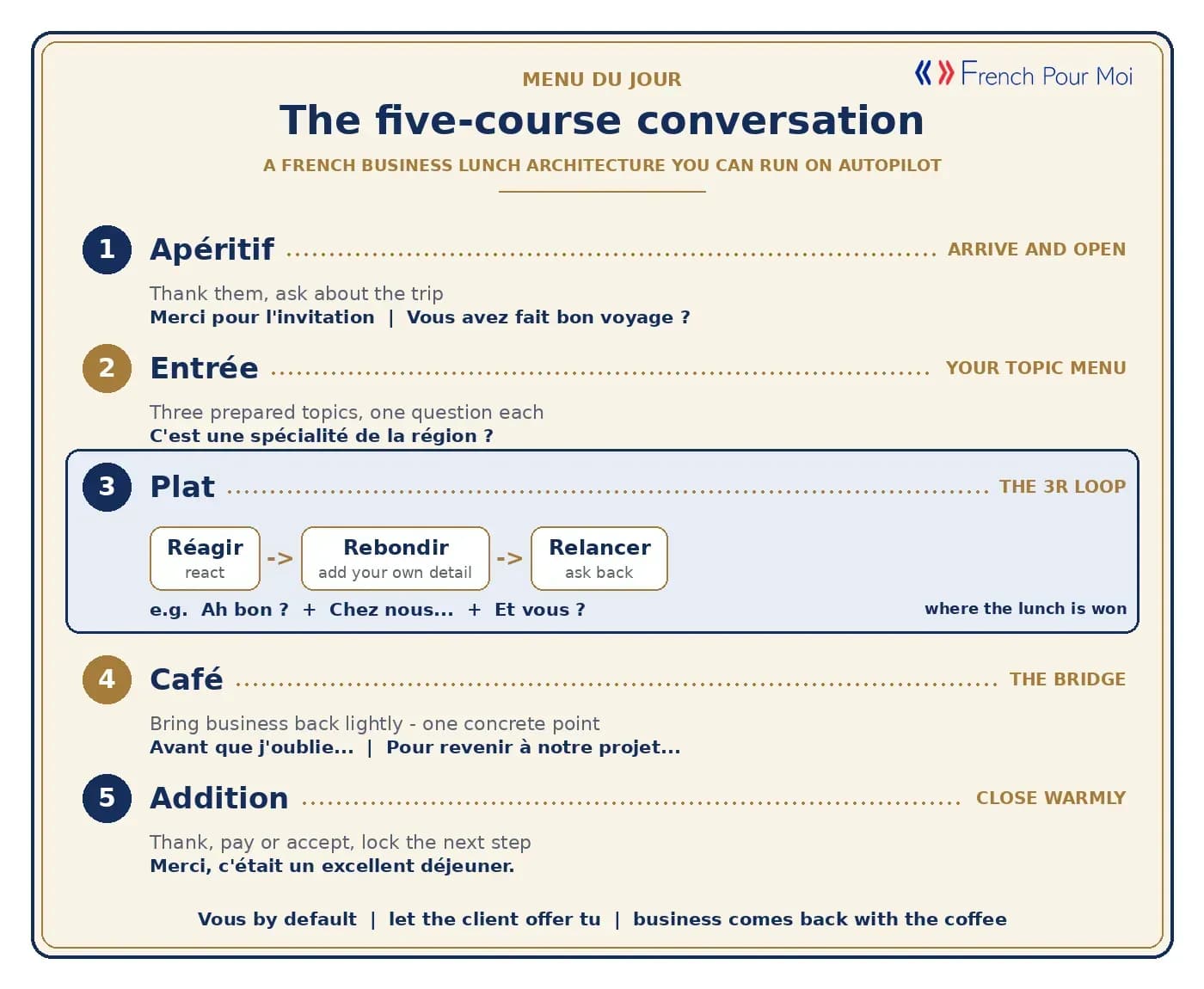
The 3R loop: what to do when the conversation leaves the agenda
When someone tells you something, don't just ask the next question. Run three tiny moves:
- Réagir - react, briefly and genuinely: Ah bon ? / Ah, c'est génial ! / Ça ne m'étonne pas. / Sans blague ?
- Rebondir - add one small thing of your own: C'est drôle, chez nous c'est pareil. / Ça me fait penser à... / Moi aussi, j'ai...
- Relancer - hand the ball back with a question: Et vous, ... ? / Et alors, c'était comment ? / Comment ça se passe chez vous ?
That middle step is the one most of my students skip, whatever their nationality. When you're working in a second language, it feels safer to ask lovely polite questions one after another, and it starts to feel like an interview. One small personal detail - your weekend, your town, a holiday memory - turns it back into a conversation.
Your topic menu (and what to leave on the side of the plate)
Before any lunch, prepare three topics with one opening question each. Good autumn choices:
- The food and the place: C'est une spécialité de la région ? / C'est une de vos adresses préférées ?
- The trip and the city: Qu'est-ce qu'il faut voir à Lyon, à votre avis ?
- Holidays and the season: the French Toussaint school holidays run from 17 October to 2 November this year, so in late October and November Vous avez pu partir un peu pendant les vacances ? is a natural opener. In December: Vous avez des projets pour les fêtes ?
- Where you're from: French clients are often curious about your country and your city. Have a short, warm answer ready about where you live, what people eat there and why you like it.
Leave salaries, money, very personal questions and heavy politics on the side of the plate unless your host brings them up. And don't feel you must fill every silence: a short pause over a good meal is perfectly normal.
Table phrases that do the real work
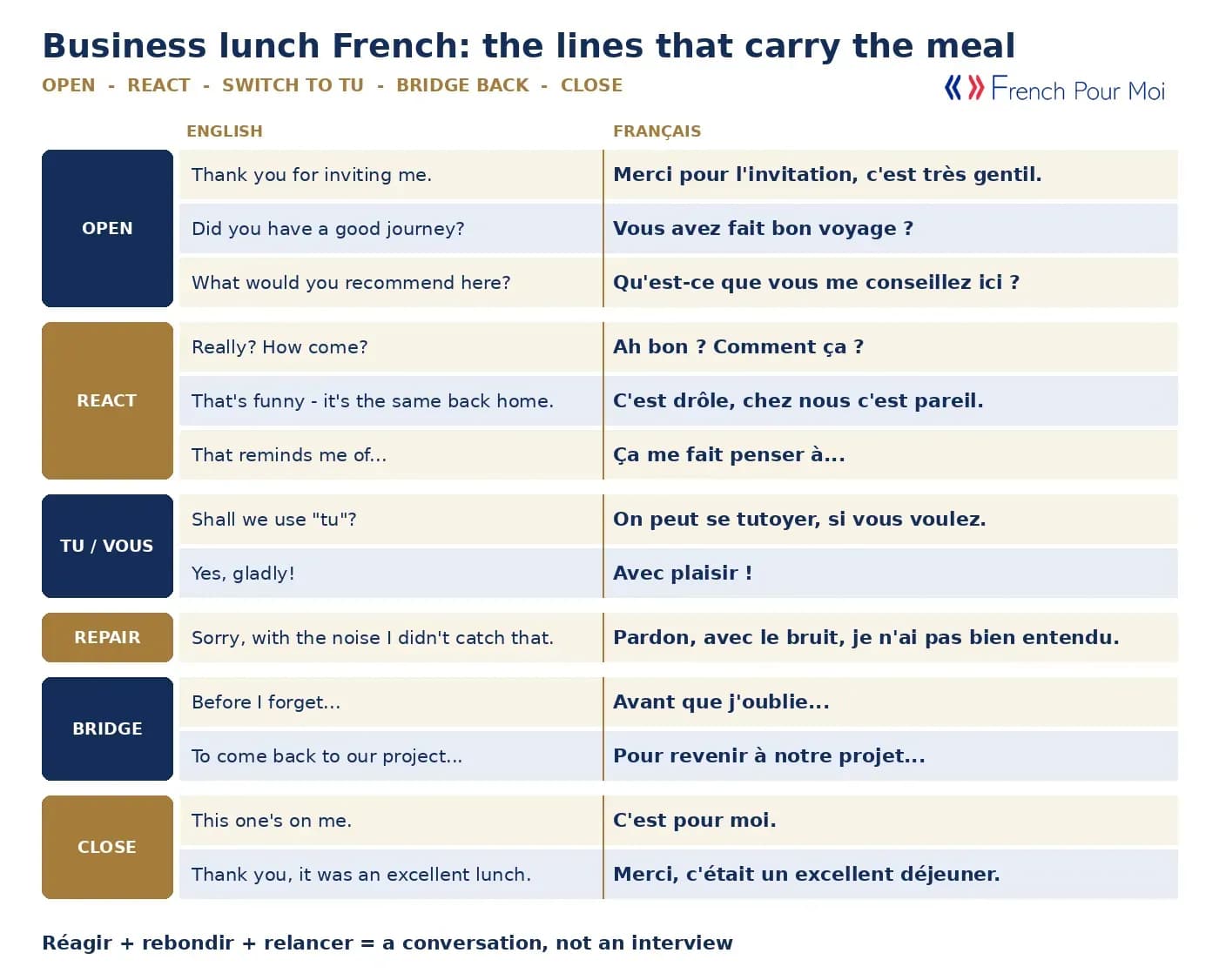
These are the lines I practise most with professionals before a client visit. Learn the shape, then make them yours.
| English | French |
|---|---|
| Thank you for inviting me - that's very kind. | Merci pour l'invitation, c'est très gentil. |
| Did you have a good journey? | Vous avez fait bon voyage ? |
| What would you recommend here? | Qu'est-ce que vous me conseillez ici ? |
| Is that a local speciality? | C'est une spécialité de la région ? |
| Did you manage to get away during the holidays? | Vous avez pu partir un peu pendant les vacances ? |
| Really? How come? | Ah bon ? Comment ça ? |
| That's funny - it's the same back home. | C'est drôle, chez nous c'est pareil. |
| That reminds me of... | Ça me fait penser à... |
| Shall we use "tu"? | On peut se tutoyer, si vous voulez. |
| Yes, gladly! | Avec plaisir ! |
| Sorry, with the noise I didn't quite catch that. | Pardon, avec le bruit, je n'ai pas bien entendu. |
| Before I forget... | Avant que j'oublie... |
A worked example: Hannah's client lunch in Lyon
Hannah is an account manager in Bristol. In November she visits a client in Lyon to plan a January launch. After the morning meeting, Laurent, the client's purchasing director, takes her to lunch. My students come from all over the world, but the five courses play out in much the same way for everyone. Here's Hannah's version.
Apéritif
Laurent: Alors, vous avez fait bon voyage ?
Hannah: Oui, très bien, merci - l'avion était à l'heure, pour une fois ! Et merci pour l'invitation, c'est très gentil.
Entrée
Hannah: Qu'est-ce que vous me conseillez ici ? Je ne connais pas du tout la cuisine lyonnaise.
Laurent: Ah, il faut goûter les quenelles. C'est la spécialité.
Plat - the 3R loop
Laurent: Moi, je rentre de vacances. On était en Bretagne pour la Toussaint, avec les enfants.
Hannah: Ah, super ! (réagir) Je ne connais pas la Bretagne, mais on m'en a dit beaucoup de bien - c'est un peu comme la Cornouailles chez nous, non ? (rebondir) Vous y allez souvent ? (relancer)
Laurent: Tous les ans ! Ma femme est de Quimper. Écoutez, on peut se tutoyer, non ? Ce sera plus simple.
Hannah: Avec plaisir ! Alors, qu'est-ce que tu me conseilles de voir en Bretagne ?
Café - the bridge
Hannah: Avant que j'oublie - pour le lancement en janvier, tu préfères qu'on fasse un point la semaine prochaine ?
Laurent: Oui, bonne idée. Mardi, ça te va ?
Addition
Laurent: Non, non, laisse - c'est pour moi.
Hannah: Merci beaucoup, c'était un excellent déjeuner. La prochaine fois, c'est moi qui t'invite - à Bristol !
Notice what made this work. None of Hannah's French is advanced. She reacted before she asked, and offered one personal link from home (Cornwall) instead of a string of questions - whether you're from Seville, Seattle or Seoul, you'll have your own equivalent. She had a tu question ready when Laurent proposed the switch, so the moment felt warm rather than awkward. She waited for the coffee to bring business back, with one light, concrete question. And she closed with a thank-you and a future plan - which is exactly what a relationship lunch is for.
Mistakes that make foreign professionals run dry
-
Interview mode. Question, answer, next question. Without rebondir, your host does all the sharing and the conversation tires quickly.
-
Bringing business back with the starter. Raising the contract before the first course arrives can feel like you've missed the point of the meal. Let the café carry it.
-
Hesitating when tu is offered. A long pause or a nervous euh... oui ? can read as reluctance. A quick Avec plaisir ! is all it takes.
-
Retreating into English. If the table switches to English for your benefit, that's kind - but On peut continuer en français ? Ça me fait du bien de pratiquer usually goes down very well.
-
Over-apologising for your French. One apology is plenty. Better still: N'hésitez pas à me corriger ! It invites help instead of pity.
-
Nodding when you haven't heard. Pardon, avec le bruit, je n'ai pas bien entendu is not a confession of weak French - native speakers say it too.
How to practise this week
You don't need months. Five ten-minute sessions before your next client visit or end-of-year lunch will change how it feels.
- Monday - write your menu. Choose three topics and one opening question for each. Write each question twice: once with vous, once with tu.
- Tuesday - drill the 3R loop. Write five things a French colleague might tell you (Je rentre de Bretagne, Mon fils a commencé le rugby). For each one, say a reaction, one detail of your own and a question back - out loud, in under fifteen seconds. Record yourself on your phone.
- Wednesday - rehearse the switch. Say On peut se tutoyer ? and Avec plaisir ! a few times, then flip your six most-used questions from vous to tu until it's quick: vous avez / tu as, vous connaissez / tu connais, vous préférez / tu préfères.
- Thursday - bridge and close. Practise two bridges back to business (Avant que j'oublie..., Pour revenir à notre projet...) and your closing lines, including who pays and the next step.
- Friday - a full role-play. Ten minutes with a tutor, a French-speaking colleague or even voice notes. Ask your partner to change topic twice without warning - that's the real test.
On the day, keep the phrase table on your phone and read it in the taxi, not at the table. If you'd like to check where your French sits before you plan, this guide helps: What is my level in French? A1, A2, B1, B2?
How we help with professional French at French Pour Moi
At French Pour Moi, I work with professionals of many nationalities - British, American, German, Spanish, Indian, Chinese and more - on the French they actually use with French colleagues and clients. That includes the lunch, not just the meeting. In lessons we can role-play your real client visit from start to finish: the morning meeting, the restaurant, the tu / vous moment and the bridge back to business over coffee, built around your own sector and clients.
Lessons run 1-to-1, online or in person - get in touch to ask about in-person lessons near you. 2-to-1 lessons work beautifully for two colleagues heading to the same client visit - you can practise on each other between sessions.
If that sounds useful, get in touch to book a lesson and tell me about your role, your clients and your next trip. And if you'd like a quick snapshot of your current level first, try our free French level test.
FAQs
Should I say "bon appétit" at a business lunch?
In everyday professional life in France, yes - it's common and friendly. Some very formal circles consider it a little old-fashioned, so if you're unsure, let your host say it first and reply Merci, vous aussi (or Merci, toi aussi once you're on tu).
Who pays at a French business lunch?
Usually the person who invited. If your host says C'est pour moi or Je vous invite, thank them warmly rather than arguing for long, and offer the next one: La prochaine fois, c'est moi qui invite. If you're the one who invited, settle it discreetly with the waiter before the bill arrives, or simply say C'est pour moi, j'insiste.
What if I don't drink alcohol?
That's completely fine. Pour moi, de l'eau, merci is enough, and you can still raise your glass for a Santé ! Many French people make eye contact as glasses touch - a small detail that gets noticed.
Closing
French business lunches stop feeling like a test once you stop trying to be clever and start following a shape. Apéritif, entrée, plat, café, addition - with the 3R loop doing the work in the middle - will carry you through most client meals this autumn.
Prepare three topics, get your tu questions ready, and let the coffee bring business back. I'll be glad to help you enjoy the meal - in French.
À bientôt - et bon appétit, Sophie