


Bonjour à tous! - it's Sophie here.
If you've ever left a French meeting thinking, "I had three useful points and I said none of them," you're not alone. I hear this constantly from UK professionals who are perfectly capable one-to-one, who write careful emails, and who then go oddly quiet the moment the call becomes a room full of Francophone voices.
Autumn is when it bites again. Projects restart after the summer, French clients come back from congés, and suddenly you're in weekly réunions where the agenda moves fast and the floor feels... occupied. You nod. You smile. You type a note you'll never send. And afterwards you rewrite the meeting in your head in perfect English.
This post is not about phone calls or work emails - those patterns deserve their own toolkit (and if email tone is your other soft spot, start here: French Work Emails: Why UK Professionals Sound Abrupt). This one is about meetings: how to stop freezing, and how to take the floor with a reusable architecture plus a few recovery phrases you can actually reuse under pressure.
Why capable people go quiet in French meetings
A French meeting is a different sport from a British one - even when the project is the same.
In a lot of UK workplaces, turn-taking is polite and sequential. People wait for a gap. Interrupting feels rude. Soft disagreement often arrives late ("I wonder if we might also consider..."). Status language is underplayed. Silence can mean you're thinking carefully.
In many Francophone professional settings - especially with French clients or mixed teams - the rhythm is denser. People overlap. They stake a claim mid-flow. Disagreement can arrive earlier and more directly, cushioned by formula rather than by British understatement. Speed is social as well as practical: if you wait for the perfect British gap, the topic has already moved on.
So you go quiet for very rational reasons:
- You're translating while everyone else is already answering.
- You're waiting for a clean turn that never quite appears.
- You're unsure of the status language (je me permets, si je peux me permettre, j'aimerais rebondir).
- You're afraid that one imperfect sentence will lower your standing more than silence will.
None of that means your French is "not good enough." It means meeting French is a skill of timing and formula, not only of vocabulary. If you're unsure where your overall level sits, this CEFR walkthrough helps: What is my level in French?. For meetings, B1 with good structure often beats flashy B2 that never gets spoken aloud.
A reusable meeting architecture
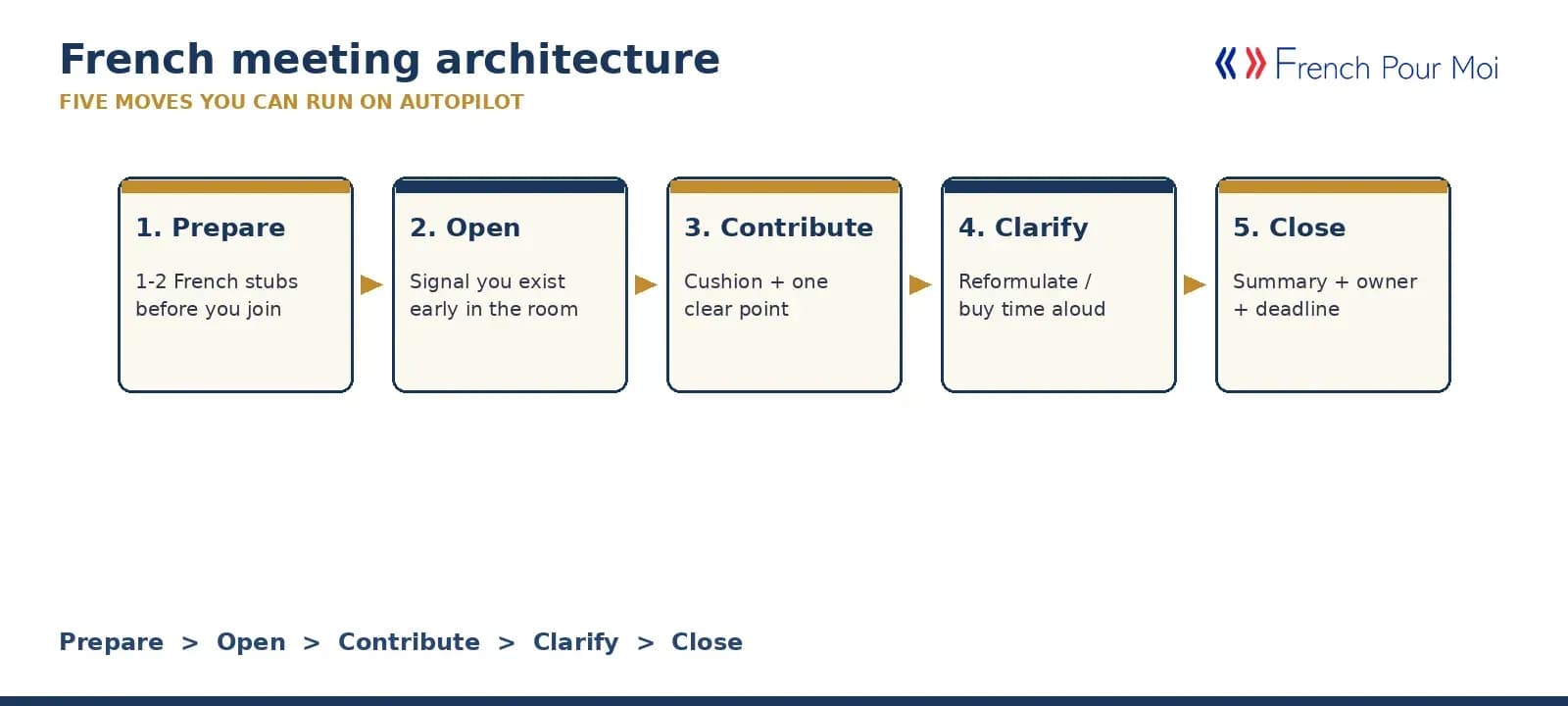
You don't need to sound like a native chair. You need five moves you can run on autopilot: prepare, open, contribute, clarify, close.
| Move | What it does | Phrase shape |
|---|---|---|
| 1. Prepare | Decide your 1-2 points before you join | Write them in French stubs, not essays |
| 2. Open | Signal you exist in the room | Bonjour à toutes et tous / short status line |
| 3. Contribute | Take the floor with a cushion | Si je peux me permettre... + one clear point |
| 4. Clarify | Buy time / repair understanding | Pour être sûr(e) de bien comprendre... |
| 5. Close | Lock next steps in shared language | Donc, si je résume... + owner + deadline |
A full meeting skeleton looks like this in your head:
- Before: two bullet points in French (even rough ones).
- Early: one short open so you're not a silent avatar.
- Mid: one contributed point with a floor-taking cushion.
- When lost: one clarify / reformulate ask - out loud, not later by email.
- End: one summary line so actions don't stay fuzzy.
Notice what this architecture forces: you never rely on "I'll jump in if it feels natural." Natural is unreliable under cognitive load. Formula is reliable.
Floor-taking and cushion phrases that do the real work
Vocabulary lists don't save meetings. These lines do - because they manage turn-taking and tone.
Taking the floor
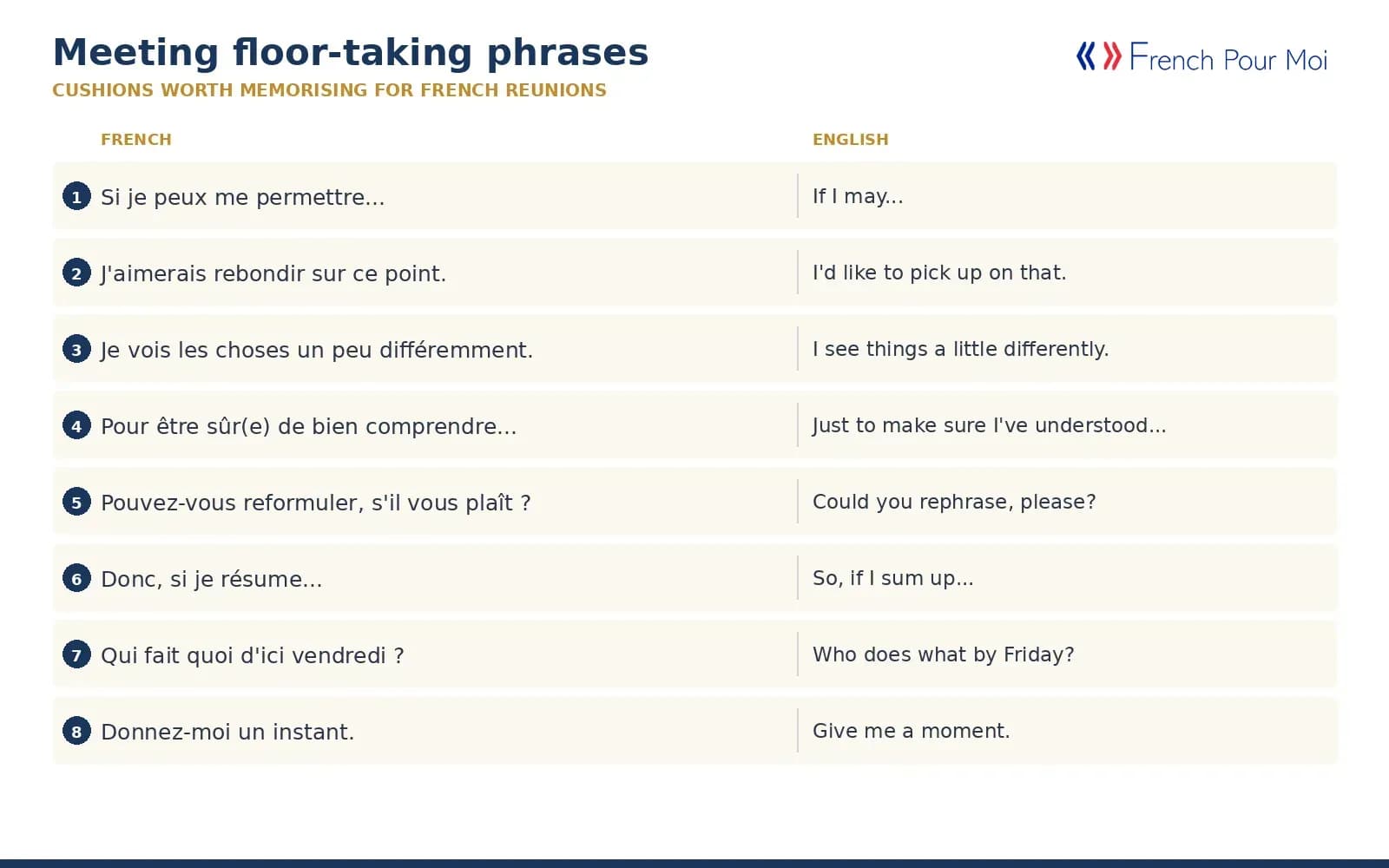
- Si je peux me permettre... - "If I may..."
- J'aimerais rebondir sur ce point. - "I'd like to pick up on that point."
- Pour compléter ce que vient de dire [Name]... - "To add to what [Name] just said..."
- Deux secondes - j'ai une question rapide. - "Two seconds - I have a quick question."
Softening disagreement
- Je vois les choses un peu différemment. - "I see things a little differently."
- Je suis d'accord sur le fond, en revanche... - "I agree on the substance; however..."
- Est-ce qu'on a envisagé une autre option ? - "Have we considered another option?"
Clarifying / buying time
- Pour être sûr(e) de bien comprendre... - "Just to make sure I've understood..."
- Vous parlez de... ? - "Are you talking about...?"
- Pouvez-vous reformuler, s'il vous plaît ? - "Could you rephrase, please?"
- Donnez-moi un instant. - "Give me a moment."
Closing / next steps
- Donc, si je résume... - "So, if I sum up..."
- Qui fait quoi d'ici vendredi ? - "Who does what by Friday?"
- Je peux m'en occuper et vous faire un retour demain. - "I can take that and come back to you tomorrow."
You don't need twenty. Pick six, say them aloud until they're boring, and rotate. Boredom is the point - boring phrases survive adrenaline.
Mini scripts for the moments that freeze people
Here are four high-frequency scenes. Steal them, shorten them, make them yours.
1) Joining late
Désolé(e) pour le retard - j'avais un chevauchement. Où en êtes-vous ? ("Sorry I'm late - I had an overlap. Where have you got to?")
Then stop talking. Let someone give you the 20-second catch-up. Don't apologise for three more sentences.
2) Disagreeing politely without disappearing
Je suis d'accord sur le délai. En revanche, je suis moins convaincu(e) par la séquence. Si on inversait les deux étapes ? ("I agree on the deadline. However, I'm less convinced by the sequence. What if we swapped the two steps?")
Structure: agree on something real -> mark the pivot (en revanche) -> offer one alternative. That lands better than silent disagreement followed by a long English email later.
3) Asking for reformulation (without sounding lost)
Pardon - je n'ai pas bien saisi le dernier point sur le budget. Vous parlez du devis initial ou de la révision ? ("Sorry - I didn't quite catch the last point on the budget. Do you mean the initial quote or the revision?")
Specificity is kindness. "I didn't understand" invites a full replay. A binary choice invites a clean answer.
4) Summarising next steps before the call ends
Avant de terminer: donc Marie envoie le brief demain, je valide mercredi, et on se revoit vendredi. C'est bien ça ? ("Before we finish: so Marie sends the brief tomorrow, I confirm on Wednesday, and we meet again Friday. Is that right?")
If nobody owns the summary, actions dissolve. Taking thirty seconds of floor here often saves a week of confusion - in any language.
Mistakes that keep UK professionals silent
-
Waiting for the British gap. In denser French meetings, the gap may never come. Use a cushion and enter: Si je peux me permettre... is socially licensed interruption, not rudeness.
-
Saving your point for "when my French is ready". Your point gets colder every minute. A slightly imperfect contribution early beats a perfect contribution that never happens.
-
Trying to sound advanced instead of clear. Long subordinate clauses under pressure are where freeze begins. Short sentences with good cushions sound more professional than elegant wreckage.
-
Repairing only afterwards by email. Email is useful (and tone still matters - see the work emails post). But if you never practise floor-taking live, meetings stay scary. Ask one clarify question in the room this week.
-
Equating silence with professionalism. In UK culture, quiet can read as thoughtful. In a French client meeting, consistent silence can read as disengagement - even when you're working hard internally.
A 2-4 week practise plan
You don't need a year of immersion. You need deliberate meeting reps.
Weeks 1-2 - notice and install the architecture
- Before each French meeting, write two French stubs (not scripts): your main point + one question.
- Choose three floor-taking phrases and say them aloud twice the morning of the meeting.
- In the meeting, force one early open (hello / short status) and one mid contribution.
- Afterward, note only this: Did I take the floor once? What blocked me?
Weeks 3-4 - speed, disagreement, close
- Practise one polite disagreement script with a tutor or colleague (60 seconds is enough).
- In live meetings, add one clarify ask when needed - out loud.
- Volunteer the closing summary once: Donc, si je résume...
- Record yourself (or role-play) joining late + taking the floor; listen only for cushions and clarity, not accent perfection.
By week four, the goal isn't flawless French. It's a default meeting shape your mouth trusts when the agenda jumps.
How we help with professional French at French Pour Moi
If you'd like a clear starting point, take our free French level test, then tell us your role, the meetings you actually sit in (client calls, internal coms, kick-offs), and your timeline. We can shape a short professional plan around the phrases and scenarios you need - meetings included, not only grammar worksheets.
Autumn restarts are a good moment to do this: the calendar is filling, and small speaking habits compound quickly when you practise on real réunions.
FAQs
Do I need B2 before I speak in French meetings?
No. From about solid B1, structure and cushions matter more than sounding advanced. A clear B1 contribution with si je peux me permettre usually lands better than a complex sentence that never leaves your mouth. Check your level here if you're unsure: What is my level in French?.
Is interrupting always rude in French meetings?
Not in the British sense. Overlap is common, and licensed cushions (si je peux me permettre, j'aimerais rebondir) signal respect while you take the floor. Shouting someone down is rude. Entering with a formula usually isn't.
What if my French colleagues speak very fast?
Ask for reformulation with a specific anchor ("budget", "deadline", "version 2"). Speed often drops once they know you need a cleaner pass. You can also summarise back: Si je comprends bien... - that slows the room helpfully.
Should I prepare a full script?
Prepare stubs, not theatre. Two points and three cushions beat a memorised paragraph that collapses when the agenda changes. Script the high-risk moments (late join, disagreement, close) if those are your freeze points.
What if I freeze mid-sentence?
Use a repair line immediately: Donnez-moi un instant or Ce que je voulais dire, c'est que... Silence stretches the freeze; a formula ends it. Then finish with one short sentence and stop.
Closing
French meetings stop feeling mysterious once you stop waiting for a British turn and start using a French shape. Prepare, open, contribute, clarify, close - plus a small bank of floor-taking phrases - will carry most of your professional week.
Practise on real réunions. Keep three cushions visible for a fortnight. Then notice how often the "I went quiet again" story simply shrinks.
If you want help making this automatic for your actual job, start with the free French level test and get in touch. I'll be glad to help you sound like yourself - just in French that fits the room.
À bientôt - et prenez la parole, Sophie