

If you work with French-speaking clients, suppliers, or colleagues, you've probably had that tiny moment of doubt after you hit send. The email felt polite in your head. You used Bonjour, you said merci, you kept it short because short is respectful in English. And still... something felt off. Or worse: you got a reply that was perfectly correct and somehow a little cooler than you expected.
The problem usually isn't missing vocabulary. It's that you wrote an English work email in French.
UK professional English prizes clarity and speed. French professional email prizes cushioning, register, and a little social padding before the ask. Translate your British politeness word-for-word and it can land as abrupt - sometimes even slightly rude - to a Francophone reader who expected a softer runway into the request.
Autumn is when this shows up again for a lot of UK professionals: projects restart, Francophone clients come back from congés, and the inbox fills with "quick" emails that somehow create friction. So let's fix the pattern properly - with a reusable structure and a small set of cushion phrases you can use from about B1 onwards.
Why English politeness maps badly into French email
In British work English, politeness often lives in understatement and efficiency:
- "Just checking in on the proposal."
- "Could you send that over when you get a chance?"
- "Thanks in advance."
Those lines feel soft to us. In French business email, the same spirit - if you keep the same bare structure - can sound like you've skipped the social opening, jumped straight to the task, and closed without enough relational glue.
French professional writing usually expects:
- A proper greeting matched to the relationship
- A short context line (why you're writing now)
- The request, softened
- An availability / next-step cushion
- A warm-enough closing formula
Miss steps 2 and 4 especially, and even good French can feel brusque. I see this constantly with capable B1 and B2 professionals who can discuss a project in a meeting... then send an email that reads like a sticky note.
There's also register. English "Hi Sarah" does not map cleanly onto French. Bonjour Madame Dupont and Bonjour Sophie are different social temperatures. Tu vs vous matters. And phrases that feel friendly in English ("as discussed", "per my last email", "looping you in") can sound managerial or cold if you drop them in without cushioning.
If you're unsure where your overall French sits, this CEFR walkthrough helps: What is my level in French? A1, A2, B1, B2?. For work email specifically, you don't need literary elegance. You need predictable structure and a handful of phrases that signal care.
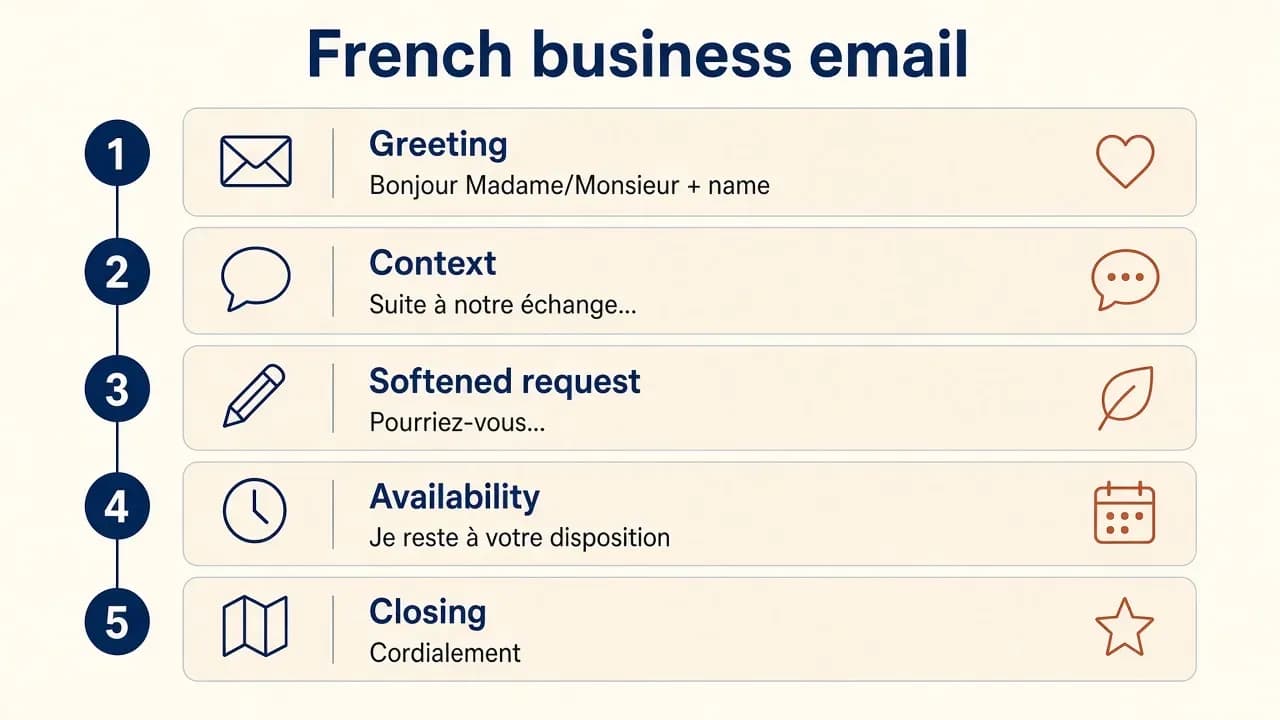
The 5-part email architecture
Here's the template I teach professionals who need French that sounds competent without sounding stiff.
| Part | What it does | Mini example |
|---|---|---|
| 1. Greeting | Sets register | Bonjour Madame Martin, / Bonjour Julien, |
| 2. Context | Why this email exists | Je me permets de revenir vers vous concernant... |
| 3. Request | The actual ask, softened | Serait-il possible de... |
| 4. Availability | Soft next step / flexibility | Je reste à votre disposition pour en discuter. |
| 5. Closing | Relational exit | Cordialement, / Bien à vous, + name |
A full skeleton looks like this:
Bonjour (Name),
Je me permets de vous écrire au sujet de (topic).
(One short context sentence.)
Serait-il possible de (clear request)?
Je reste à votre disposition si besoin.
Cordialement,
(Your name)
(Copy this shape and fill the brackets. Keep the cushions even when you're in a rush.)
Notice what this architecture forces you to do: you never open with the naked ask, and you never end on the naked ask either. The request sits in the middle, held by context and availability. That middle placement alone softens a huge amount of British bluntness.
Cushion phrases that do the real work
Vocabulary lists don't save emails. These phrases do - because they manage tone.
Opening / context cushions
- Je me permets de... - "I take the liberty of..." (very common; softer than jumping in)
- Je me permets de revenir vers vous concernant... - "I'm coming back to you regarding..."
- Suite à notre échange de mardi... - "Following our exchange on Tuesday..."
- Comme convenu... - "As agreed..."
- Pour faire suite à votre message... - "Further to your message..."
Softening the ask
- Serait-il possible de... - "Would it be possible to..."
- Pourriez-vous... - "Could you..." (more formal than peux-tu)
- Je vous serais reconnaissant(e) de... - "I would be grateful if you would..."
- N'hésitez pas à me dire si... - "Don't hesitate to tell me if..."
- Quand vous aurez un moment... - "When you have a moment..." (gentler than "ASAP")
Availability / closing cushions
- Je reste à votre disposition. - "I remain at your disposal."
- N'hésitez pas à me contacter. - "Feel free to contact me."
- Dans l'attente de votre retour, - "Looking forward to your reply,"
- Je vous remercie par avance. - "Thank you in advance." (use sparingly; fine with clients you know)
- Belle journée à vous. - "Have a nice day." (warmer; better once the relationship exists)
Useful repair phrases
- Merci pour votre patience. - "Thank you for your patience."
- Désolé(e) pour ce retard de réponse. - "Sorry for this late reply."
- Pour éviter tout malentendu... - "To avoid any misunderstanding..."
You don't need twenty of these. Pick six you like, practise them until they're automatic, and rotate. From about B1, that's enough to sound markedly more professional.
Before / after: one short email rewrite
Before (English-in-French - abrupt):
Bonjour,
Pouvez-vous m'envoyer le devis aujourd'hui?
Merci.
Mark
Technically understandable. Socially chilly. No context, naked imperative energy, abrupt close.
After (same ask, French professional shape):
Bonjour Madame Lefèvre,
Je me permets de revenir vers vous concernant le devis pour le projet Orléans.
Serait-il possible de me l'envoyer dans la journée, si cela vous arrange?
Je reste à votre disposition si vous avez besoin d'informations complémentaires.
Cordialement,
Mark
Same request. Completely different temperature. You've named the topic, softened the deadline, offered help, and closed properly. That is the whole game.
If the relationship is already warm and you're on first-name vous or solid tu terms, you can shorten - but keep the cushion bones. Short does not have to mean blunt.
Three mistakes UK professionals keep making
1. Translating British "just" emails
"Just circling back" / "Just a quick one" encourages bare asks. In French, "quick" still needs greeting + context + soft close. Brevity is fine; baldness is not.
2. Using tu or first names too early
If they signed Cordialement + surname, or your first contact was formal, stay in vous and match their greeting until they clearly open the door. Jumping to casual can feel presumptuous, not friendly.
3. Saving all the soft language for the end - or skipping it
A blunt middle with Je vous prie d'agréer... at the bottom still feels blunt. Distribute courtesy: context before the ask, flexibility after it. Also watch false friends: Actuellement means "currently", not "actually"; sensible means "sensitive"; assister often means "attend". Those little slips quietly undermine an otherwise careful email.
One more quiet habit: over-apologising in English style ("Sorry to bother you!!!") can sound oddly heavy in French. Prefer a clean cushion (Je me permets de...) over theatrical guilt.
How to practise this in 2 weeks
You don't need a three-month course to improve work email. You need deliberate reps.
Week 1 - notice and rebuild
- Save 5 real emails you've sent in French (or English emails you often need in French).
- Rewrite each with the 5-part architecture.
- Highlight every cushion phrase you used. Aim for at least two per email (context + soft ask, or soft ask + availability).
- Read one French professional email a day from a client/supplier (or a well-written public example) and mark greeting, context, ask, close.
Week 2 - speed and feedback
- Create a personal phrase bank of 8-10 lines in a notes app.
- Send (or role-play with a tutor) 4 emails: request info, chase politely, decline/push back, thank + next step.
- Time one of them: 8 minutes max once the template is familiar.
- Get one native or tutor pass on tone - not on making it "more advanced", just on whether it feels abrupt.
By day 14, the goal isn't perfect French. It's a default shape your fingers trust when you're busy.

How we help with professional French at French Pour Moi
At French Pour Moi, our native tutors work one-to-one with UK professionals who need French that holds up at work - emails, calls, meetings, and the small register choices that change how you're received.
In practice that often means rewriting real emails from your job, drilling cushion phrases until they're automatic, and practising the exact situations you face with Francophone clients or colleagues. Sessions stay concrete. No textbook theatre.
If you'd like a clear starting point, take our free French level test, then tell us your role, the situations you need (email, calls, meetings), and your timeline. We can shape a short professional plan around what you actually send and say.
(And if your French goal is also tied to living in France rather than only work, this related piece on levels for residence may help: A2, B1 or B2? The French level you'll need in France in 2026.)
FAQ
Do I need perfect grammar before I send French work emails?
No. You need clear structure, appropriate vous/tu, and soft phrasing around the ask. A B1 email with good architecture usually lands better than a flashy B2 sentence with no cushioning.
Is Cordialement always safe?
It's the default professional close and almost always fine. Bien à vous is a touch warmer for people you already work with. Save Amicalement for warmer relationships. Match what your contact uses over time.
Should I write longer emails to sound more polite?
Not longer - complete. Two short cushion sentences beat a long apology paragraph. French professional politeness is often about shape and formula, not word count.
What if my client writes very casually?
Match their level gradually. If they use Bonjour + first name and lighter closings, you can soften too - while keeping your ask clear. When in doubt, stay one notch more formal than them for one more exchange.
Closing
French work emails stop feeling mysterious once you stop translating British brevity and start using a French shape. Greeting, context, soft ask, availability, close - plus a small bank of cushion phrases - will carry most of your professional week.
Practise on real messages. Keep the template visible for two weeks. Then notice how often the "abrupt" problem simply disappears.
If you want help making this automatic for your actual job, start with the free French level test and get in touch. I'll be glad to help you sound like yourself - just in French that fits the room.
À bientôt, Sophie