


If you live in France part-time, you've just moved, or you run a holiday home from the UK, you already know this feeling. Your French is fine in a lesson. You can order coffee. You can chat with a neighbour at the gate. Then the phone rings - or worse, you have to dial first - and your brain empties like someone pulled a plug.
Doctor. School. Plumber. Bank. Mairie. Insurance. ANEF follow-up. Suddenly every word you "know" is somewhere else.
The problem usually isn't vocabulary. It's that phone French is a different sport from classroom French.
On the phone you lose lips, gesture, and the polite pause of a face-to-face exchange. The other person speaks at full admin speed. Numbers arrive in a blur. You can't point at a form. And because you can't see them, your brain decides this is an emergency - even when you're only booking a boiler service.
Autumn is when this shows up hard again: kids are back at school, artisans finally answer after congés, GP diaries fill, and residence or admin files need chasing. So let's build a phone habit that survives real French life - with a reusable call architecture and a tiny set of recovery phrases.
A quick note: préfecture, ANEF, and local admin steps vary by département, and rules change. Treat this as practical language coaching for the call itself, then check service-public.fr or your local préfecture for the official procedure. I'm not giving immigration advice.
Why capable learners freeze on the phone
I see the same pattern with adults who are solid A2, even early B1, in lessons.
In class, you get:
- time to think
- a patient tutor
- visual clues
- a second try without shame
On a French admin line, you get:
- a greeting you barely catch
- a question you weren't expecting
- a number said once
- the quiet fear of sounding stupid
So people do one of three things. They switch to English too early. They say oui when they didn't understand. Or they hang up and email instead - which sometimes works, and sometimes leaves the file stuck.
If you're unsure where your overall French sits, start here: What is my level in French? A1, A2, B1, B2?. For phone calls specifically, you don't need elegant French. You need a predictable structure and a way to buy time without panic.
For residence-level targets (A2 / B1 / B2), this companion piece maps the paperwork side: A2, B1 or B2? Which French Level You'll Need to Live in France and How to Reach It. Phone practice is one of the fastest ways to make those levels feel real.
The 6-part phone call architecture
Write this on a sticky note beside your phone. Use it for almost every admin call.
| Part | What it does | Mini French |
|---|---|---|
| 1. Greeting | Opens politely | Bonjour Madame / Monsieur, |
| 2. Who you are | Names you clearly | Je m'appelle [Name]. |
| 3. Why you're calling | One clear purpose | J'appelle pour... |
| 4. The ask | Softened request | Serait-il possible de... |
| 5. Confirm next step | Locks the outcome | Donc, on se dit... / Vous confirmez que... |
| 6. Closing | Clean exit | Merci beaucoup. Au revoir. |
The basic structure looks like this:
Bonjour Madame,
Je m'appelle [Your name].
J'appelle pour [reason in one short line].
Serait-il possible de [clear ask]?
Donc, si je comprends bien, [repeat the next step].
Merci beaucoup. Au revoir.
(Copy the shape. Fill the brackets before you dial. Keep the cushions even when you're nervous.)
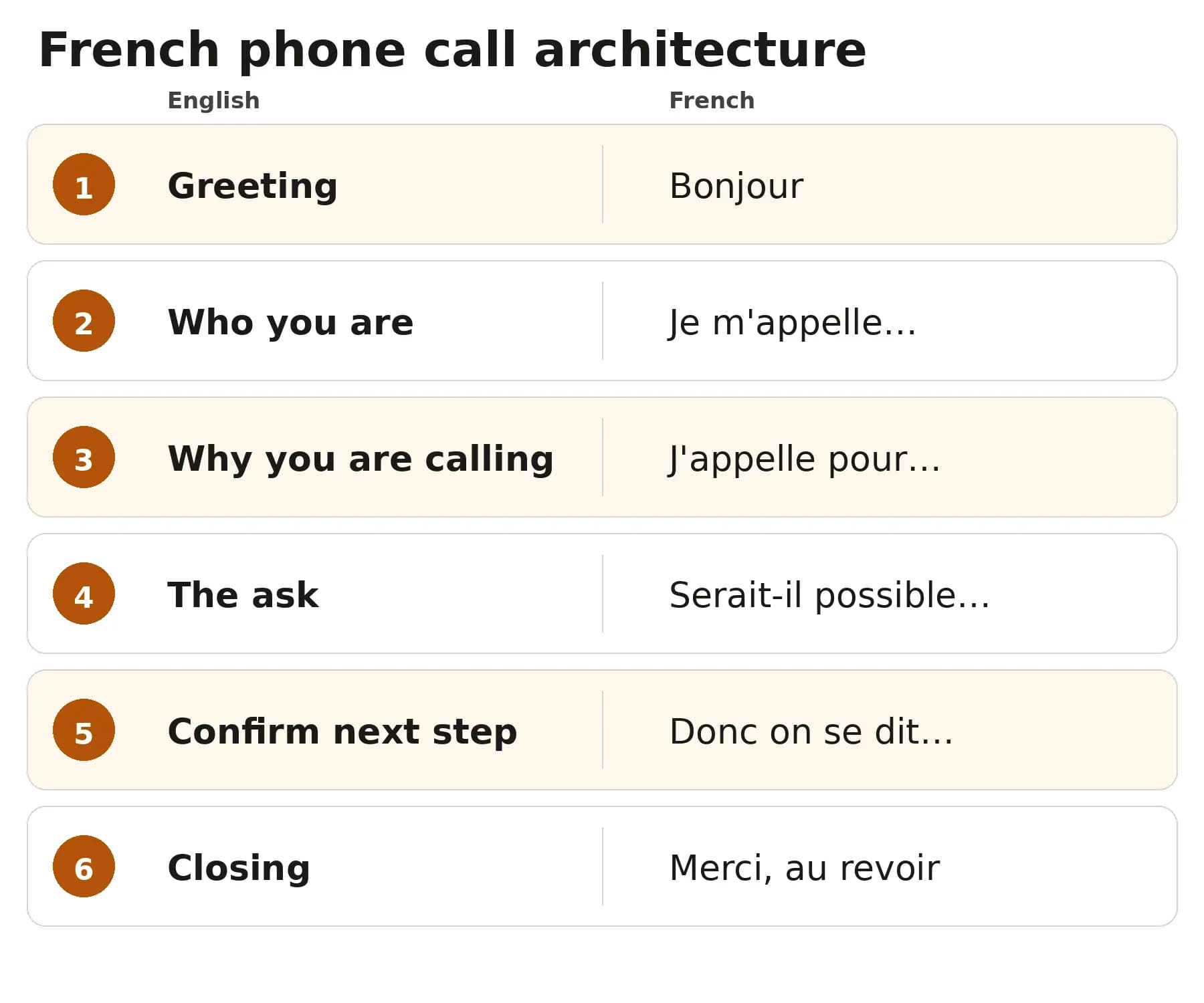
Notice what this forces you to do: you never open with the naked ask, and you never end without confirming what happens next. Most phone disasters aren't missing vocabulary. They're missing structure.
Before you dial: a 60-second prep that changes everything
Don't "wing it" in French. Prep in English first, then translate only the bones.
- Purpose in one sentence - "I need an appointment next week for X."
- Key facts written down - full name, date of birth, address, policy / dossier number, preferred days.
- Numbers you'll hear - dates, times, reference codes. Leave a blank line to write them.
- Your ask, softened - one Serait-il possible de... sentence.
- Plan B - "If they speak too fast, I will ask them to repeat / slow down / spell."
If you're calling about renovation or an artisan quote, keep the property vocab nearby - this older guide still helps: Renovating a Holiday Home in France - How to Communicate With French Tradesmen.
Recovery phrases that save the call
These are more valuable than fancy vocabulary, because they stop the spiral.
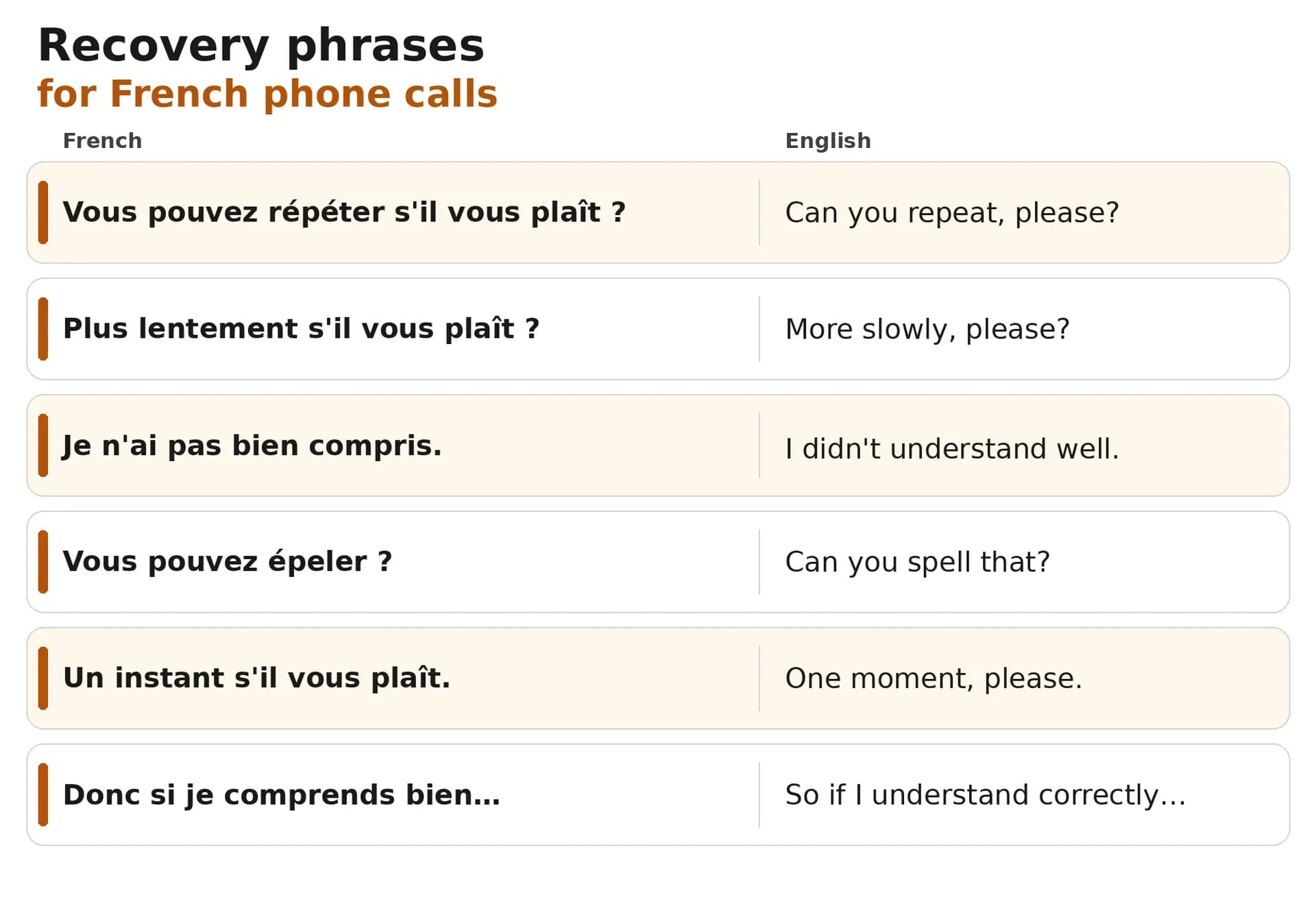
Memorise them until they're automatic:
- Vous pouvez répéter, s'il vous plaît ? - Could you repeat that, please?
- Plus lentement, s'il vous plaît. - More slowly, please.
- Je n'ai pas bien compris. - I didn't quite understand.
- Vous pouvez épeler, s'il vous plaît ? - Could you spell that, please?
- Un instant, s'il vous plaît. - One moment, please.
- Donc, si je comprends bien... - So if I've understood correctly...
That last one is gold. It lets you repeat the appointment time, the street, or the reference number back in your own words. French admin staff would rather hear a careful confirmation than a confident oui that creates a wrong booking.
Three mini scripts you can steal
1) Doctor / specialist appointment
Bonjour Madame, je m'appelle [Name]. J'appelle pour prendre rendez-vous avec le docteur [Name]. Serait-il possible d'avoir un créneau la semaine prochaine ? ... Donc, le mardi à dix heures, c'est bien ça ? Merci beaucoup.
2) Artisan / plumber callback
Bonjour Monsieur, je m'appelle [Name]. J'habite à [village / address]. J'appelle concernant [boiler / leak / quote]. Serait-il possible de passer cette semaine ? ... Vous pouvez me confirmer le jour et à peu près l'heure ?
3) Admin / mairie / follow-up
Bonjour Madame, je m'appelle [Name]. J'appelle au sujet de mon dossier [reference if you have one]. Je voudrais savoir où en est la demande. Serait-il possible de me dire s'il manque un document ? ... Donc, je dois envoyer [X], c'est bien ça ?
Keep each script on one phone note. Read it if you need to. Fluent people still use notes on hard calls.
Mistakes that make phone French harder than it needs to be
-
"I'll understand once I'm in the conversation."
You won't - not reliably. Prep the purpose and the ask first. -
"Saying oui keeps things moving."
False oui creates wrong dates, wrong addresses, wrong files. Confirm instead. -
"I need perfect grammar before I call."
You need clear structure and recovery phrases. Perfect grammar can wait. -
"Email is always safer."
Sometimes yes. Often the slot, the callback, or the récépissé only moves after a spoken exchange. Train both.
A practice plan that actually transfers to real calls
Phone confidence doesn't come from more vocabulary lists. It comes from short, slightly uncomfortable reps.
Weekly rhythm (about 60-90 minutes total)
- 2 x 10-minute listening drills: French voicemail / appointment dialogues at natural speed
- 2 role-plays with a tutor: one "easy booking", one "fast speaker + number confirmation"
- 1 real low-stakes call when you can: bakery order, restaurant booking, artisan availability
- After each call: write the three phrases that saved you, and the one that blanked
4-week starter block
- Week 1: architecture + recovery phrases only (no fancy vocab)
- Week 2: doctor / appointment scripts + number confirmation
- Week 3: artisan / service calls + spelling practice
- Week 4: admin follow-up calls + "si je comprends bien" confirmations
How we help with phone French at French Pour Moi
At French Pour Moi, our native tutors work one-to-one with adults who need French that holds up outside the classroom - including the calls that make competent learners freeze.
In practice that means short role-plays at real speed, feedback on the exact moment you lose the thread, and scripts matched to your life in France (health, school, property, admin), not generic tourist dialogues.
Do I need B1 before I practise phone calls?
No. From solid A2 you can train short, structured calls. B1 makes longer explanations easier, but waiting for "ready" is how people stay stuck.
What if the person switches to English?
That's fine sometimes. Still practise finishing one clean French ask first. Many staff switch because they hear hesitation, not because your French is useless.
Should I tell them I'm not French?
A short Je parle un peu français can help set the pace. Then go back to your architecture so the call doesn't drift into chaos.
How do I handle numbers and spellings?
Ask for a repeat. Write as you hear. Confirm with Donc, c'est bien... Spelling aloud (A comme Anne...) is a skill - practise it on purpose.
Can apps replace phone practice?
Apps help vocabulary. A tutor (or a brave real call with a recovery phrase ready) is what trains the freeze.
A final thought
Phone French feels personal because it happens in your ear, with no safety net. It isn't a verdict on your level. It's a trainable skill with a small architecture and a handful of rescue lines.
Write the six parts. Practise the recovery phrases until they're boring. Make one slightly uncomfortable call this week. Then another.
That's how life in France starts feeling less like a test and more like a place you can actually operate.
Quand vous voulez travailler les appels sans panique, on est là.
Start here: free level test then tell us your target and timeline.