


If you've got a Year 10 or Year 11 doing GCSE French this school year, you already know the scene. Headphones on. Paper in front of them. The recording starts. And within ten seconds their face says: I've already missed it.
That panic almost always lands on the first play. Not because your child "can't do Listening." Because the first play is where cognitive load, unknown vocab, and the urge to write everything collide - and autumn mocks are when that collision starts again.
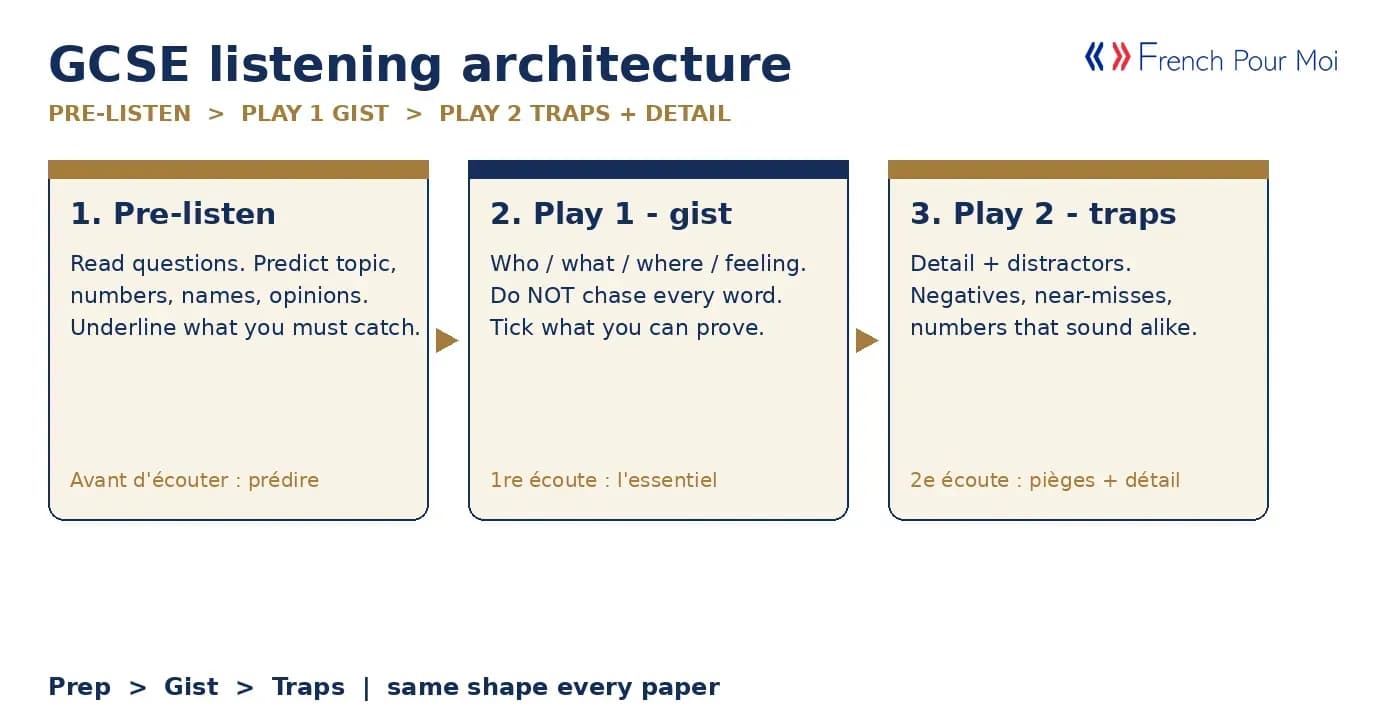
This post is the Listening companion to the Writing habits I wrote about here: GCSE French Writing After the 2026 Reform: Why Control Beats Fancy Phrases. Same idea: stop treating the paper like a personality test, and give your child a reusable architecture they can run under pressure - pre-listen prep -> play 1 gist -> play 2 detail/traps.
A quick note: exam boards publish their own papers and mark schemes, and small details can be updated. Treat this as practical coaching for AQA-style Listening (the pattern most UK families ask me about), then check your child's exact board booklet and sample papers.
Why the first play feels impossible
Listening is not "hearing French." It is hearing French while reading questions, holding predicted answers, spotting distractors, and deciding what to write - all in real time.
On play one, three things stack:
- Cognitive load. The brain is juggling sound, spelling, and the question paper at once. That is normal. It is also why "just concentrate harder" is useless advice.
- Unknown-vocab panic. One unfamiliar word appears and the whole clip suddenly feels opaque - even when the rest is manageable. Students chase that word and miss the next three easy ones.
- Writing everything. Many Year 10s try to transcribe. Transcription is a different skill. On GCSE Listening you need evidence for the question, not a script of the audio.
So the first play feels impossible when students treat it like "catch every word." It becomes possible when they treat it like "catch the gist I predicted."
If speaking nerves are the other half of the story at home, this older guide still helps: How to prepare for the GCSE French Speaking Exam. Listening and speaking share the same ear - but Listening has its own exam shape.
A reusable listen architecture
You don't need a new method for every topic. You need three moves that stay the same whether the clip is about school, holidays, or le weekend dernier.
| Stage | What your child does | What success looks like |
|---|---|---|
| 1. Pre-listen | Read questions; predict topic, people, numbers, opinions; underline must-catch words | They know what they are hunting before sound starts |
| 2. Play 1 - gist | Who / what / where / feeling; tick only what they can prove; ignore shiny unknown words | Rough shape of the clip; 40-70% of answers sketched |
| 3. Play 2 - traps + detail | Negatives, near-miss numbers, time frames, who said what; correct and fill | Final answers that survive distractors |
A full Listening skeleton looks like this in their head:
- Before sound: 20-40 seconds of ruthless prediction. Circle question words (qui, où, quand, combien, pourquoi). Guess the likely opinion words (j'adore, je déteste, ça va, pas mal).
- Play 1: prove the big picture. Who is speaking? About what? Positive or negative? Write short stubs, not essays.
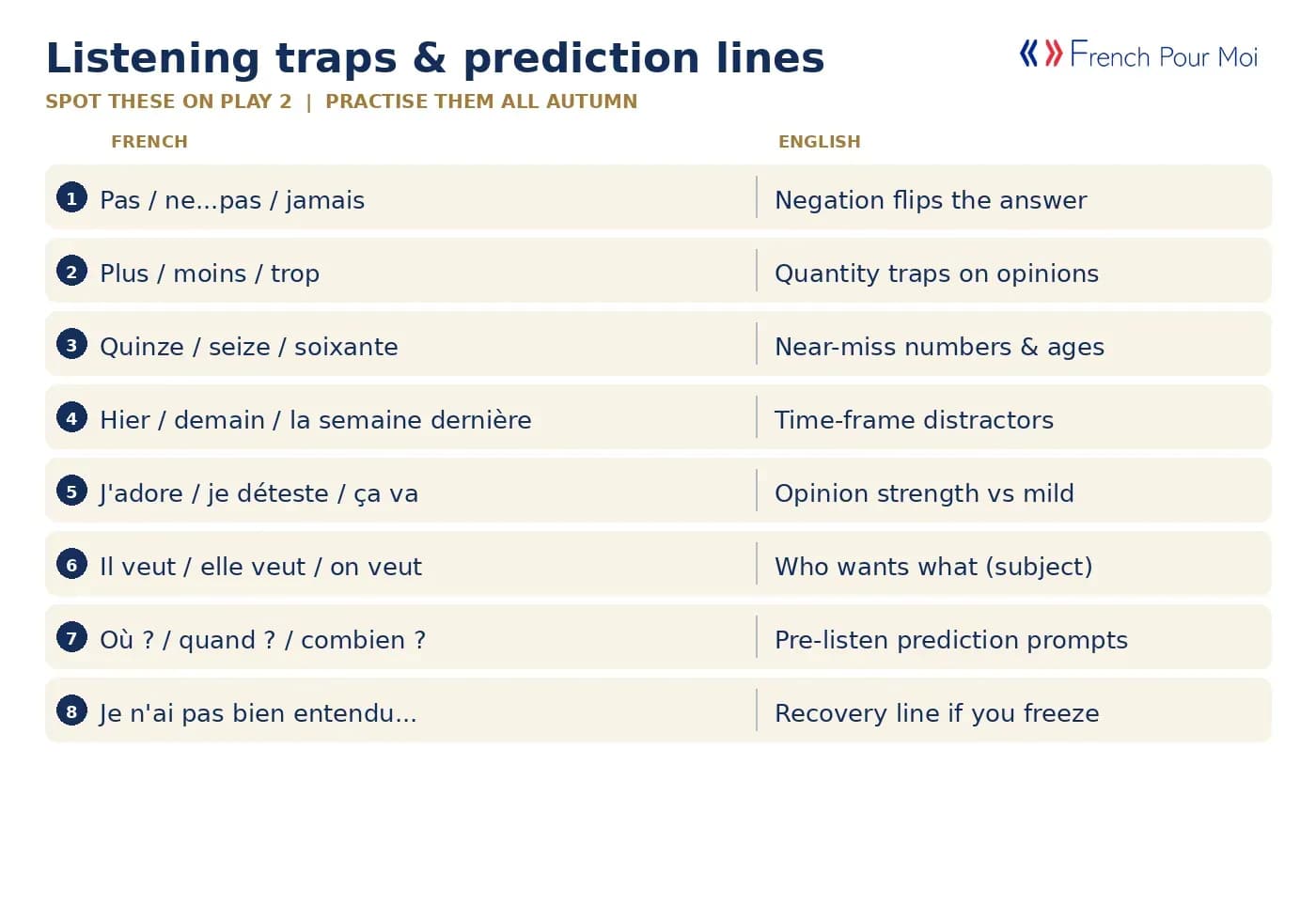
- Play 2: hunt traps. Negation (ne...pas, jamais), swapped subjects (il vs elle), near-miss numbers (quinze / seize / soixante), time-frame swaps (hier vs demain).
Notice what this architecture forces: your child never relies on "I'll understand it if I concentrate." Concentration is unreliable under adrenaline. A checklist is reliable.
Concrete drills parents and students can do this autumn
You do not need fluent French to coach Listening well. You need short clips and a clear job for each play.
Drill 1 - 90-second prediction (no audio yet)
Give your child a question paper (or three questions you invent). Timer: 90 seconds. They must write:
- likely topic in English
- 5 French words they expect to hear
- 1 probable trap (negation, number, or time)
Then play the clip. Score only the prediction quality, not the mark. Prediction is a muscle.
Drill 2 - gist-only first play
Play a short authentic clip (school podcast extract, slow news for learners, past paper audio). Rule for play 1: they may write only who / what / where / feeling. No full sentences. If they start transcribing, stop them. This feels unnatural at first - that is the point.
Drill 3 - trap spotting on play 2
On the second listen, their only job is: circle one negation, one number, one opinion word, one time marker. Then answer. This trains the ear to look for the exact places examiners hide marks.
Drill 4 - "unknown word shrug"
When an unknown word appears, they say out loud (or whisper): Je continue. Then keep listening for the next familiar anchor. Practise this until the panic reflex softens. One unknown word is almost never the whole answer.
Weekly rhythm (about 60-90 minutes beyond school)
- 2 short prediction + gist drills (10-15 minutes each)
- 1 full mini Listening section under mild timing
- 1 trap autopsy: rewrite only the answers lost to negation / number / subject mix-ups
- Light vocab recycling from the board list - little and often, especially numbers, days, opinions, school verbs
If you want the bigger picture of high grades across papers, this guide still pairs well: How to Get a Grade 9 in GCSE French. Pair it with Listening architecture rather than treating a 9 as a mystery personality trait.
Trap types worth memorising (and saying aloud)
Vocabulary lists help. Trap families help more - because they transfer across topics.
- Negation flips: pas, ne...pas, jamais, plus (in the "no longer" sense). Students hear a positive cognate and tick the wrong box.
- Quantity / opinion strength: j'adore vs ça va vs je déteste; trop, assez, un peu.
- Near-miss numbers and ages: quinze, seize, soixante, soixante-dix - train these as audio, not only as writing.
- Time-frame distractors: hier, demain, la semaine dernière, l'année prochaine.
- Who said what: il veut / elle veut / on veut / mes parents veulent. Subject errors are expensive and quiet.
Recovery line when the brain freezes mid-clip: Je n'ai pas bien entendu... je réécoute pour le détail. On the real paper they cannot say it to an examiner - but saying it in practise stops the spiral so play 2 still has a job.
Myths that waste autumn
-
"If I don't understand every word, I've failed the clip." False. GCSE Listening rewards selective listening. Gist first, detail second. Unknown words are normal.
-
"More past papers with no method will fix it." Papers without an architecture just rehearse panic. Do fewer papers, but run prep -> gist -> traps every time.
-
"Listening is only for students who 'have a good ear'." Ears improve with deliberate reps - especially prediction and trap families. This is trainable, not mystical.
-
"Subtitles will get them there." French subtitles can help reading. For Listening exams, practise without them once the clip is familiar, or you train a different skill.
-
"We'll start serious Listening after Christmas." Autumn mocks exist for a reason. Light, frequent Listening now beats heroic cramming in spring.
How we help with GCSE Listening at French Pour Moi
At French Pour Moi, our native tutors work one-to-one with GCSE students who need Listening that holds up on the day - prediction habits, gist discipline, trap spotting, and calm second-play routines.
In practice that means short targeted audio drills rather than endless silent past papers, feedback that names the exact habit to fix next (negation panic, number mush, transcription addiction), and sessions that fit around school and clubs.
If you'd like a clear starting point, take our free French level test, then tell us your child's year group, board if you know it, and whether Listening or Speaking is the louder panic at home. We can shape a short GCSE plan around the skills they actually need.
Autumn is a good moment: mocks are coming, and small Listening habits compound quickly when you practise on real clips twice a week.
FAQs
Is this only for AQA?
The prep -> gist -> traps principle travels well across boards. Exact task types, number of plays, and timings differ, so always check your child's specification and sample papers.
Foundation vs Higher - does the architecture change?
The shape stays. Ambition and clip speed change. Foundation still needs prediction and negation awareness. Higher needs the same discipline plus faster trap spotting.
My child freezes when they miss the opening sentence. What then?
Train a reset: shrug the unknown, listen for the next name / number / opinion. Practise starting mid-clip sometimes so missing the first line stops feeling fatal.
Should we practise with French YouTube or only past papers?
Both. Past papers teach exam shape. Short authentic clips (school topics, clear speech) build stamina. Always run the same architecture so the brain trusts the method.
How does this link to Writing practice?
Same philosophy as the Writing post: control beats chaos. Listening control means selective attention and trap awareness; Writing control means bullets and secure tenses. Different papers, same calm craft.
Can apps replace a tutor for Listening?
Apps help with vocab and short exposure. A tutor (or a very disciplined parent loop) is what catches the repeated Listening leaks - chasing unknown words, skipping prediction, ignoring negation.
A final thought
The first play stops feeling impossible when it stops being a scramble for every syllable.
Train the architecture the mark scheme quietly assumes: prepare the hunt, catch the gist, then use play 2 for traps and detail. Do that steadily through the school year - short clips, honest autopsies, boring repetition of negation and numbers - and Listening becomes a craft your child can trust when the headphones go on.
Quand vous voulez un plan clair pour le Listening, on est là.
À bientôt - et bonne écoute, Sophie