


Most people prepare for the DELF B2 listening paper by training their ears. Then they lose points with their pens. I'll call her Hana: a 26-year-old biology researcher from Osaka who needs the DELF B2 to apply for a master's programme in France. She listens to French radio on her commute, and when she sat her first mock listening paper, using the official sample, she understood almost everything. The first exercise was a five-minute radio interview with a professor of microbiology about mobile phones in hospitals. She followed it easily, even the fast parts.
Her marks told a different story. She got nearly every multiple-choice question right, then lost seven and a half points on the open ones. For the question about what surprised the journalist, she described what the professor had said about dirty phones, which was a true fact and not what was asked. For another she wrote half a word, a bit like a note to herself, and ran out of time before the last question, the one about the professor's conclusion, so she left it blank. All of it came from her listening, because she had understood it. It was the writing that failed.
I see this with strong listeners everywhere: nurses from the Philippines, engineers from Brazil, teachers from Poland, students from Vietnam or Nigeria. B2 listening is not only a listening test. It is a listening-and-answering test, and most of the points sit in the answering. This post looks at where the marks really are, what the official answer key tells us about what examiners accept, and a simple routine for writing short, correct answers while the audio is still playing in your head.
What the DELF B2 listening paper looks like
DELF B2 compréhension de l'oral - the official format
- Time: about 30 minutes, for a mark out of 25.
- Documents: several recordings, none longer than 8 minutes. Talks, documentaries and radio or television programmes are played twice. Interviews and news bulletins are played once.
- In the official sample paper I use: Exercise 1 is a recording of about 5 minutes, played twice, with 13 questions worth 18 points. Exercise 2 is a recording of 1 minute 30 to 2 minutes, played once, with 7 questions worth 7 points.
- How you answer: the instructions say you answer en cochant la bonne réponse ou en écrivant l'information demandée, which means ticking a box or writing the information asked for.
- Passing: 50/100 for the whole diploma, with at least 5/25 in each of the four papers.
One warning about genres: the official description says talks and programmes are played twice and interviews once, yet in the sample the long exercise is a radio interview played twice. So don't rely on the genre. Rely on the instructions you hear at the start of each exercise. The numbers of questions and exercises also change a little from one paper to another, so check the sample paper for your version on the official DELF B2 sample page. The pattern, though, is stable: some documents are heard twice, some once, and some questions are boxes while others are blank lines.
In Exercise 1 the recording gives you very precise timing. You have 1 minute to read the questions, then you hear the document, then 3 minutes to start answering, then you hear it a second time, then 5 minutes to complete your answers. In Exercise 2 you have 1 minute to read, one listening, and 3 minutes to answer.
Look at that carefully. In Exercise 1 you have eight minutes of writing time in total, spread across thirteen questions. Hana spent most of her first three minutes ticking boxes, which is exactly where she shouldn't have.
Where the points really are
I counted the points in the official sample paper and answer key, question by question. This is what I found:
| Multiple choice | Written answers | Total | |
|---|---|---|---|
| Exercise 1 (13 questions) | 5 questions, 5.5 points | 8 questions, 12.5 points | 18 |
| Exercise 2 (7 questions) | 4 questions, 4 points | 3 questions, 3 points | 7 |
| Whole paper | 9.5 points | 15.5 points | 25 |
Almost two-thirds of the marks on that paper are for answers you have to write. And the more points a question carries, the more likely it is to be an open one. In Exercise 1, every question worth 2 points is a written answer, and the three of them are the ones that ask what surprised the journalist, what she suggests to patients and what the professor's conclusion is. Notice the pattern. They are not questions about facts you can tick. They are questions about stance: what someone feels, recommends or concludes.
That's why a candidate who "understood everything" can still land near the pass mark. The easy points are the quick ones, and the expensive points are the ones where you have to turn a spoken idea into a short written sentence, under time pressure, in a language that isn't yours.
What the answer key tells you about marking
This is the part that surprises my students, and it's good news. The official answer key opens with an instruction to correctors, which I'll paraphrase closely: for the listening and reading papers, spelling and syntax are not taken into account unless they seriously damage understanding, and the corrector accepts the answers given in the key and any reformulation or coherent answer to the question asked.
So you don't need perfect French. You need an answer that is clear, relevant and on the question. That shifts what you should practise.
The key shows what a good answer looks like, and it is short. For the question about the journalist's surprise, the model answer is a single clause: that part of the medical staff doesn't automatically disinfect their hands. For the conclusion, it's one sentence: that mobile phones in hospitals are here to stay, but their use can be limited. Where a question asks for a list ("name two other objects"), the key accepts any two from a short list. Where several answers are possible, the key says so with OU, "or".
One more detail from the sample paper is useful: the questions follow the order of the recording. That means you always know roughly where you are in the audio, and that the last questions are usually about the last stretch of it.
The "que" trick
If you read the model answers to the questions about surprise, suggestions and conclusions, you'll see that they all start with the same word: que. Qu'est-ce qui surprend la journaliste ? is answered with Que.... Que suggère la journaliste aux patients ? is answered with Que les patients exigent.... Quelle est la conclusion ? is answered with Que la présence des téléphones...
This is a very practical habit. When a question asks about what someone thinks, recommends, discovers or concludes, start your answer with Que and write one complete idea. It stops you from writing a fragment, it keeps you on the question and it gives you a ready-made sentence frame while you're under pressure.
Question words and the answers they want
- Pourquoi... ? / Pour quelle raison... ? - Parce que... / Pour... plus the reason, not the fact.
- Qu'est-ce qui surprend... ? - Que... plus the thing that is unexpected.
- Que suggère / conseille / propose... ? - De... or Que... plus the recommendation.
- Quelle est la conclusion... ? - Que... plus the final message, usually near the end of the recording.
- Combien... ? / Quand... ? - just the number or the time, nothing else.
- Citez deux... / Mentionnez... - the exact number of items asked, no more.
Listen for the signals
Because the expensive questions are about stance, learn the little phrases speakers use when they reach one. Native speakers announce their stance, almost like road signs:
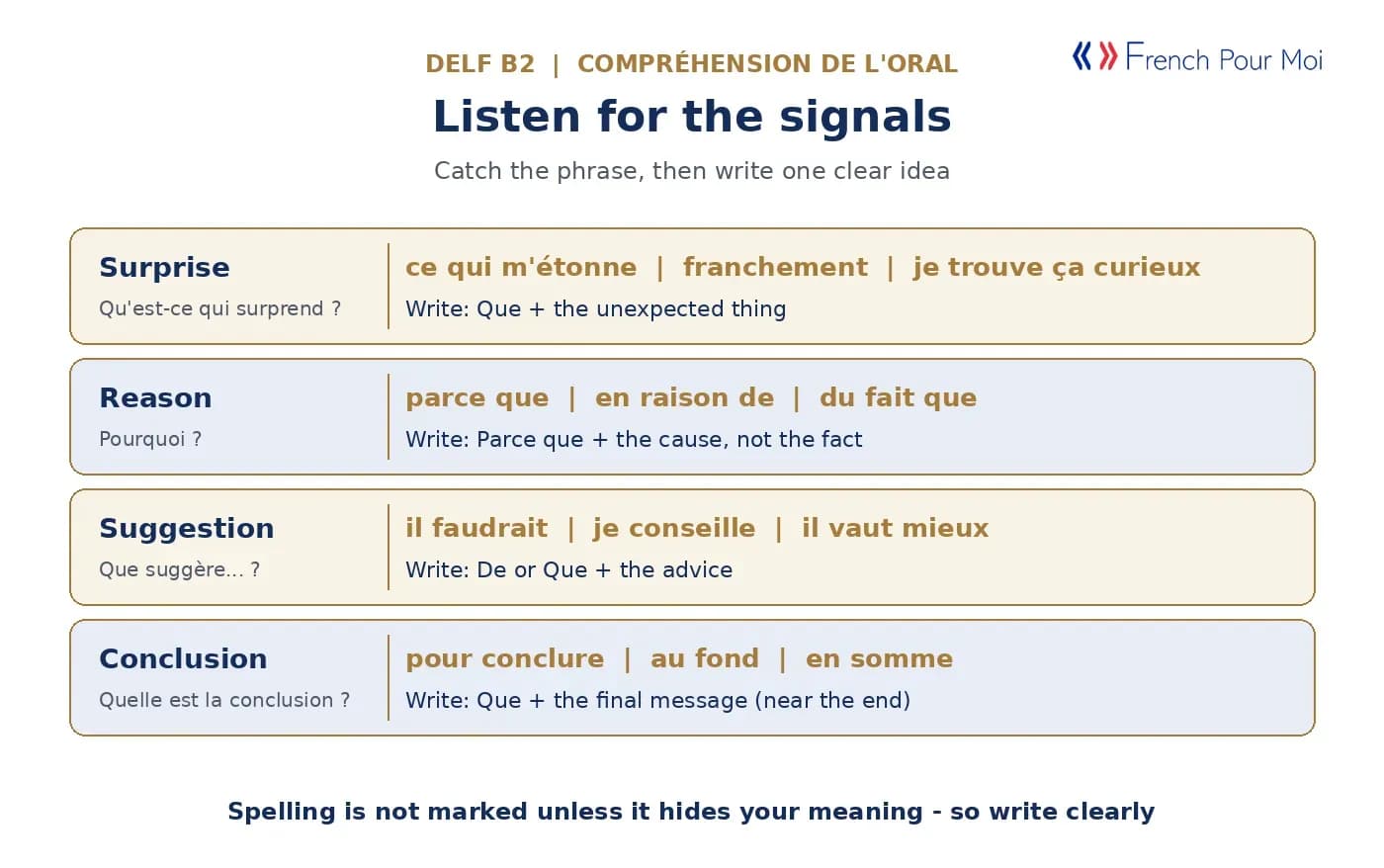
When you hear ce qui m'étonne, franchement or je trouve ça curieux, a surprise is coming. When you hear il faudrait, je conseille or il vaut mieux, a suggestion is coming. And when the interviewer slows down and says pour conclure or si je vous comprends bien, the closing message is about to land, usually just before the end. In my experience, the last two questions of a long exercise are often about the last minute of the recording, so don't let your attention drop in the final stretch, even though you're tired.
A routine for the two listenings
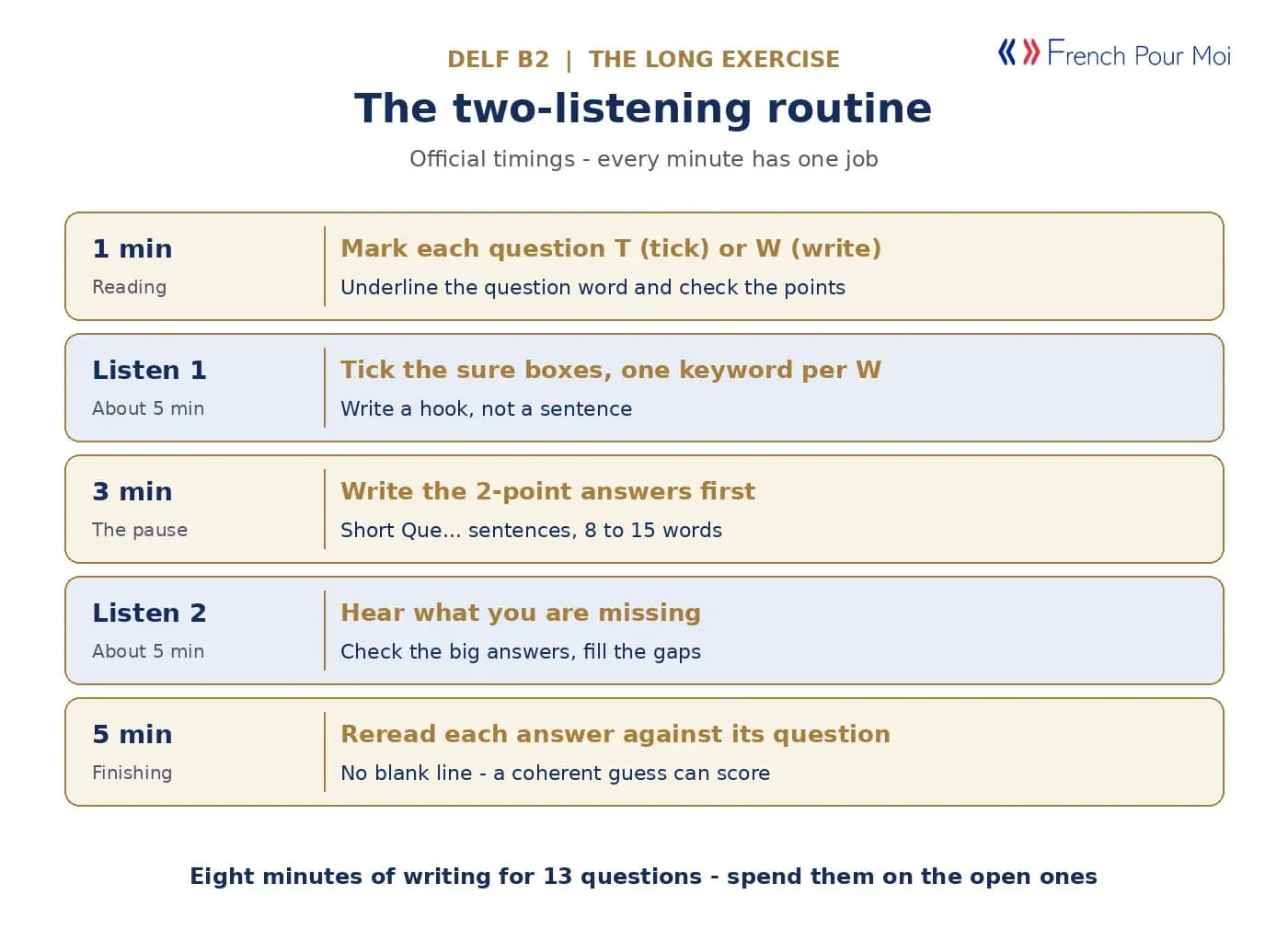
This is the method I teach for the long exercise, the one with two listenings. The timings are the official ones.
During the first minute (reading): don't read the questions as a story. Read them as a list of jobs. Next to each number, write one letter in the margin: T for a box to tick, W for something to write. Underline the question word. Then look at the points: a 2-point question wants a full idea, and a 1-point question wants one fact.
First listening: tick the boxes you are sure of, quickly, and don't agonise over the others. For each W question, write one keyword next to it, not a sentence. If you hear the surprise, write "médecins - mains". If you hear the conclusion, write "portable - limiter". You are only keeping a hook for the next three minutes.
The three-minute pause: this is where the points are won. Go straight to the W questions, starting with the highest-value ones. Turn each keyword into a short, clean sentence, starting with Que... where it fits. Aim for 8 to 15 words. Then finish the boxes.
Second listening: don't try to hear everything again. Hear what you're missing. Check your 2-point answers first, and fill the gaps you left. If you realise your answer to a question is wrong, correct it. If a question was one you missed completely, concentrate on that part of the audio.
The last five minutes: reread each answer against its question, not against the audio. Does it answer exactly what was asked? Is there something on every line? A blank can never earn a point, while a short, coherent guess sometimes does.
For the shorter exercise, the one you hear only once, the plan is different. Spend the minute reading the questions and guess what sort of detail each one needs: a number, a name, an occasion, a reason. While the audio plays, write only those details, and nothing else. The questions follow the recording in order, so tick or write as you go, and use the three minutes afterwards to turn your jotted words into answers. One of the questions in the sample asks you to decide which of three people would be accepted as a blood donor. It sounds like a trick, but it is only a test of whether you noted the numbers (age and weight) when you heard them.
Hana's second attempt
Hana did exactly this on her next mock paper. She marked each question T or W, underlined the question words, and wrote single keywords on the first listening instead of full sentences. In the three-minute pause she answered the 2-point questions first, with a Que... clause for each. This time, for the journalist's surprise, she wrote that some of the doctors don't disinfect their hands systematically. She still wasn't sure about her spelling of désinfecter, and it didn't matter, because the answer was clear. She reached the final question with two minutes to spare and wrote the conclusion in one sentence. She recovered most of her lost points, and she told me afterwards that the paper felt much calmer, even though the French itself was exactly the same.
A practice routine that works
- Three times a week (15 minutes): take a short recording, ideally one to two minutes, from a French radio programme or podcast. Listen once, then write three answers to your own que questions: "What surprised the speaker? What did they recommend? What was the conclusion?" Keep each to 15 words or fewer. Then listen again and check.
- Once a week (30 minutes): do a full listening paper under exam conditions, using the official sample papers, or the DELF B2 listening exercises that RFI Savoirs and France Éducation international offer, with long exercises of about 5 minutes and shorter ones of around 2 minutes. Respect the pauses. Don't rewind.
- After each paper, sort every lost point into one of four boxes: didn't hear it, heard it but wrote something else, too vague, left blank. Most candidates are surprised to find that "didn't hear it" is the smallest box.
- Keep a model-answer notebook: each time you read the key, copy one answer worded the way an examiner expects, such as Que ... mais qu'on peut limiter.... Reread it before the exam. Your own reformulations are accepted, but a notebook of good patterns speeds you up.
- Practise the pen as well as the ear: write with the clock on, without a dictionary, with imperfect spelling. It's good practice for the real exam, where neither spelling nor a perfect sentence is what is being marked.
Common mistakes to avoid
- Spending the first pause on boxes and running out of time for the 2-point answers.
- Writing a true fact from the audio that doesn't answer the question asked.
- Writing a whole transcript sentence when 10 words would earn the same points.
- Giving three examples when the question asks for two. Give exactly what is asked for.
- Leaving a line empty because you're afraid of making mistakes. The key says spelling and syntax don't count unless they hide the meaning.
- Letting your attention drop in the last minute of a long recording, where the conclusion often sits.
Where to go next
Listening is only one of the four DELF B2 papers, and the same skill of giving a clear, short, relevant answer carries over to the others. If you're also preparing the speaking paper, my post on the DELF B2 speaking exam and how to defend your opinion when the examiner pushes back shows how to hold your ground out loud. For the written paper, DELF B2 writing exam: why well-argued letters still lose marks covers structure and connectors. And if you're not sure whether B2 is the right target yet, What is my level in French? A1, A2, B1, B2? explains each level, and our free French level test gives you a quick starting point.
If you'd like someone to play you the recordings, time the pauses, and go through your written answers line by line against the official key, get in touch with us. Lessons run 1-to-1 or 2-to-1, online or in person - get in touch to ask about in-person lessons near you. 2-to-1 works well for two candidates preparing the DELF together: you can answer the same questions separately, then compare your wording, which is often where you learn the most.
À bientôt,
Sophie