


You've picked up the hire car. The seat is adjusted, the mirrors are perfect, the satnav is speaking confident French. Then a sign flashes past - Toutes directions - and you realise you have no idea where "all directions" is supposed to take you.
Driving in France is one of the best ways to see the country: villages, vineyards, coastlines and that one boulangerie in the middle of nowhere. But it comes with its own vocabulary, a few rules that surprise visitors, and some very fast decisions at the petrol pump.
Wherever you're from, here's the French you need on the road.
Read the road signs before they read you
Most French road signs are pictures. The ones in words are the ones that catch people out.
| French | What it means |
|---|---|
| Toutes directions | all destinations - follow it to get out of town |
| Autres directions | other destinations (not listed on the other signs) |
| Centre-ville | town centre |
| Sortie | exit |
| Rappel | reminder (usually of a speed limit you've already been given) |
| Vous n'avez pas la priorité | you don't have priority (often at roundabouts) |
| Cédez le passage | give way |
| Sauf riverains | except residents |
| Chaussée déformée | uneven road surface |
| Péage | toll |
Toutes directions and Autres directions are lifesavers in towns. When you don't see your destination, follow one of them and the next junction will usually show you the way.
Your takeaway: learn Toutes directions, Sortie and Cédez le passage first. They'll get you out of most towns in one piece.
Priorité à droite: the rule that surprises everyone
In France, there's an old rule called la priorité à droite - priority to the right. At some junctions, especially in towns and villages, traffic coming from your right has priority, even if it's coming from a small side street and you're on what looks like the main road.
Signs tell you when you're on a priority road (the yellow diamond) and when the rule applies (a triangle with a black X). If there's no sign at all, be ready to give way to the right.
At most roundabouts, the traffic already on the roundabout has priority - that's what Vous n'avez pas la priorité is telling you as you approach.
And yes: drive on the right. Especially when you pull out of a quiet car park on an empty road. That's when habits come back.
Your takeaway: in towns and villages, watch your right. A tiny side street can have more priority than you do.
At the petrol station: gazole is not "gas"
This is the mistake that can ruin a road trip. At French pumps:
- le gazole (also written gasoil) = diesel
- le sans plomb (SP95, SP98) = unleaded petrol
- l'E10 / SP95-E10 = unleaded with ethanol (check your car can use it)
If you're used to calling petrol "gas", the word gazole looks dangerously familiar. It isn't. Check what your car takes before you lift the nozzle - often it's written inside the fuel flap.
Useful phrases:
- Je voudrais faire le plein, s'il vous plaît. - I'd like to fill up.
- Où est-ce qu'on paie ? - Where do we pay?
- La pompe numéro trois. - Pump number three.
- Vous acceptez les cartes étrangères ? - Do you accept foreign cards?
Many stations are automatic (automate, 24/24), especially in the countryside. Some machines can be fussy with foreign cards, so don't let the tank run too low on small roads.
Your takeaway: gazole = diesel. Say it twice, then check the fuel flap anyway.
The péage: motorways and tolls
Many French motorways (autoroutes) are toll roads. You'll see Péage signs, then a row of booths.
How it usually works:
- You take a ticket (un ticket) when you join.
- You pay at the péage when you leave or at a barrier on the way.
- Choose your lane: look for the card symbol (CB) or a person/coins symbol. Avoid lanes marked only with a t - those are for electronic toll tags (télépéage).
Useful lines if something goes wrong at the barrier (there's usually a help button and an intercom):
- Bonjour, ma carte ne passe pas. - My card isn't working.
- J'ai perdu mon ticket. - I've lost my ticket.
- Est-ce que je peux payer autrement ? - Can I pay another way?
Speaking French through a crackly intercom with a queue behind you is advanced-level French. If you freeze, we have a whole post on calls and speaking without visual cues: How to Practise French Phone Calls for Real Life in France.
Your takeaway: at the péage, avoid the "t" lane unless you have a tag - and keep your ticket somewhere safe.
Parking: blue, white and very creative
French parking has its own words:
- le stationnement payant - paid parking
- l'horodateur - the parking ticket machine
- le parking souterrain - underground car park
- la zone bleue - blue zone: free, time-limited parking, with a disque (parking disc) showing your arrival time
- stationnement interdit - no parking
- la fourrière - the car pound (you don't want to learn this word in real life)
Useful phrases:
- Est-ce que je peux me garer ici ? - Can I park here?
- C'est payant ? - Do I have to pay?
- Le parking ferme à quelle heure ? - What time does the car park close?
Your takeaway: before walking away from the car, look for an horodateur or a blue line. Five seconds can save you a ticket.
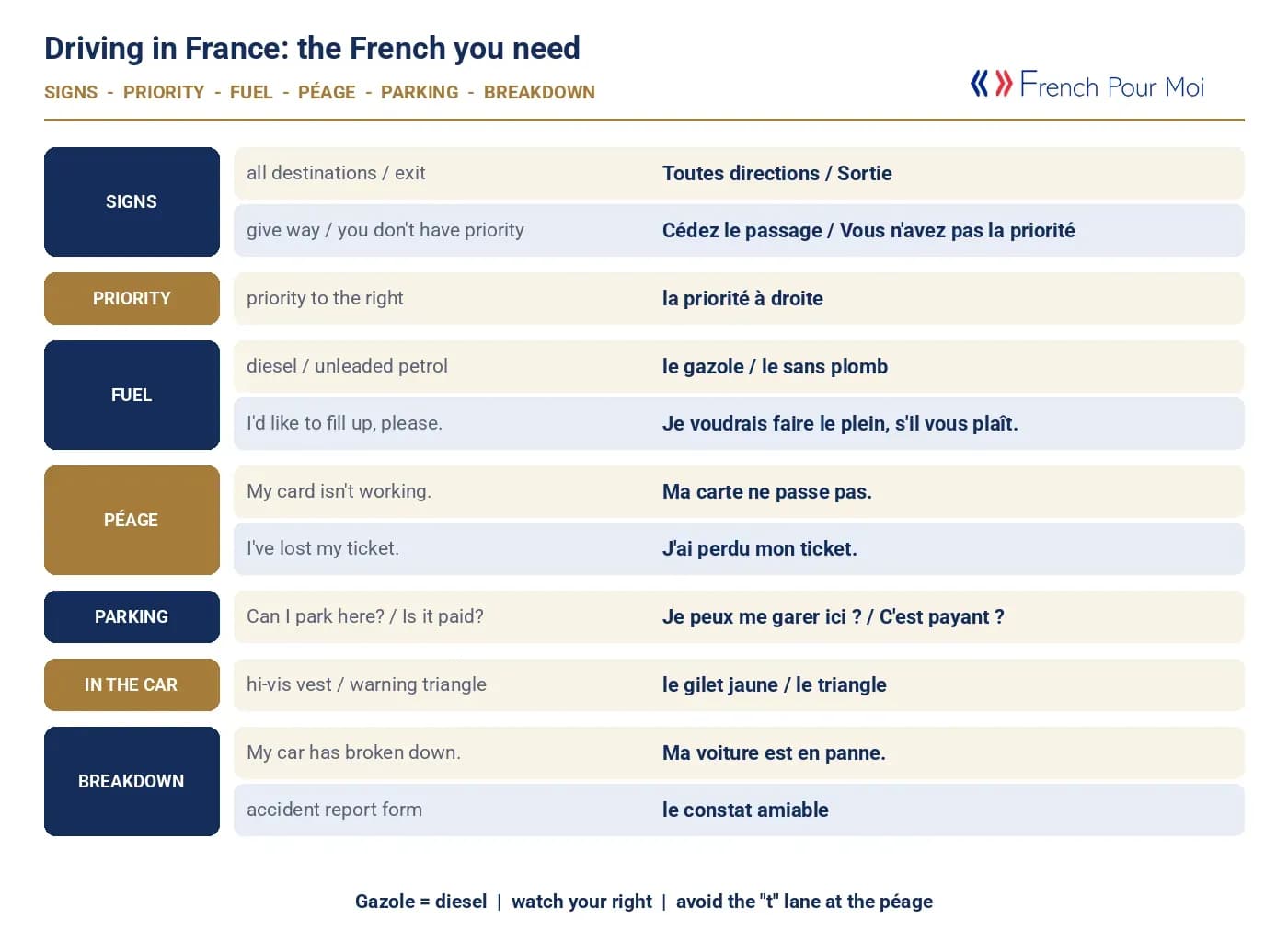
What to keep in the car
French rules require some safety equipment in the car - notably a high-visibility vest (le gilet jaune) within reach and a warning triangle (le triangle de signalisation). If you're hiring a car, check they're on board. If you're driving your own car from abroad, check the current requirements for your vehicle before you set off.
Some cities also have low-emission zones (zones à faibles émissions, ZFE) that require a Crit'Air sticker showing your vehicle's emissions category. Check before you drive into a big city centre.
And always carry your documents: le permis de conduire (driving licence), la carte grise (vehicle registration document) and l'attestation d'assurance (insurance certificate). Rules about using a foreign licence depend on where it was issued and your situation - check the official rules for your case.
Your takeaway: gilet jaune and triangle in the car, papers in the glovebox. Boring, essential, done.
Breakdowns, accidents and the police
Nobody plans for it, but having the words ready helps you stay calm.
Breakdown (une panne):
- Ma voiture est en panne. - My car has broken down.
- J'ai un pneu crevé. - I've got a flat tyre.
- Je suis sur l'autoroute A[number], direction [ville], au kilomètre [number]. - I'm on motorway A..., heading for..., at kilometre...
- Pouvez-vous envoyer une dépanneuse ? - Can you send a tow truck?
On motorways, the orange emergency phones (bornes d'appel d'urgence) connect you directly to help and tell them where you are.
Minor accident: in France, drivers often fill in a constat amiable together - a standard accident report form you'll usually find in the car. Fill it in calmly, and don't sign anything you don't understand.
- Il faut remplir un constat. - We need to fill in an accident report.
- Je ne comprends pas bien, vous pouvez m'expliquer ?
Police check (un contrôle): stay polite and calm. Bonjour, monsieur / madame. Have your papers ready: Voici mon permis, la carte grise et l'attestation d'assurance.
In an emergency, call 112 (European emergency number) - it works anywhere in the EU.
Your takeaway: learn Ma voiture est en panne and constat amiable now. You'll probably never need them - and you'll be very glad if you do.
Five driving mistakes (and the fix)
- Putting diesel in a petrol car (or the reverse). Fix: gazole = diesel. Check the flap.
- Missing the priority to the right. Fix: watch side streets in towns and villages.
- Queuing in the "t" lane at the péage. Fix: look for CB or the person symbol.
- Forgetting the parking ticket. Fix: look for an horodateur or blue zone.
- No gilet jaune in the car. Fix: check before you drive off.
How to practise before your road trip
- Learn the sign table - say each one out loud.
- Practise faire le plein and Ma carte ne passe pas until they're automatic.
- Plan your route in French on a map app set to French - you'll hear sortie, rond-point and tournez à droite again and again.
- Role-play a breakdown call with a friend or tutor: where you are, what's wrong, what you need.
At French Pour Moi, we can role-play the péage intercom, the breakdown call and the police check in 1-to-1 or 2-to-1 lessons with native tutors, online or in person. Prefer face to face? Get in touch and ask where in-person lessons are available. And if you're moving to France for good, our guide to renting a flat in France covers the next big vocabulary list.
FAQs
What does "priorité à droite" mean?
At junctions where it applies, traffic coming from your right has priority. It's common in towns and villages; signs show when you're on a priority road instead.
Is "gazole" petrol or diesel?
Diesel. Unleaded petrol is sans plomb (SP95, SP98, or E10 if your car can use it).
Do I have to pay to use French motorways?
Many French motorways are toll roads (autoroutes à péage), though not all. You usually take a ticket when you join and pay when you leave.
What should I have in the car in France?
At minimum, a high-visibility vest (gilet jaune) and a warning triangle, plus your licence, registration document and insurance certificate. Check the current rules for your situation before you travel.
One last thing
Driving in France is freedom: lunch in one village, coffee in another, a view you'll never forget in between. The French you need for it is short and practical - and it makes every stop easier.
Learn the signs. Watch your right. Say gazole with respect. And enjoy the road.
Curious how ready your French is for the open road? Take our free French level test - it only takes a few minutes and shows you where to start.
À bientôt, Lucie – French Pour Moi