


You've found the perfect flat online. Two rooms, big windows, a balcony with room for exactly one chair and one very French plant. You call the number. Someone answers fast, says something about un dossier complet and charges comprises, and hangs up before you've found your pen.
Renting in France comes with its own vocabulary - and a lot of paperwork. Whether you're coming from the US, China, Japan, Brazil or anywhere else, the words are the same for everyone. Learn them once, and the whole process gets much less scary.
Here's the French you need, from the first listing to the day you hand back the keys.
Decode the listing before you call
French rental ads (annonces) are short and full of abbreviations. Here's your cheat sheet.
| French | What it means |
|---|---|
| un T1 / F1, T2 / F2, T3... | number of main rooms (a T2 is usually a living room + one bedroom; kitchen and bathroom not counted) |
| un studio | one main room |
| meublé / non meublé (vide) | furnished / unfurnished |
| CC (charges comprises) | rent including service charges |
| HC (hors charges) | rent excluding service charges |
| les charges | service charges (building upkeep, sometimes water or heating) |
| le chauffage individuel / collectif | heating for your flat only / shared for the whole building |
| au 3e étage sans ascenseur | on the 3rd floor, no lift |
| de particulier à particulier | direct from the owner, no agency |
| le DPE | the energy rating (A to G) - shown on the ad |
One trap: the French rez-de-chaussée is the ground floor, and the 1er étage is one floor up. If you're from a country where the ground floor is "floor 1", count again before you agree to carry a sofa up there.
Your takeaway: CC or HC changes the real price. Always check which one you're reading.
The first call or email
Good listings go fast, so be ready with a short, polite message.
- Bonjour, je vous contacte au sujet de l'annonce pour l'appartement rue [nom].
- Est-ce qu'il est toujours disponible ? - Is it still available?
- Est-ce qu'on pourrait organiser une visite ? - Could we arrange a viewing?
- Le loyer est charges comprises ? - Does the rent include charges?
- À partir de quand est-il disponible ? - From when is it available?
Phone calls feeling like an exam? You're not alone - we have a whole post on that: How to Practise French Phone Calls for Real Life in France.
Your takeaway: one polite, ready-made message in French will get you more replies than a long one in English.
The visit: ask before you fall in love
Viewings (visites) can be quick - sometimes several people at once. Have your questions ready.
- Les charges comprennent quoi ? - What do the charges include?
- Le chauffage, c'est individuel ou collectif ?
- L'eau chaude, c'est un chauffe-eau électrique ou au gaz ?
- Il y a une cave ou un local à vélos ? - Is there a cellar or a bike store?
- Le bail commence quand ? - When does the lease start?
- Qu'est-ce qu'il faut pour le dossier ? - What do you need for the application?
And look up, look down, open things. Turn on the taps. Check the windows close. A flat can be très lumineux (very bright) and très froid at the same time.
Your takeaway: the visit is a two-way interview. You're allowed to ask questions - and you should.
The dossier: the French love a complete file
In France, you usually apply with a dossier de location - a rental application file. Landlords and agencies often expect it ready to send the same day.
Typical documents:
- une pièce d'identité - ID (passport or residence permit)
- un justificatif de domicile - proof of current address
- un contrat de travail - employment contract
- les bulletins de salaire / fiches de paie - payslips
- le dernier avis d'imposition - your latest tax notice (if you have one)
- un RIB - your bank details
Many landlords also ask for un garant - a guarantor, someone who agrees to pay if you can't. New arrivals often don't have a French guarantor; ask whether the landlord accepts alternatives. Some tenants may be eligible for Visale, a free state-backed guarantee scheme - check whether it applies to you.
Useful lines:
- Mon dossier est complet, je peux vous l'envoyer aujourd'hui.
- Je viens d'arriver en France. Est-ce que vous acceptez un garant à l'étranger ? - Do you accept a guarantor abroad?
- Il me manque l'avis d'imposition, je viens d'arriver. - I don't have the tax notice, I've just arrived.
And one firm rule: never send money or original documents before you've visited the flat and checked it really exists. Pas de visite, pas de virement. No visit, no transfer.
Your takeaway: prepare your dossier before you start visiting. In France, the fastest complete file often wins.
The lease, the deposit and the insurance
When your dossier is accepted, you'll sign le bail - the lease. Furnished and unfurnished leases have different standard lengths and rules, so check which one you're signing.
Words you'll see:
- le bail (de location) - the lease
- le dépôt de garantie - the deposit (the law caps it - ask what applies to your lease)
- le loyer - the rent
- la date d'entrée dans les lieux - the move-in date
- le préavis - notice period when you leave
Before you get the keys, you'll usually need une assurance habitation - home insurance. The landlord or agency will ask for une attestation d'assurance (insurance certificate).
- Quelle est la durée du bail ? - How long is the lease?
- Le dépôt de garantie, c'est combien ? - How much is the deposit?
- Vous avez besoin de l'attestation d'assurance quand ?
Your takeaway: no attestation d'assurance, no keys. Sort it before moving day.
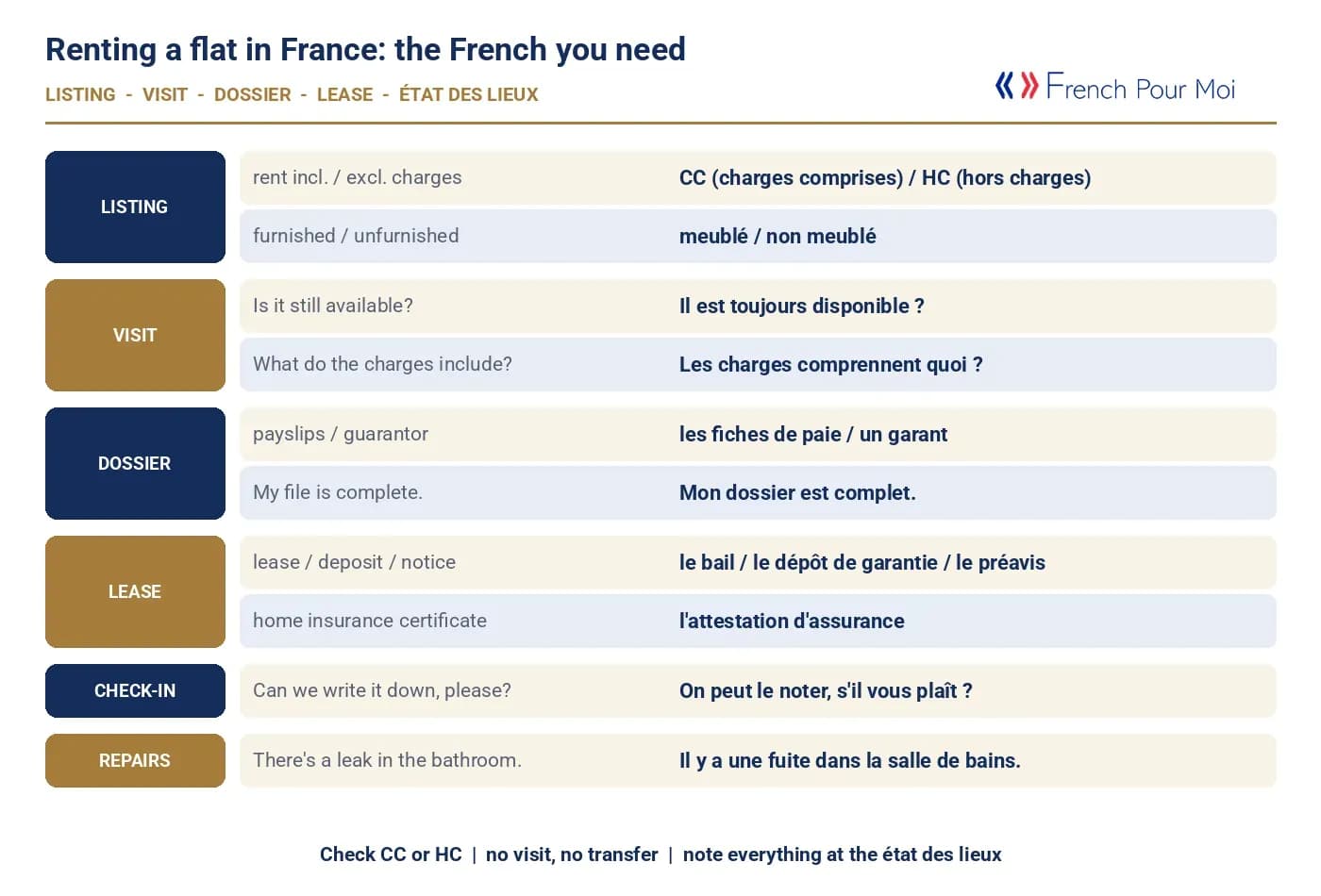
The état des lieux: your most important appointment
The état des lieux d'entrée is the check-in inspection: you and the landlord or agent walk through the flat and write down the condition of everything. At the end, you do it again - the état des lieux de sortie - and compare.
This document can decide how much of your deposit you get back. So take your time.
- Il y a une tache sur le mur, ici. - There's a stain on the wall here.
- Cette fenêtre ferme mal. - This window doesn't close properly.
- Le parquet est rayé. - The wooden floor is scratched.
- Est-ce qu'on peut le noter, s'il vous plaît ? - Can we write it down, please?
- Je peux prendre des photos ?
Yes, you'll feel a bit fussy pointing at every scratch. That's the point.
Your takeaway: if it isn't written in the état des lieux, it didn't exist. Note everything, photograph everything.
Living there: repairs, rent and the landlord
Something will break eventually. It's an old French building; it has opinions.
- Il y a une fuite dans la salle de bains. - There's a leak in the bathroom.
- Le chauffe-eau ne marche plus. - The water heater has stopped working.
- Le chauffage est en panne. - The heating has broken down.
- Pouvez-vous envoyer quelqu'un, s'il vous plaît ? - Could you send someone?
- Pourriez-vous m'envoyer une quittance de loyer ? - Could you send me a rent receipt?
The quittance de loyer is a rent receipt - useful as proof of address for banks and administration.
When you leave, you give notice in writing: Je vous informe que je donne mon préavis. Check your lease for how much notice you need and how to send it.
Your takeaway: report problems in writing, early and politely. Par e-mail, s'il vous plaît is your friend.
Five renting mistakes (and the fix)
- Reading HC as CC. Fix: check the charges every time.
- Visiting without a dossier. Fix: have it ready as a single PDF.
- Paying before visiting. Fix: Pas de visite, pas de virement.
- Rushing the état des lieux. Fix: note and photograph everything.
- Fixing things by phone only. Fix: confirm by email.
How to practise before you start searching
- Read five real listings and translate every abbreviation.
- Write your first-contact message in French and save it on your phone.
- Role-play the visit with a friend, a tutor or a very patient houseplant.
- Practise the état des lieux in your current home: walk around and describe what you see in French.
At French Pour Moi, we can role-play your calls, visits and the état des lieux in 1-to-1 or 2-to-1 lessons with native tutors, online or in person. Prefer face to face? Get in touch and ask where in-person lessons are available. And if you're thinking of buying rather than renting, read Buying a House in France: The French You Need With the Estate Agent and the Notaire.
FAQs
What does T2 mean in a French rental ad?
It refers to the number of main rooms. A T2 usually has a living room and one bedroom; the kitchen and bathroom aren't counted.
Do I need a French guarantor to rent?
Many landlords ask for one, but not all. Ask what they accept, and check whether a guarantee scheme like Visale applies to your situation.
What is the état des lieux?
It's the written check of the flat's condition when you move in and when you leave. Comparing the two helps decide what happens to your deposit - so be thorough.
Is home insurance compulsory when renting?
Landlords generally require it, and you'll usually be asked for an attestation d'assurance before getting the keys.
One last thing
Renting in France is a paperwork marathon with a lovely finish line: your own front door, your own boulangerie round the corner, and a balcony for that one very French plant.
Decode the listing. Prepare your dossier. Note everything at the état des lieux. And ask every question - in French.
Wondering if your French is ready for the agency? Take our free French level test - it only takes a few minutes and shows you where to start.
À bientôt, Lucie – French Pour Moi