


Your French neighbour, colleague or new friend says: "Venez dîner à la maison samedi !" Lovely. Then the questions start. What time do you actually arrive? What do you bring? How many kisses? And what do you say when you can't eat another bite of cheese?
Being invited into a French home is a real compliment. A restaurant is neutral ground; a home is personal. The good news: the codes are clear, the French is simple, and your hosts mostly want you to relax and enjoy yourself.
Wherever you're from, here's how to be the guest everyone wants to invite again.
The invitation: say yes properly
French invitations are often casual, but your reply still matters.
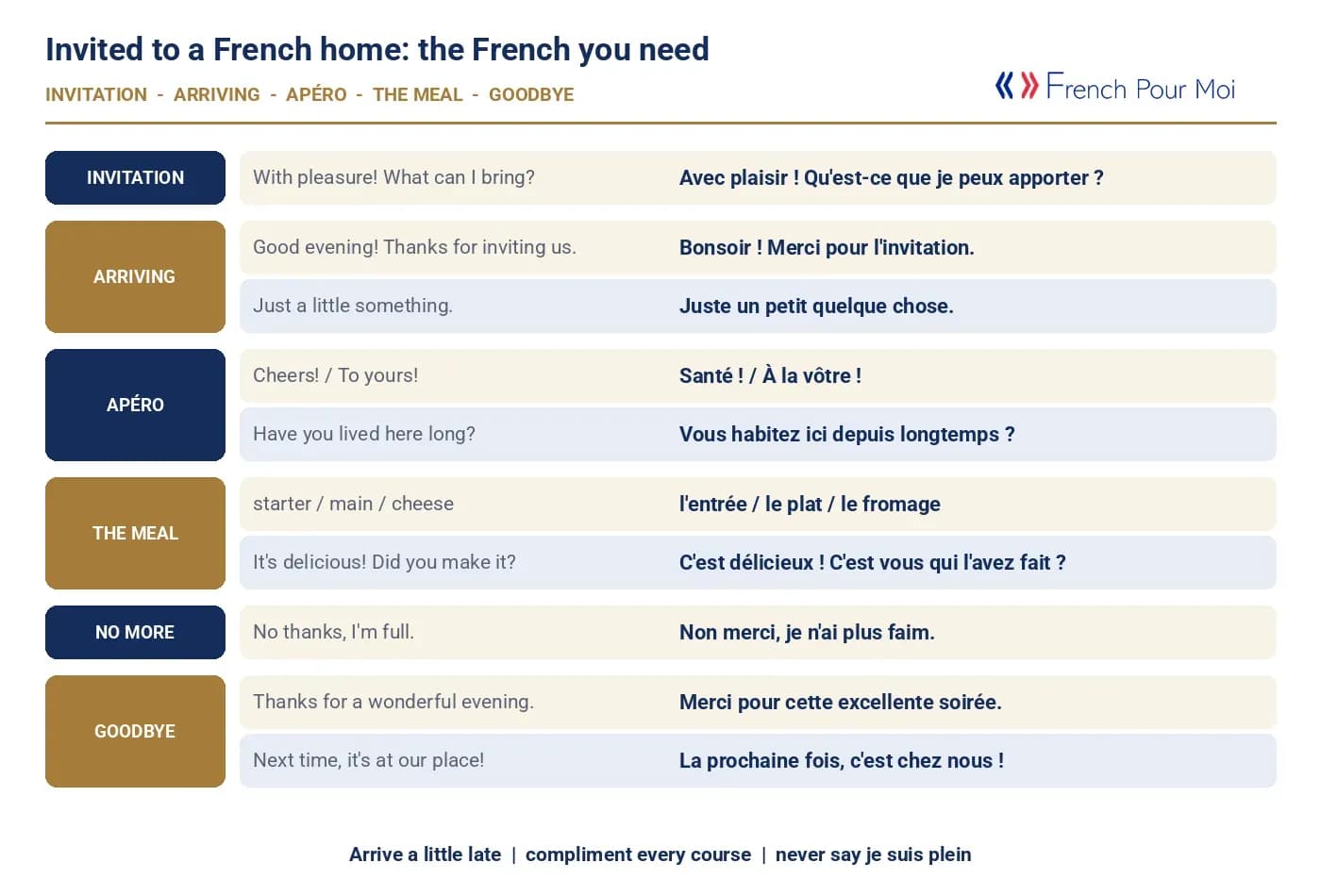
- Avec plaisir ! - With pleasure!
- C'est très gentil, merci. - That's very kind, thank you.
- Qu'est-ce que je peux apporter ? - What can I bring?
- À quelle heure ? - What time?
- Je ne mange pas de viande / J'ai une allergie aux noix. - I don't eat meat / I have a nut allergy.
Mention allergies or dietary needs when you accept, not when the main course arrives. Your host will be grateful for the warning.
Also listen for the type of invitation. Venez prendre l'apéro (come for drinks and nibbles) is not the same as venez dîner (come for dinner). An apéro can be short - or, if it becomes an apéro dînatoire, it can replace dinner entirely with lots of small bites.
Your takeaway: reply with Avec plaisir ! Qu'est-ce que je peux apporter ? - warm, polite and useful in one line.
Timing: the polite quarter of an hour
In France, arriving exactly on time for a dinner at someone's home can catch your hosts still in the kitchen. Many people follow the quart d'heure de politesse - arriving around ten to fifteen minutes after the stated time.
This is for private homes only. For a restaurant booking, a work meeting or a train, be on time.
Arriving very late is a different story. If you're running behind, send a message:
- On a un peu de retard, on arrive dans vingt minutes. Désolés ! - We're running a bit late, we'll be there in twenty minutes. Sorry!
Your takeaway: at a French home, a few minutes late is polite. Much later needs a message.
What to bring (and what to avoid)
Arriving empty-handed is rarely a good look. Classic choices:
- une bouteille de vin - a bottle of wine
- des fleurs - flowers
- des chocolats or something from a good pâtisserie
- a small speciality from your own country - always a great conversation starter
A few classic notes:
- Wine: your host may already have chosen wines for the meal, so don't be offended if your bottle goes into the cupboard instead of onto the table. It's a gift, not a contribution.
- Flowers: chrysanthemums are traditionally associated with cemeteries in France, so choose something else.
- Dessert: only bring one if you've agreed it with your host - otherwise you may be competing with the one they made.
What to say as you hand it over:
- C'est pour vous / C'est pour toi. - This is for you.
- Juste un petit quelque chose. - Just a little something.
Your takeaway: bring a small gift, say Juste un petit quelque chose, and don't expect your wine to be opened.
Hello: la bise, tu and vous
At the door, greetings can be a small adventure.
La bise (cheek kisses) is common among friends and family, and often among friends of friends. The number of kisses varies by region and by family - two is common, but you may meet three or four. The simplest rule: follow your host's lead. If you're not comfortable, a warm handshake and a smile is perfectly acceptable, especially at a first meeting.
Tu or vous? If you're not sure, start with vous and let your hosts suggest tu:
- On peut se tutoyer ? - Shall we use tu?
- Oui, bien sûr !
Useful first lines:
- Bonsoir ! Merci pour l'invitation. - Good evening! Thanks for inviting us.
- C'est très joli chez vous. - Your home is lovely.
And yes, use Bonsoir, not Bonjour, for an evening invitation.
Your takeaway: say Bonsoir, merci pour l'invitation, follow your host's lead on la bise, and start with vous.
The apéro: drinks, nibbles and small talk
Most dinners start with l'apéritif: drinks and small things to nibble, usually in the living room or outside.
When you clink glasses, look people in the eye. It's a well-known French custom - and a fun one to explain. The two classic toasts:
- Santé ! - Cheers! (literally "health")
- À la vôtre ! / À la tienne ! - To yours! (vôtre for vous, tienne for tu)
The apéro is where small talk happens. Good topics: food, travel, the area where your hosts live, books, films, what brought you to France. Topics many French people find too personal for a first evening: how much people earn, and how much things cost.
- Vous habitez ici depuis longtemps ? - Have you lived here long?
- Qu'est-ce que vous me conseillez de visiter dans la région ? - What would you recommend visiting around here?
Don't fill up on nibbles. The apéro is only the warm-up.
Your takeaway: Santé !, eye contact, easy questions - and pace yourself.
At the table: the order of the meal
A French dinner at home usually follows a familiar order:
| French | What it is |
|---|---|
| L'apéritif | drinks and nibbles before the meal |
| L'entrée | starter (not the main course) |
| Le plat principal | main course |
| Le fromage | cheese, often with a little salad |
| Le dessert | dessert |
| Le café | coffee, sometimes with something sweet |
| Le digestif | an after-dinner drink (optional) |
Every family has its own version - some skip the cheese, some add a salad - but knowing the shape helps you pace yourself.
A few table habits:
- Wait for the host to say Bon appétit ! before you start.
- Keep your hands on the table (wrists resting on the edge), not in your lap.
- Bread is often placed directly on the tablecloth beside your plate, and torn by hand - no need to look for a side plate.
- Let your host pour the wine. If you serve yourself, offer to others first.
Your takeaway: l'entrée is the starter, cheese comes before dessert, and Bon appétit is your green light.
Compliments, seconds and "no more, thank you"
Complimenting the food is not optional - it's half the fun.
- C'est délicieux ! - It's delicious!
- C'est vous qui l'avez fait ? - Did you make it yourself?
- Vous pouvez me donner la recette ? - Could you give me the recipe?
Accepting more:
- Avec plaisir, juste un petit peu. - With pleasure, just a little.
Refusing politely:
- Non merci, c'était délicieux, mais je n'ai plus faim. - No thank you, it was delicious, but I'm full.
- J'ai très bien mangé, merci. - I've eaten really well, thank you.
Now the famous trap: don't translate "I'm full" as Je suis plein(e). In casual French, plein can mean drunk - and pleine is the word used for a pregnant animal. Your hosts will laugh kindly, and you'll have a great story. But Je n'ai plus faim is safer.
At the cheese course: take a reasonable piece, and when cutting a wedge, cut along its length so the next person also gets some of the rind and some of the centre. Taking the whole "nose" of a Brie is a classic faux pas.
Your takeaway: compliment every course, and when you're done, say Je n'ai plus faim - never Je suis plein.
Leaving: the long goodbye
French dinners can go on for hours, and that's a good sign. The goodbye takes time too: thank-yous, more bises, one last conversation at the door.
- Merci pour cette excellente soirée. - Thank you for a wonderful evening.
- On a passé une très bonne soirée. - We had a lovely evening.
- La prochaine fois, c'est chez nous ! - Next time, it's at our place!
Offering to help clear the table is kind; insisting on doing the washing-up is not usually expected.
The next day, a short message is a lovely touch:
- Encore merci pour hier soir, c'était un vrai plaisir ! - Thanks again for last night, it was a real pleasure!
And if you said La prochaine fois, c'est chez nous, mean it. Inviting back is how French friendships grow.
Your takeaway: thank them at the door, message the next day, and invite them back.
Five dinner-party mistakes (and the fix)
- Arriving exactly on the dot. Fix: give your hosts their quart d'heure de politesse.
- Expecting your wine to be served. Fix: it's a gift - let your host decide.
- Calling the main course l'entrée. Fix: l'entrée = starter, le plat = main.
- Saying Je suis plein(e). Fix: Je n'ai plus faim or J'ai très bien mangé.
- Asking what people earn. Fix: talk about food, travel and the region instead.
Your takeaway: most dinner-party mistakes are tiny - and a warm merci fixes almost all of them.
How to practise before the big night
- Learn your five lines: Avec plaisir, Merci pour l'invitation, Santé !, C'est délicieux, Je n'ai plus faim.
- Say the meal order out loud - apéritif, entrée, plat, fromage, dessert, café.
- Prepare two small-talk questions about your hosts' area and two short answers about yourself.
- Role-play the arrival and the goodbye - they're the moments that feel most awkward and are easiest to prepare.
Your takeaway: five lines, one meal order, two questions - that's enough French for a lovely evening.
For more table French, our guide to eating out in France covers cafés, bistros and restaurants, and if your invitation is from a client, French Business Lunches: Why Foreign Professionals Run Out of Things to Say will help you keep the conversation going.
At French Pour Moi, we can role-play the whole evening - from the doorstep to the cheese board - in 1-to-1 or 2-to-1 lessons with native tutors, online or in person. Prefer face to face? Get in touch to ask where in-person lessons are available.
FAQs
What should I bring to a dinner in a French home?
A small gift: a bottle of wine, flowers (but not chrysanthemums), chocolates or a speciality from your country. Only bring a dessert if you've agreed it with your host.
Should I arrive on time for dinner in France?
At a private home, arriving around ten to fifteen minutes after the stated time is common and polite - the quart d'heure de politesse. For restaurants and work, be on time.
How do I say "I'm full" in French?
Say Je n'ai plus faim (I'm not hungry any more) or J'ai très bien mangé (I've eaten very well). Avoid Je suis plein(e).
Do I have to do la bise?
No. Follow your host's lead. A warm handshake and a smile is perfectly polite, especially when you first meet.
Your takeaway: when in doubt, watch your host - and copy them.
One last thing
An invitation to a French home is an invitation into someone's life. You don't need perfect French to be a wonderful guest - just a few good lines, a small gift, a real appetite and a genuine merci.
Say Avec plaisir. Arrive a little late. Compliment the cheese. And invite them back.
Your takeaway: be curious, be grateful, and the French will follow.
Curious how ready your French is for your first French dinner party? Take our free French level test - it only takes a few minutes and shows you where to start.
À bientôt, Lucie – French Pour Moi