


If you've ever stood at a French cabinet médical reception with a sore throat, a passport, and a blank mind, you're in very good company. I hear this constantly from UK travellers, holiday-home owners, and new expats who can order coffee, ask for directions, even survive a restaurant - and then go oddly quiet the moment someone behind a counter asks Vous avez un rendez-vous ?
Illness is already stressful. Add an unfamiliar system, paperwork you don't recognise, and the fear that one imperfect sentence will delay help - and reception becomes the freeze point. Not because your French is "useless." Because medical French is a skill of sequence and formula, not of holiday vocab lists.
This post is not about phone calls in general (phone-calls toolkit here), and not about long-term residence levels (A2, B1 or B2 for living in France). This one is narrower: how to practise a full French doctor-and-pharmacy visit so reception stops winning.
Why capable travellers freeze at reception
A French medical visit is a different sport from a British GP walk-in - even when the symptoms are the same.
In the UK, many of us expect a receptionist who switches to English at the first hesitation, or forms that look familiar. In France - especially outside big tourist hubs - the first thirty seconds at accueil set the tone. You need a bonjour, a clear reason, and papers ready. If you arrive with only "I don't feel well" in English in your head, the counter feels like an exam.
So you freeze for very rational reasons:
- You're translating symptoms while the receptionist is already asking the next question.
- You're unsure whether this is avec rendez-vous or sans rendez-vous.
- You don't know which document they want first (passport, carte européenne d'assurance maladie / GHIC, address, ordonnance).
- You're afraid that imperfect French will sound like you don't need help - so you shrink.
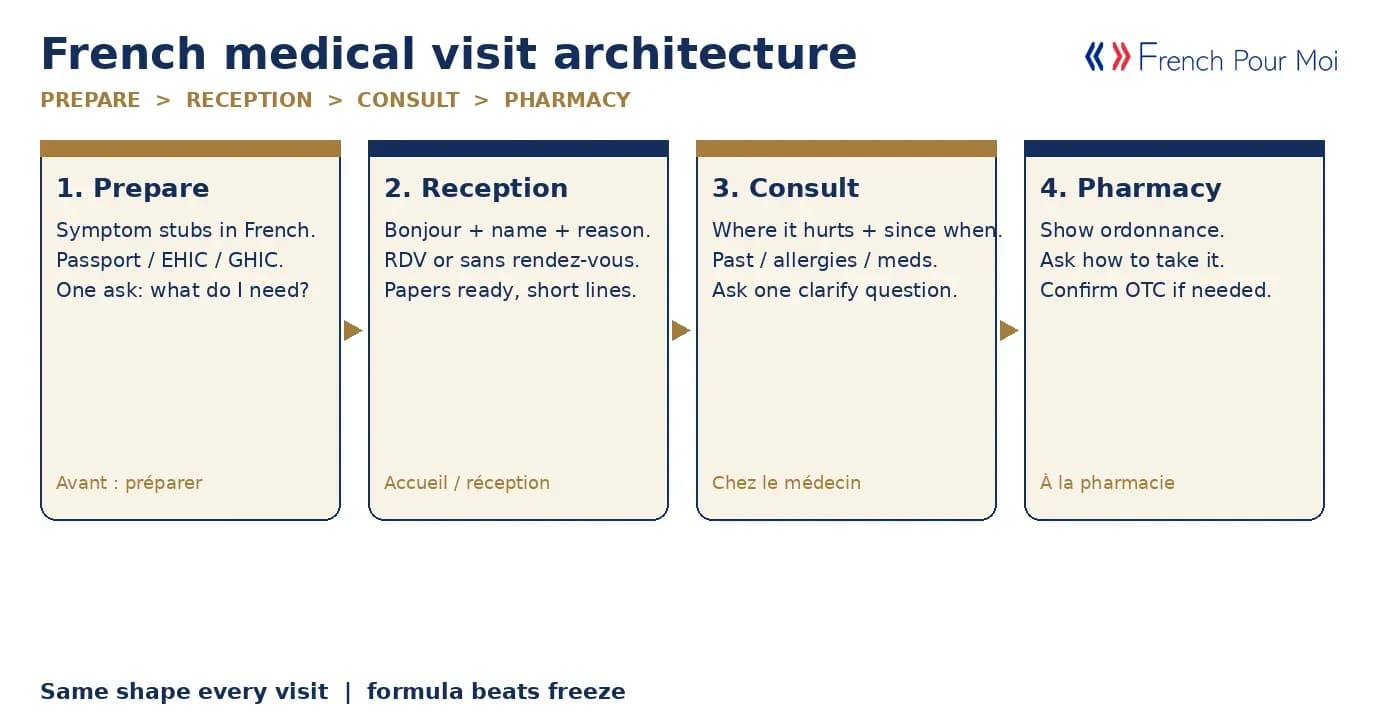
None of that means you should wait until your French is "ready." Medical visits don't wait. Formula does the work: prepare, reception, consult, pharmacy - same shape every time.
For a doctor visit, clear A2/B1 stubs with good structure often beat elegant B2 that never leaves your mouth. Unsure of your level? Start here: What is my level in French?.
A reusable medical-visit architecture
You don't need to sound like a native patient. You need four moves you can run on autopilot.
| Move | What it does | Phrase shape |
|---|---|---|
| 1. Prepare | Decide symptoms + documents before you walk in | Write stubs in French, not essays |
| 2. Reception | Signal who you are and why you're there | Bonjour + name + reason + papers |
| 3. Consult | Describe + answer + clarify | Where / since when / allergies + one ask |
| 4. Pharmacy | Turn the ordonnance into action | Show paper + how to take it + OTC if needed |
A full visit skeleton looks like this in your head:
- Before: three French stubs (main symptom, since when, one allergy or medication). Passport / EHIC-GHIC / payment method ready.
- At reception: Bonjour, name, j'ai besoin d'un médecin / j'ai rendez-vous, hand over papers without a speech.
- With the doctor: location of pain + duration + what makes it worse; then one clarify question before you leave.
- At the pharmacy: show the ordonnance, ask comment dois-je prendre..., confirm anything sans ordonnance if you still need it.
Notice what this architecture forces: you never rely on "I'll explain it if they seem friendly." Friendly is unreliable when you feel awful. Formula is reliable.
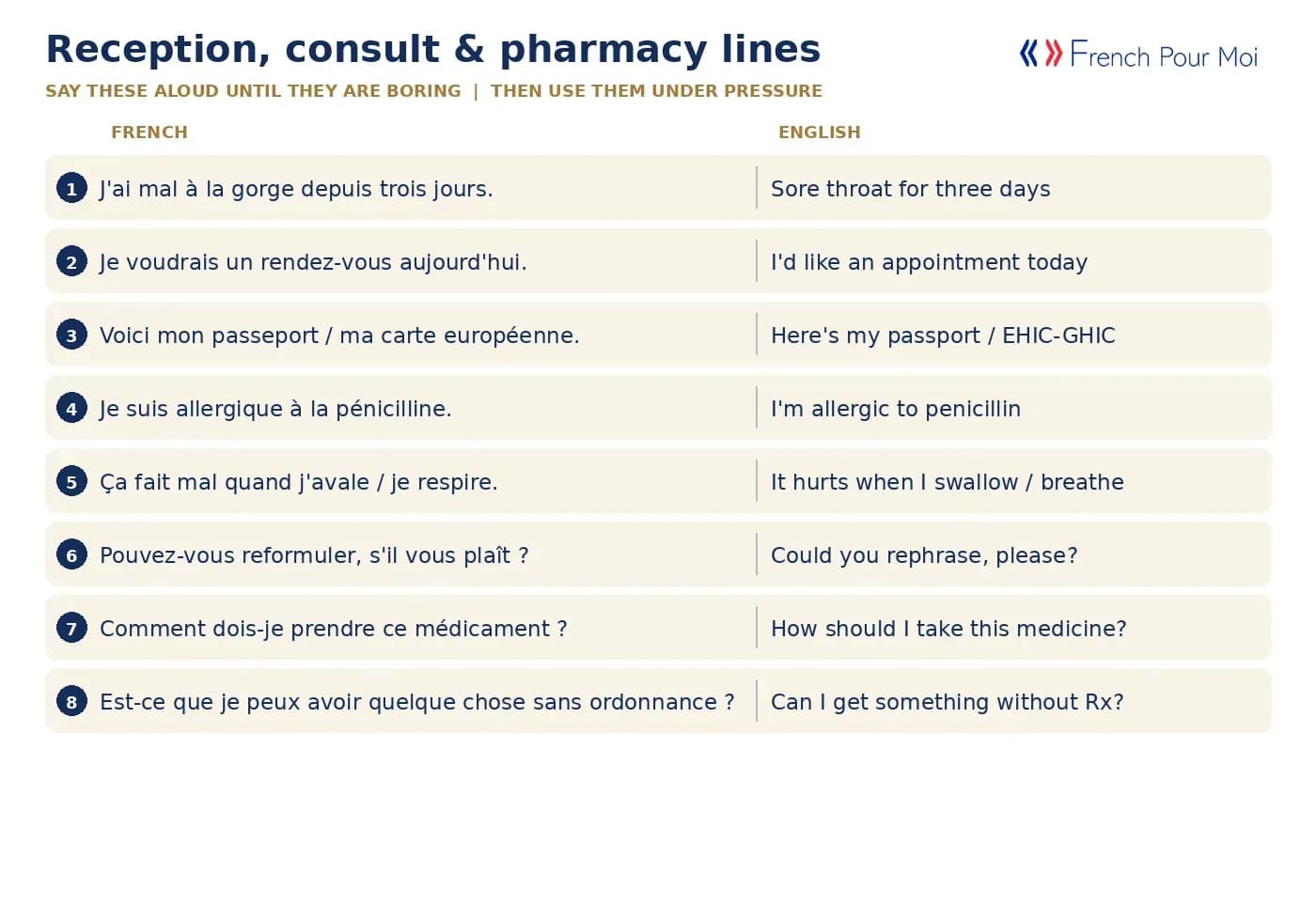
Reception, consult and pharmacy lines that do the real work
Vocabulary lists don't save a visit when you're dizzy. These lines do - because they manage the sequence and buy you time.
At reception (accueil)
- Bonjour, je m'appelle [Name]. J'ai rendez-vous à [heure]. - "Hello, my name is... I have an appointment at..."
- Bonjour. Est-ce que je peux voir un médecin aujourd'hui ? Je n'ai pas de rendez-vous. - "Hello. Can I see a doctor today? I don't have an appointment."
- Voici mon passeport. Voici ma carte européenne d'assurance maladie. - "Here's my passport. Here's my European Health Insurance Card / GHIC."
- Je suis de passage / je suis en vacances dans la région. - "I'm passing through / on holiday in the area."
Describing symptoms (keep them boring and concrete)
- J'ai mal à la gorge depuis trois jours. - "I've had a sore throat for three days."
- J'ai de la fièvre / je tousse / j'ai mal au ventre. - "I have a fever / I'm coughing / I have stomach pain."
- Ca fait mal quand j'avale / je respire / je marche. - "It hurts when I swallow / breathe / walk."
- Je suis allergique à la pénicilline / aux anti-inflammatoires. - "I'm allergic to penicillin / anti-inflammatories."
- J'en prends déjà [médicament]. - "I'm already taking [medicine]."
Clarifying / buying time
- Pouvez-vous reformuler, s'il vous plaît ? - "Could you rephrase, please?"
- Vous parlez de... ? - "Are you talking about...?"
- Lentement, s'il vous plaît. - "Slowly, please."
- Je n'ai pas bien compris - vous recommandez... ? - "I didn't quite catch that - are you recommending...?"
At the pharmacy (pharmacie)
- Bonjour. Voici mon ordonnance. - "Hello. Here's my prescription."
- Comment dois-je prendre ce médicament ? - "How should I take this medicine?"
- Combien de fois par jour ? Avant ou après les repas ? - "How many times a day? Before or after meals?"
- Est-ce que je peux avoir quelque chose sans ordonnance pour [symptôme] ? - "Can I get something without a prescription for [symptom]?"
You don't need thirty lines. Pick eight, say them aloud until they're boring, and rotate. Boredom is the point - boring phrases survive adrenaline and a blocked nose.
Mini scripts for the moments that freeze people
Here are four high-frequency scenes. Steal them, shorten them, make them yours.
1) Same-day appointment with no booking
Bonjour. Je n'ai pas de rendez-vous. J'ai mal à la gorge et un peu de fièvre depuis hier. Est-ce qu'un médecin peut me recevoir aujourd'hui ? ("Hello. I don't have an appointment. I've had a sore throat and a bit of fever since yesterday. Can a doctor see me today?")
Then stop. Let them answer with a time, a wait, or a redirect to another cabinet / maison médicale. Don't apologise for four more sentences.
2) Opening the consult without a novel
Bonjour docteur. Depuis trois jours, j'ai mal à la gorge, je tousse la nuit, et j'ai 38 de fièvre hier soir. Je ne suis pas allergique. Je prends juste du paracétamol. ("Hello doctor. For three days I've had a sore throat, I cough at night, and I had 38 fever last night. No allergies. I'm only taking paracetamol.")
Structure: duration -> main symptoms -> allergy/meds. That lands better than a long English story whispered in panic.
3) Asking for reformulation without sounding lost
Pardon - je n'ai pas bien saisi. Vous parlez d'un antibiotique ou d'un traitement pour la fièvre ? ("Sorry - I didn't quite catch that. Do you mean an antibiotic or something for the fever?")
Specificity is kindness. "I didn't understand" invites a full replay at the same speed. A binary choice invites a clean answer.
4) Pharmacy follow-through
Bonjour. Voici l'ordonnance. Pouvez-vous me dire comment prendre chaque médicament - combien par jour, et pendant combien de jours ? Et est-ce que je peux aussi prendre quelque chose pour la toux sans ordonnance ? ("Hello. Here's the prescription. Can you tell me how to take each medicine - how many a day, and for how many days? And can I also get something for the cough without a prescription?")
If you skip this step, you leave with boxes you don't dare open. Thirty seconds of floor here saves a sleepless night of guessing.
Mistakes that keep UK travellers silent (or stuck)
-
Waiting to "feel fluent" before seeking help. Symptoms don't wait for B2. A clear A2 stub with depuis trois jours beats silence.
-
Explaining your whole holiday biography at reception. They need who you are, why you're there, and papers. Save the story for the doctor - and keep even that short.
-
Forgetting documents until you're at the counter. Passport and EHIC/GHIC (or private insurance details) belong in the same pocket as your phone. Fumbling papers is where freeze starts.
-
Leaving the consult without one clarify ask. If you nod through instructions you didn't catch, the pharmacy becomes a second exam. Ask vous recommandez... ? before you stand up.
-
Treating the pharmacy as a silent shop. French pharmaciens are trained advisers. Showing the ordonnance and asking how to take it is normal, not needy - the same "short clear ask" habit holiday-home owners already use with tradesmen (holiday-home renovations).
A 2-4 week practise plan (before you need it)
You don't need medical immersion. You need deliberate visit reps when you're well - so the shape is automatic when you're not.
Weeks 1-2 - install the architecture
- Write three symptom stubs for two common scenarios (sore throat; stomach upset). Keep them under fifteen words each.
- Practise the reception open aloud twice: bonjour + name + reason + papers line.
- Role-play once: partner plays receptionist and only accepts short clear French.
- Put passport + insurance card in one pouch so the habit is physical, not theoretical.
Weeks 3-4 - consult speed + pharmacy close
- Practise one full consult script (60-90 seconds): duration, symptoms, allergy, one question.
- Practise the pharmacy close: show paper, ask dosage, ask OTC if needed.
- Add one repair line under pressure: Pouvez-vous reformuler... or Lentement, s'il vous plaît.
- If you travel soon, walk past a real pharmacie and mentally run the open - no purchase required.
By week four, the goal isn't medical fluency - it's a visit shape your mouth trusts when your head feels foggy.
How we help with travel and expat French at French Pour Moi
At French Pour Moi, our native tutors work one-to-one with travellers, holiday-home owners, and expats who need French that holds up at reception desks, cabinets, and pharmacies - not only restaurant menus.
That means short scenario drills (reception -> consult -> pharmacy), feedback on the exact habit to fix next, Take our free French level test, then tell us your travel pattern and which scenarios scare you most - we can shape a short plan around the visits you actually face.
FAQs
Do I need B1 before I see a French doctor?
No. From solid A2 with prepared stubs, you can handle most routine visits. Structure and documents matter more than sounding advanced. Check your level here if you're unsure: What is my level in French?.
What if it's an emergency?
For life-threatening emergencies, call 15 (SAMU) or 112. This post is for routine and urgent-but-not-emergency visits - sore throats, infections, minor injuries - where reception and pharmacy French actually decide the day. Don't practise scripts instead of calling emergency services when you need them.
Can I just speak English at reception?
Sometimes, especially in big cities or tourist areas. Often, not reliably - and hoping for English is what creates the freeze when it doesn't appear. Prepare French stubs anyway; use English as a bonus, not a plan.
Should I phone ahead or walk in?
Both exist. Many médecins généralistes prefer rendez-vous (Doctolib is common). Pharmacies can often advise and sometimes point you to a doctor on duty (médecin de garde). If phone booking is your weak spot, pair this post with the phone-calls practise guide.
What if I freeze mid-sentence at the counter?
Use a repair line immediately: Donnez-moi un instant or Ce que je voulais dire, c'est que... Then finish with one short symptom stub and stop. Silence stretches the freeze; a formula ends it.
Closing
French doctor and pharmacy visits stop feeling mysterious once you stop waiting for fluent inspiration and start using a French shape. Prepare, reception, consult, pharmacy - plus a small bank of concrete lines - will carry most of the visits travellers and holiday-home owners actually face.
Practise when you're well. Keep eight phrases visible for a fortnight. Then notice how often the "I went blank at reception" story simply shrinks.
If you want help making this automatic before your next trip, start with the free French level test and get in touch. I'll be glad to help you sound like yourself - in French that works when you don't feel your best.
A bientôt et prenez soin de vous, Sophie