


It's the last week of your October stay. The garden furniture is back in the barn, someone is wrestling with a stiff shutter, and the car is half packed for the ferry. There's one job left, and it's the one many of my holiday-home students put off until the very last morning: walking across the lane to ask Madame next door if she'd mind keeping an eye on the house until spring.
You know her a little. You wave, you once chatted about her tomatoes. But a real favour in French - with keys, dates, a boiler and a "what if" in it - is a different thing. So it often ends up as a rushed Euh... vous pouvez regarder la maison ? Merci ! on the doorstep, and four months of wondering what she understood.
October is exactly the moment for it. The French Toussaint school holidays run from Saturday 17 October to Monday 2 November 2026 in every zone, so villages fill up for a fortnight and then go very quiet - and many UK owners close up straight after half-term. Here's a simple shape for the conversation, the phrases that carry it, the mistakes I see most, a worked example with the follow-up messages, and a way to practise before you go.
Why this favour feels harder than it should
Asking a neighbour for help sounds small, but it combines several skills at once.
It's personal, not transactional. With a plumber you're a customer and the script is clear. With a neighbour, you're asking for their time for nothing, and you'll live next to them for years. The relationship matters more than the information.
The details really matter. "Keep an eye on the house" can mean almost anything. Does she go inside? Check the heating? What if a tile blows off? If you don't say it clearly, she'll either do too little or worry she's doing too much.
It happens in real time. Your neighbour may come back with questions you didn't expect - Et vous revenez quand ? Il y a quelqu'un d'autre qui a les clés ? - quickly, sometimes with a strong regional accent.
British politeness doesn't translate word for word. We soften requests in layers: I was just wondering, if it's not too much trouble, whether you might possibly... In French, piled-up apologies don't sound extra polite. They sound anxious, and they hide the request. French politeness sits in a few clear signals: a proper bonjour, vous, a conditional verb and a warm thank-you.
None of this is about your level. It's about having a shape to follow, so your head is free to listen.
The doorstep favour: a five-step architecture
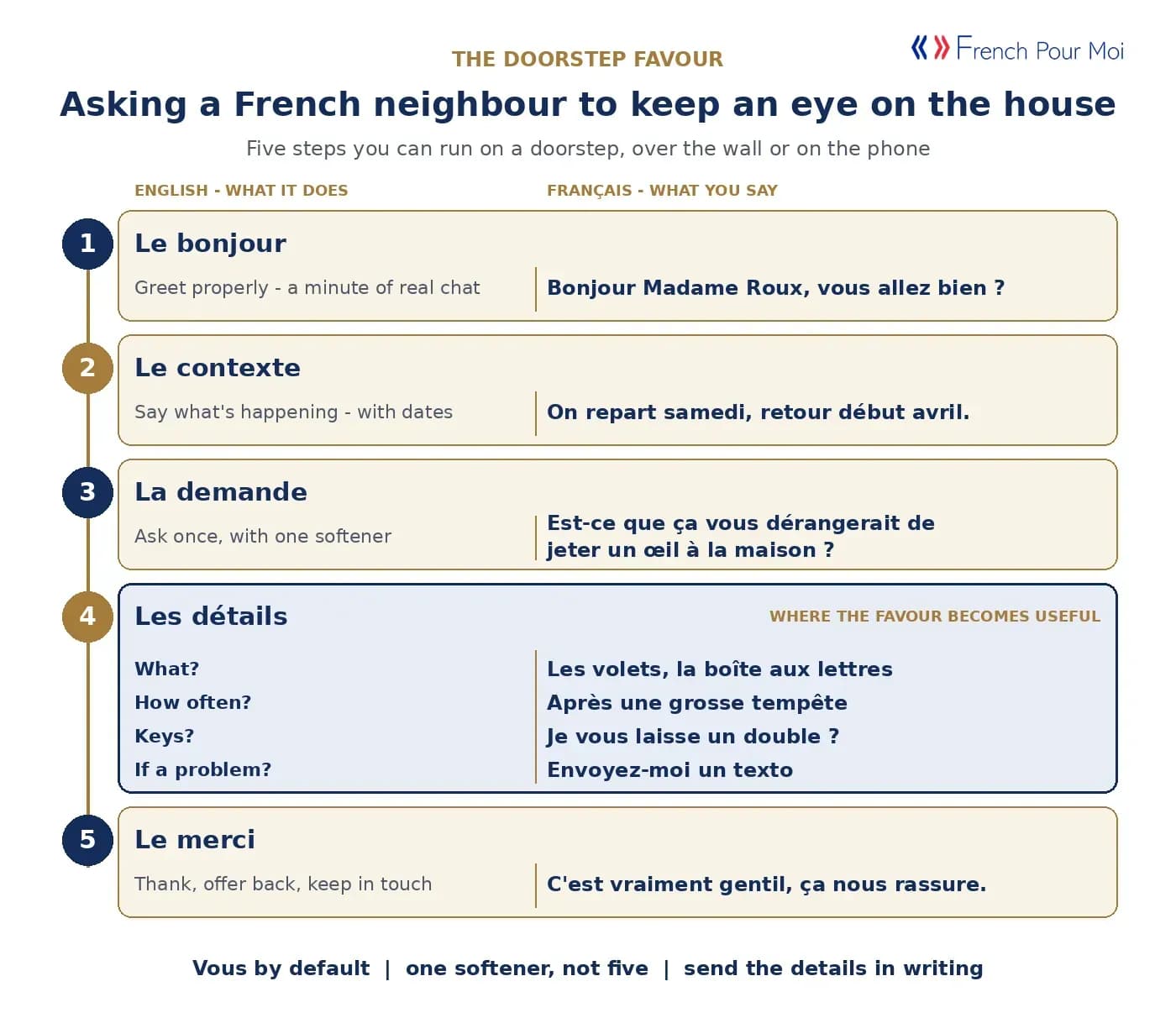
Here's the structure I teach holiday-home owners. It works on a doorstep, over the garden wall, or on the phone.
| Step | What it does | Phrase shape |
|---|---|---|
| 1. Le bonjour | Greet properly, a minute of real chat | Bonjour Madame Roux, vous allez bien ? |
| 2. Le contexte | Say what's happening and when | On repart samedi, on revient début avril. |
| 3. La demande | Ask the favour clearly, once | Je voulais vous demander un petit service. |
| 4. Les détails | What, how often, keys, who to call | Je vous laisse un double des clés ? |
| 5. Le merci | Thank, offer something back, keep in touch | C'est vraiment gentil. Je vous envoie un message de temps en temps. |
Steps 3 and 4 are where most of the useful French lives, and step 1 is the one UK owners skip when they're nervous.
Step 1 - Le bonjour
In a French village, bonjour isn't a throwaway, and opening with your question can feel abrupt. Say Bonjour Madame (or use their surname), ask how they are, and give the small talk a minute: the weather, the Toussaint visitors, the walnuts. Then move on.
Step 2 - Le contexte
Give the frame before the request: On rentre en Angleterre samedi matin, et la maison va rester fermée jusqu'à début avril. Dates help. Tout l'hiver is vague; jusqu'à début avril is a plan.
Step 3 - La demande
One clear, polite request. My favourite three shapes:
- Je voulais vous demander un petit service. (I wanted to ask you a small favour.)
- Est-ce que ça vous dérangerait de jeter un œil à la maison de temps en temps ? (Would you mind keeping an eye on the house now and then?)
- Si ça ne vous embête pas, bien sûr. (Only if it's no bother, of course.)
That last line is your one softener - you don't need five. And make it easy to say no: Pas de souci si ce n'est pas possible takes the pressure off.
Step 4 - Les détails
This is where the favour becomes useful. Cover four things:
- What exactly: juste passer devant de temps en temps, vérifier que les volets sont bien fermés, et regarder la boîte aux lettres. If you'd like her to go inside: jeter un œil au chauffage, qu'il reste bien en hors-gel.
- How often: no pressure. Pas besoin de passer souvent - surtout après une grosse tempête ou s'il gèle fort.
- Keys and access: Je vous laisse un double des clés ? or La clé est chez les Martin si besoin.
- What if something goes wrong: who she calls and how. S'il y a un problème, vous pouvez m'envoyer un texto ou un WhatsApp. Et voici le numéro du plombier. Also show her the stopcock if she might need it: Le robinet d'arrivée d'eau est ici, sous l'évier.
Then ask how she prefers to keep in touch: Vous préférez un texto, un WhatsApp ou un appel ? Some neighbours love WhatsApp photos; others would rather you rang.
Step 5 - Le merci
Thank her warmly: C'est vraiment gentil, ça nous rassure beaucoup. Offer something back: Et si vous avez besoin de quoi que ce soit, n'hésitez pas. Then keep in touch over the winter.
Phrases that carry the conversation
These are the lines I drill most with owners before they close up. Learn the shapes, then make them yours.
| English | French |
|---|---|
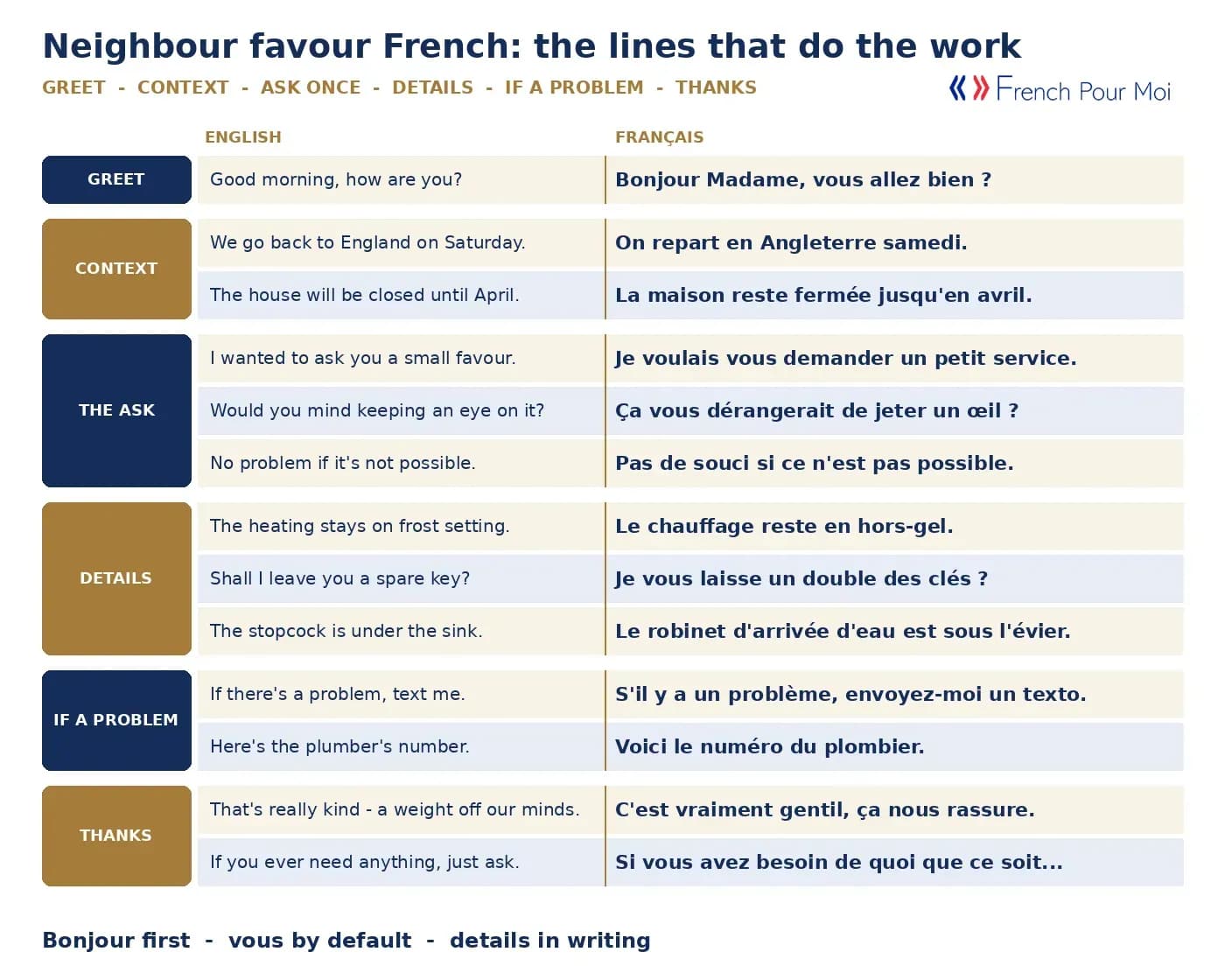
| Good morning, how are you? | Bonjour Madame, vous allez bien ? |
| We're heading back to England on Saturday. | On repart en Angleterre samedi. |
| The house will be closed until early April. | La maison va rester fermée jusqu'à début avril. |
| I wanted to ask you a small favour. | Je voulais vous demander un petit service. |
| Would you mind keeping an eye on the house? | Est-ce que ça vous dérangerait de jeter un œil à la maison ? |
| Only if it's no bother, of course. | Si ça ne vous embête pas, bien sûr. |
| No problem if it's not possible. | Pas de souci si ce n'est pas possible. |
| Just checking the shutters and the post. | Juste vérifier les volets et la boîte aux lettres. |
| The heating stays on frost setting. | Le chauffage reste en hors-gel. |
A worked example: Helen and David near Sarlat
Helen and David live in Bristol and co-own a stone house just outside Sarlat, in the Dordogne. Their neighbour across the lane, Madame Roux, is retired and has known the house far longer than they have. It's the Thursday before they leave. Helen walks over with a jar of quince jelly.
Helen: Bonjour Madame Roux ! Vous allez bien ? Vous avez eu du monde pour la Toussaint ?
Mme Roux: Ah oui, les petits-enfants sont là jusqu'à lundi. Ça fait du bruit, mais c'est bien !
Helen: C'est super. Écoutez, on repart en Angleterre samedi matin, et la maison va rester fermée jusqu'à début avril. Je voulais vous demander un petit service - si ça ne vous embête pas, bien sûr.
Mme Roux: Allez-y, dites-moi.
Helen: Est-ce que ça vous dérangerait de jeter un œil à la maison de temps en temps ? Pas besoin de passer souvent - juste vérifier que les volets tiennent, surtout après une grosse tempête.
Mme Roux: Mais bien sûr. Vous me laissez une clé ?
Helen: Oui, je vous laisse un double. Le chauffage reste en hors-gel, et s'il y a un problème, vous pouvez m'envoyer un WhatsApp. Ou vous préférez un appel ?
Mme Roux: Un message, c'est très bien. Ma fille m'a installé WhatsApp.
Helen: Parfait. C'est vraiment gentil, ça nous rassure beaucoup. Tenez, c'est de la gelée de coings - on a fait ça avec les fruits du jardin.
Notice what made this work. Helen's French isn't advanced. She opened with a genuine question, gave the dates before the request, asked once with a single softener, and turned "keep an eye" into something concrete. She asked how Madame Roux liked to be contacted instead of assuming. And she closed with thanks and a gift from the garden - not an envelope of cash.
That evening, Helen sends the details in writing, so nothing depends on memory:
Bonsoir Madame Roux,
Encore merci pour tout, c'est vraiment gentil.
Petit récapitulatif :
- on part samedi matin, retour prévu début avril
- le double des clés est dans l'enveloppe que je vous ai donnée
- le chauffage reste en hors-gel
- le robinet d'arrivée d'eau est sous l'évier de la cuisine
- le plombier : M. Delmas, 06 .. .. .. ..
Si vous avez le moindre souci, n'hésitez pas à m'écrire.
Bonne soirée,
Helen
(Put the real number in, of course - I've left it as dots here.)
In January, after a windy week in the south-west, Helen checks in. (She and Madame Roux go back a while, so Bises feels natural; with a newer neighbour, Bonne journée is safer.)
Bonjour Madame Roux,
Bonne année à vous et à toute la famille !
On a vu qu'il y avait eu beaucoup de vent chez vous cette semaine. Tout va bien de votre côté ?
Si vous avez l'occasion de passer devant la maison, ce serait très gentil - mais rien d'urgent.
Bises d'Angleterre,
Helen
And the reply:
Bonjour Helen, bonne année à vous deux !
J'ai fait le tour ce matin. Les volets sont bien fermés, mais il y a une tuile tombée côté jardin. Rien de grave à l'intérieur.
Je vous envoie une photo.
Now Helen knows exactly what to say next: thank her, and call a roofer. If talking to un couvreur is the part that worries you, our post on renovating a holiday home in France and communicating with French tradesmen covers trade vocabulary and the devis. And if the call itself makes you freeze, have a look at how to practise French phone calls for real life in France.
Mistakes UK owners make (and the easy fixes)
-
Skipping the bonjour. Starting with Excusez-moi, vous pouvez... can land as abrupt. Greet first, then ask.
-
Jumping to tu. With neighbours - especially older ones - vous is the safe default, even after years of waving. Let them suggest on peut se tutoyer. First name with vous is completely normal.
-
Stacking English-style hedges. Je suis vraiment désolée de vous déranger, je me demandais si peut-être, si ce n'est pas trop... sounds nervous, and the request gets lost. One conditional plus one softener is plenty.
-
Leaving it vague. Regarder la maison without details means your neighbour has to guess. Say what, how often, and what to do if something is wrong.
-
No plan B. If she finds a leak in February, who does she call? Leave a plumber's number, a second contact and the stopcock location - in writing.
-
Disappearing until spring. Four months of silence, then a knock at Easter, feels transactional. A New Year message (les vœux are traditionally sent through January) and a thank-you when you're back keep things warm.
-
Making it about money on the doorstep. Cash for a neighbourly favour can turn kindness into a job. A gift, a meal or help in return usually lands better. If you need regular, scheduled checks, that's a different conversation - with a paid caretaker or gardiennage service - so be upfront about it.
Belt and braces: official options worth knowing
A good neighbour is wonderful, but two official things are worth knowing too. I'm a French teacher, not a lawyer, so treat these as pointers and check the current details yourself.
Opération Tranquillité Vacances (OTV). This free police and gendarmerie scheme lets you ask for patrols to watch your home while you're away, and you (or a trusted person nearby - your neighbour, perhaps) are contacted if something looks wrong. According to service-public.fr, it runs all year. The rules differ by area: in a gendarmerie zone, second homes can be registered for absences of up to twelve months; in a police zone, the scheme is for main residences. You can sign up online with FranceConnect or in person at the gendarmerie or police station, up to 45 days before you leave. Check the official page for your address: Comment s'inscrire à l'opération tranquillité vacances (OTV) ? - service-public.fr.
Registering in person is another conversation with a shape: Bonjour, je voudrais inscrire ma résidence secondaire à l'opération tranquillité vacances.
Your home insurance. service-public.fr notes that some home insurance contracts exclude theft after a long period without anyone living in the home (a clause d'inhabitation), with the length set by your own contract. Some contracts also list precautions for an empty house. So before you close up, reread your conditions générales or ask your insurer. The official overview is here: Assurance habitation et vol : conditions de prise en charge - service-public.fr.
How to practise before you go
Four short sessions before your last week will change how the doorstep feels.
- Session 1 - write your five steps. On one card: your bonjour line, your context sentence with real dates, your one-sentence request and the four details (what, how often, keys, who to call).
- Session 2 - say it out loud. Read the card aloud three times, then without it. Record yourself. Aim for under a minute, with your neighbour's name in it.
- Session 3 - prepare for their questions. Write five things your neighbour might ask (Vous revenez quand ? Il y a une alarme ? Le chauffage, vous le laissez ? Qui d'autre a les clés ?) and answer each in a short sentence.
- Session 4 - a role-play with a tutor. This is where it clicks. Ask your tutor to play a neighbour who talks quickly, interrupts with questions and once says no: Ah, cet hiver, ça va être compliqué, je pars chez ma fille. Practise accepting gracefully - Pas de souci, je comprends tout à fait - and asking who else might help: Vous connaissez quelqu'un qui pourrait passer de temps en temps ?
Then write your recap message and January check-in in advance, ready in your phone.
If you'd like to know where your French sits before you start, this guide helps: What is my level in French? A1, A2, B1, B2?. And if the holiday home is slowly turning into a longer-term plan, our post on the French level you'll need to live in France is a good next read.
How we help holiday-home owners at French Pour Moi
Many of my students own or share a house in France, and the French they need isn't textbook French. It's the doorstep, the phone call, the WhatsApp to the neighbour, the roofer's quote. In lessons we role-play your real situations - your house, your neighbours, your village - so the first time you have the conversation isn't the real one.
Lessons run 1-to-1 or 2-to-1, online or in person - get in touch to ask about in-person lessons near you. 2-to-1 works beautifully for couples and co-owners of a holiday home: you learn together, practise on each other between lessons, and you both know what was agreed with the neighbour.
If that sounds useful, get in touch to book a lesson and tell me a little about your house and what you'd like to handle in French. And if you'd like a quick snapshot of your level first, try our free French level test.
FAQs
Should I use tu or vous with my French neighbours?
Start with vous and let them suggest the switch. Many neighbours stay on vous for years, even on first-name terms - that's not coldness. If they say On peut se tutoyer, a warm Avec plaisir ! is all you need.
What if I can't understand my neighbour's accent?
Pardon, vous pouvez répéter un peu plus lentement ? is perfectly polite, and so is checking: Si j'ai bien compris, vous passez après les tempêtes, c'est ça ? Repeating the key point back is one of the most useful habits you can build.
Closing
Closing a house for winter is always a little bittersweet - the last coffee on the terrace, the shutters going down one by one. But the conversation with your neighbour needn't be the stressful part. Bonjour, context, the ask, the details, the thank-you: five steps, practised out loud, and you'll drive to the ferry knowing someone you trust is just across the lane.
Prepare your card, write your recap message, and keep in touch over the winter. I'd love to help you get there - in French.
À bientôt - et bon retour, Sophie