


There is a small section at the end of the new GCSE French Listening paper that most families still haven't really looked at. It's called the dictation. Your child hears a few short French sentences and writes down exactly what they hear - in French.
It sounds like the easy bit. No questions to decode, no distractors, no English answers to phrase. And then the marked mock comes back and the dictation looks like this:
Say tray importon pour ma famee.
What the speaker said was C'est très important pour ma famille. Your child heard every sound correctly. They just spelled French with English rules.
The dictation only arrived with the reformed GCSE (the first students sat it in summer 2026), so there is not much family know-how about it yet - and a lot of Year 11s will meet it properly for the first time in their autumn or winter mocks. The good news: it is one of the most trainable sections on the whole paper. Ten minutes, three times a week, makes a visible difference by mock season.
This post sits alongside my Listening guide, GCSE French Listening: Why the First Play Feels Impossible. That one is about catching meaning under pressure. This one is about turning sound into correct French spelling.
A quick note: exam boards publish their own specifications, sample papers and mark schemes, and details can change. Everything below is practical coaching based on the published AQA and Pearson Edexcel materials - always check your child's own board and tier.
What the dictation actually is
Here is the shape of it on the two boards most UK families ask me about.
| AQA | Pearson Edexcel | |
|---|---|---|
| Where it sits | Listening paper, Section B | Listening paper, Section B |
| Foundation | 4 short sentences, at least 20 words, 8 marks | 6 short sentences (3 gap-fill, 3 whole sentences), 20 words to write, 10 marks |
| Higher | 5 short sentences, at least 30 words, 10 marks | 6 short sentences (2 gap-fill, 4 whole sentences), 30 words to write, 10 marks |
| How often each sentence is heard | 3 times: full, then in short sections, then full again | 3 times |
| Words from outside the vocab list | 2 | 2 |
| How it's marked | Meaning across the whole dictation, plus transcription and grammatical accuracy | Each correctly represented word counts towards the mark |
Two details in that table matter more than they look.
First, there are always two words your child won't have learned. That's deliberate. The examiners want to see whether they can spell an unfamiliar word from its sound - which is only possible if they know how French sounds map onto letters.
Second, the boards reward slightly different things. Pearson Edexcel's published mark scheme credits words where the spelling represents the sound correctly, even if a grammatical ending is wrong but silent - so il aime written for ils aiment can still earn its credit, because it sounds identical. AQA's criteria include a separate mark for "transcription and grammatical accuracy", judged across the whole dictation, so silent grammar still matters there. Same habit, different price tag - which is why I always ask families which board they're on.
Why smart students write English-sounding French
When a teenager writes say for c'est or bo for beau, it isn't laziness. Their brain is doing exactly what it has done for years in English: hearing a sound and reaching for the most familiar spelling. Three things make it worse in French:
- The same sound has several spellings. The "ay" sound in été, manger, chez and et is spelled four different ways.
- French hides letters. Ils parlent ends in three silent letters. Les enfants links into "lay-zahn-fahn". Nothing you hear tells you the -ent is there - only grammar does.
- Panic writing. Students try to write the whole sentence on the first hearing, fall behind, and spend the rest of the time catching up instead of checking.
So the fix isn't "try harder at spelling". It's two things: a routine for the three hearings, and a small set of sound-spelling rules learned until they're automatic.
Three hearings, three jobs
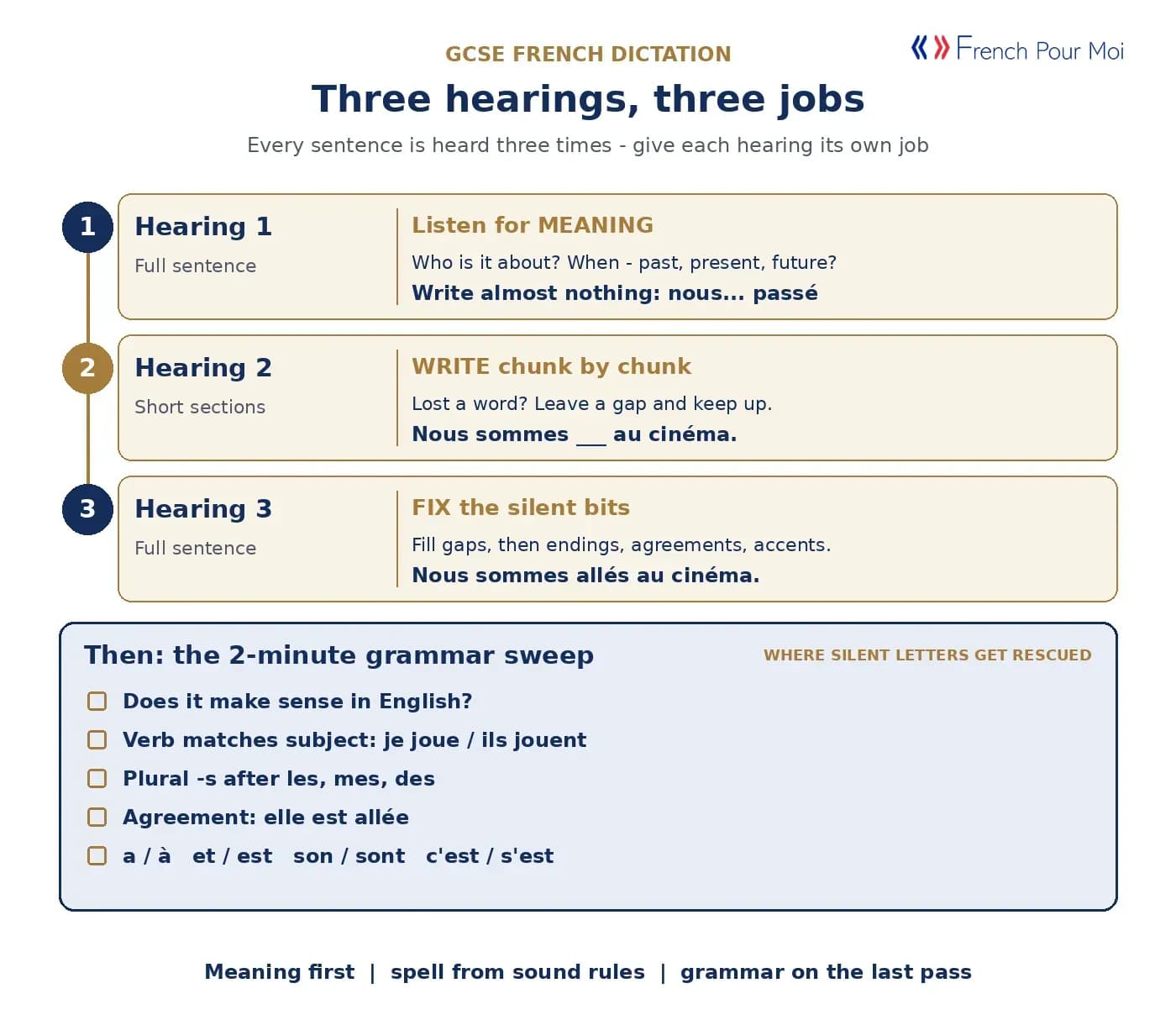
Every sentence is heard three times. Most students use all three hearings for the same job - frantic writing. Give each hearing its own job instead.
| Hearing | What your child does | What they write |
|---|---|---|
| 1 - full sentence | Listen for meaning: who is it about, and when (past, present, future)? | Almost nothing - the subject and a tense hint at most (nous... passé) |
| 2 - short sections | Write chunk by chunk; if a word goes, leave a gap and keep up | The sentence, with gaps |
| 3 - full sentence | Fill the gaps and fix: endings, agreements, accents | Corrections only |
Then, at the end of the paper, there is checking time (AQA builds in two minutes at the end of the recording). Use it for a grammar sweep of the dictation, because this is where silent letters get rescued:
- Does each sentence make sense if you translate it in your head?
- Does every verb match its subject? (je joue, nous jouons, ils jouent)
- Plurals: is there an -s on the noun and adjective after les, mes, des?
- Agreement: elle est allée, ma sœur est petite?
- The usual suspects: a or à, et or est, son or sont, c'est, s'est, ces or ses, ou or où?
The magic of this routine is that the meaning from hearing 1 drives the spelling on hearing 3. If your child knows the sentence is about my parents in the past, they know to look for ont and a past participle, not on.
The sound-spelling rules worth learning by heart
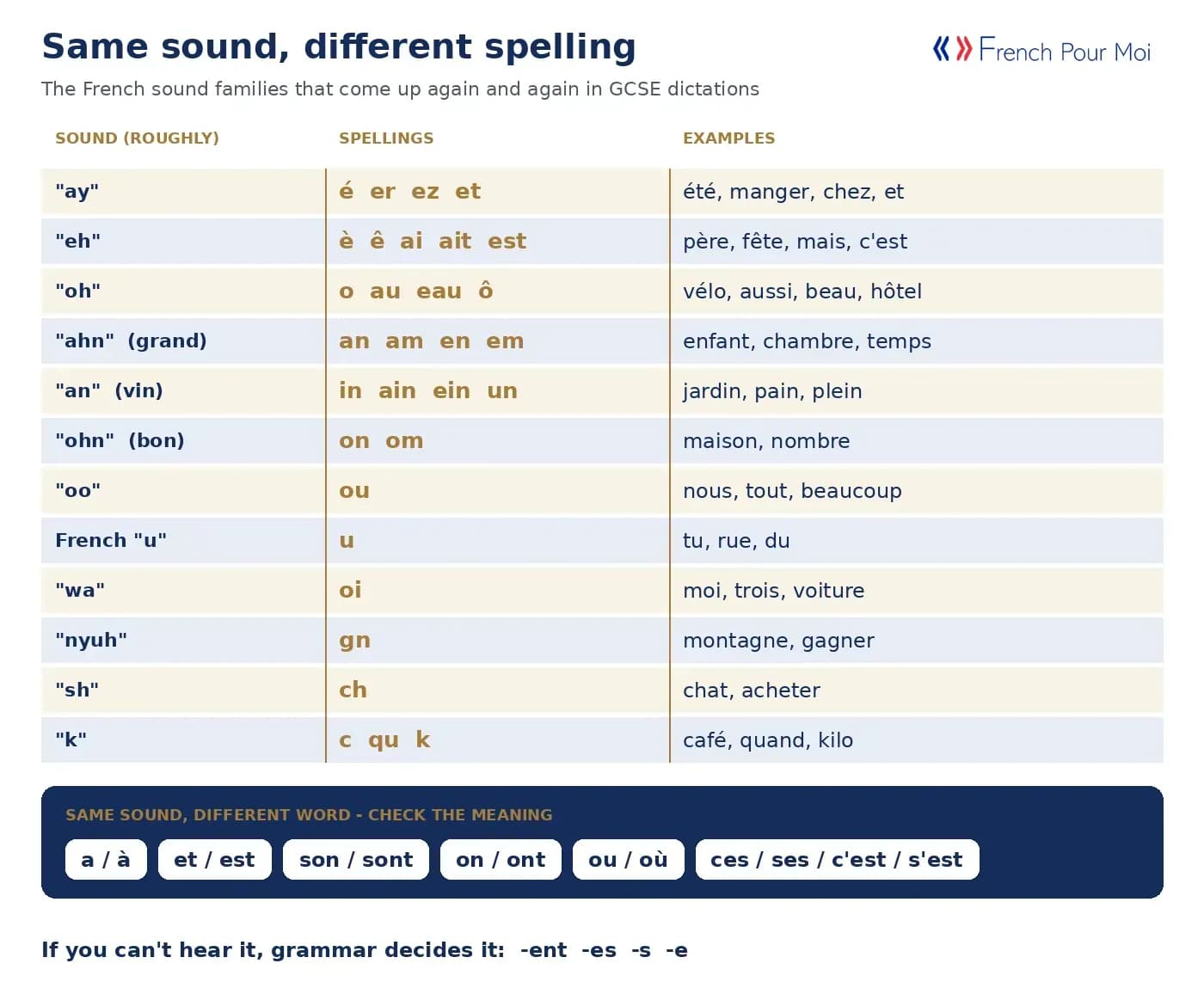
Your child does not need every rule in French phonics. They need the dozen or so sound families that come up constantly at GCSE, so that an unknown word becomes "a sound I know how to spell" rather than a guess.
| Sound (roughly, in English) | Usual spellings | Examples |
|---|---|---|
| "ay" (closed) | é, er, ez, et | été, manger, chez, et |
| "eh" (open) | è, ê, ai, ais / ait, est | père, fête, mais, il était, c'est |
| "oh" | o, au, eau, ô | vélo, aussi, beau, hôtel |
| nasal "ahn" (as in grand) | an, am, en, em | grand, chambre, enfant, temps |
| nasal "an" (as in vin) | in, ain, ein, un | jardin, pain, plein, lundi |
| nasal "ohn" (as in bon) | on, om | maison, nombre |
| "oo" | ou | nous, beaucoup |
| French "u" (lips rounded, say "ee") | u | tu, rue, du |
| "wa" | oi | moi, trois, voiture |
| "nyuh" | gn | montagne, gagner |
The ou versus u pair deserves its own drill: tout and tu, roue and rue, dessous and dessus. It is the confusion I see most often in GCSE dictations - and the one that changes meaning.
And the silent-letter rule to say out loud until it's boring: if you can't hear it, grammar decides it. Verb endings (-ent, -es, -s), plural -s, agreement -e - none of them are audible, so they're written in on hearing 3 or in the final sweep, never guessed on hearing 1.
A worked example: Maya's mock sentence
Maya is in Year 11 and sits AQA Higher. In her first practice dictation she heard: Hier, mes parents sont allés au marché.
What she wrote on the first go: Ier, may parent son allay o marshay.
Every one of those mistakes is predictable:
- Ier - she didn't know h is silent. Rule: initial h is almost always there in writing, never in sound.
- may - English spelling of the "ay" sound. Mes is a word she knows; she just didn't connect the sound to it under pressure.
- parent - singular, because the -s is silent. Mes tells her it must be parents.
- son instead of sont - same sound, but meaning (hearing 1: my parents went) points to the verb être.
- allay - English again; past participle of aller is allé, and with ils plus être it agrees: allés.
- o marshay - au is the "oh" spelling she needed, and ch plus é gives marché.
After three weeks of the routine below, here is her version: Hier, mes parents sont allés au marché. Nothing clever happened. She just stopped writing English and started running the sweep.
How to practise at home (even if you don't speak French)
You do not need to be able to pronounce French to coach this. You need audio, a transcript, and ten minutes.
Drill 1 - The ten-minute kitchen-table dictation
Use your child's board's sample dictations and their transcripts (search your board's website for the GCSE French sample assessment materials), or the audio from their textbook. Play each sentence three times, following the three-jobs routine. Then put the transcript next to their version and compare letter by letter. You don't need to know French to spot that beau and bo aren't the same.
Drill 2 - Homophone sort
Write ten short sentences with gaps, each needing one of a / à, et / est, son / sont, ces / ses / c'est / s'est, ou / où, on / ont. Your child fills them in and says why. Five minutes, twice a week. These little words are everywhere in dictations.
Drill 3 - The unknown-word challenge
Once a week, have them listen to a few words they've never seen - place names, less common foods, anything outside their vocab list - and spell them using only the sound table. Score it generously: if the spelling would be read aloud the right way, it's a win. This is exactly what the two unfamiliar words on the real paper are testing.
Drill 4 - Mark it like an examiner
After each practice, mark it twice: once counting words that represent the sound correctly, once checking grammar (verb endings, plurals, agreement). The gap between the two scores tells you what to work on. A big gap means the ear is fine and the grammar sweep needs work. A small score on both means the sound table needs more drilling.
A weekly rhythm up to mocks
- 3 kitchen-table dictations of 4 to 6 sentences (10 minutes each)
- 1 homophone sort (5 minutes)
- 1 unknown-word challenge (5 minutes)
- Reading aloud a short paragraph from their textbook - saying French out loud links sound and spelling in both directions, and it doubles as practice for the read-aloud task in the speaking exam
That's under an hour a week, and over a half-term it adds up to dozens of sentences heard, written, checked and corrected.
Myths that cost marks
-
"Dictation is just listening - you either hear it or you don't." Most dictation errors are spelling errors, not hearing errors. Maya heard every sound; she just spelled them in English.
-
"Accents don't really matter." Marche and marché are different words. Depending on the board, a missing accent may or may not cost credit - but writing it correctly is never wrong.
-
"Write as much as you can on the first hearing." The first hearing is for meaning. Writing too early puts your child behind for the rest of the sentence.
-
"It's only 8 or 10 marks." On a paper out of 40 or 50, that's a fifth to a quarter of Listening - and one of the few sections where practice converts almost directly into marks.
-
"We'll look at dictation after mocks." Mocks are where the routine gets tested under real timing. Start now and the mock becomes feedback, not a shock.
How we help with GCSE French at French Pour Moi
At French Pour Moi, our native tutors work one-to-one with GCSE students on the parts of the new exam that schools have had the least time to practise - and the dictation is high on that list.
In a session that looks like short live dictations read by a native speaker (so your child hears real French, not a robot voice), instant feedback on the exact sound or grammar habit to fix, and the same three-jobs routine every time until it's automatic. Because it's one-to-one, we can pitch it to Foundation or Higher and to your child's board.
If you'd like a starting point, take our free French level test, then get in touch with your child's year group, board and tier. We'll suggest a short plan around their mocks - online or in person (just ask us about in-person lessons near you).
FAQs
Is the dictation on every board?
The reformed GCSE French includes a dictation across the boards, but the format and marking differ. This post covers AQA and Pearson Edexcel in detail; if your child is on another board, check its specification and sample papers for the exact layout.
Does Foundation tier have it too?
Yes. Foundation dictations are shorter (around 20 words) and use more familiar language, but the three-jobs routine and the sound table work exactly the same way.
What about the two words outside the vocabulary list?
Don't try to learn them in advance - you can't. Learn the sound-spelling rules instead, so an unfamiliar word can still be spelled in a way that reads correctly.
My child is dyslexic. Is dictation unfair for them?
It can feel daunting, and access arrangements are a conversation to have with your child's school and its exams officer. In practice, the predictable sound-to-letter rules in this post often help, because they replace guessing with a short list of patterns to rely on.
How is this different from the rest of the Listening paper?
The comprehension section rewards catching meaning, and answers are in English. The dictation rewards turning sound into correct French spelling. My Listening guide covers the comprehension side; the habits complement each other.
Does this help with Writing too?
Yes. The grammar sweep - verb endings, plurals, agreement - is exactly the control I talk about in GCSE French Writing After the 2026 Reform. And if you're aiming high across all papers, How to Get a Grade 9 in GCSE French puts it in the bigger picture.
Try it tonight: six practice sentences
Read these aloud to your child (or ask their teacher for audio), three times each, using the three-jobs routine. Then compare their version with the text. The first four are Foundation-style; add the last two for Higher.
- Le samedi, je joue au foot avec mes amis.
- Ma sœur est plus âgée que moi.
- Hier, nous sommes allés au cinéma.
- C'est très important pour ma famille.
- Si j'avais le temps, je voyagerais en Italie.
- Les élèves qu'on a rencontrés étaient vraiment sympas.
If sentence 6 comes back as Lay zélève kon a ronkontré - perfect. That's an ear doing its job. Now we teach the hand.
A final thought
Dictation looks like the simplest task on the paper, and in a way it is: there's no trick question, just French sound and French spelling. What makes it hard is a lifetime of English spelling habits - and those change with short, regular, slightly boring practice.
Give each hearing a job, learn the sound families, and always sweep for silent grammar. Do that a few times a week between now and mocks, and the dictation stops being a mystery section and starts being marks your child can count on.
Quand vous voulez un coup de main pour la dictée, on est là.
À bientôt - et bonne dictée, Sophie