


"I'll do loads of French this week." It's one of the most common promises a GCSE student makes - and one of the least kept. Not because the student is lazy, but because "French" with four papers' worth of content is far too big to sit down and start.
I often hear two versions of the same week. In the first, a student plans hours of revision, sits down on day four, feels overwhelmed, and closes the laptop. In the second, a student does thirty focused minutes a day, follows a simple plan, and ends the week with a short list of exactly what still goes wrong.
The second student hasn't worked harder. They've worked smaller. This post gives you that plan: a seven-day GCSE French revision timetable you can use any time - before the mocks, before the real exams, in a school holiday, or in any week your child needs a reset - plus the shape of one 30-minute session and the jobs parents can do even if they don't speak a word of French.
A quick note: exam boards publish their own specifications, sample papers and mark schemes, and mock timings vary from school to school. Check your child's board (AQA or Pearson Edexcel for most families) and tier, and ask the school which past papers they'll use for the mock so you don't "spoil" them at home.
Why a short plan works (and why most plans fail)
The reformed GCSE French has four papers - Listening, Speaking, Reading and Writing - each worth a quarter of the grade. That's the first trap: students try to revise "French" as one big subject, and there's no obvious place to start.
The second trap is the plan itself. Revision plans usually fail for three reasons:
- Too big. "Two hours a day" sounds impressive on day one and impossible by day three.
- Too passive. Rereading vocab lists and highlighting notes feels like revision but shows almost nothing in a mock.
- No feedback. If nobody marks anything, the same mistakes go straight into the exam hall.
So the plan below is deliberately modest: six 30-minute sessions, one rest day, one skill per day, and everything gets marked. Start it on any day of the week - the days are numbered, not named.
The 7-day revision plan
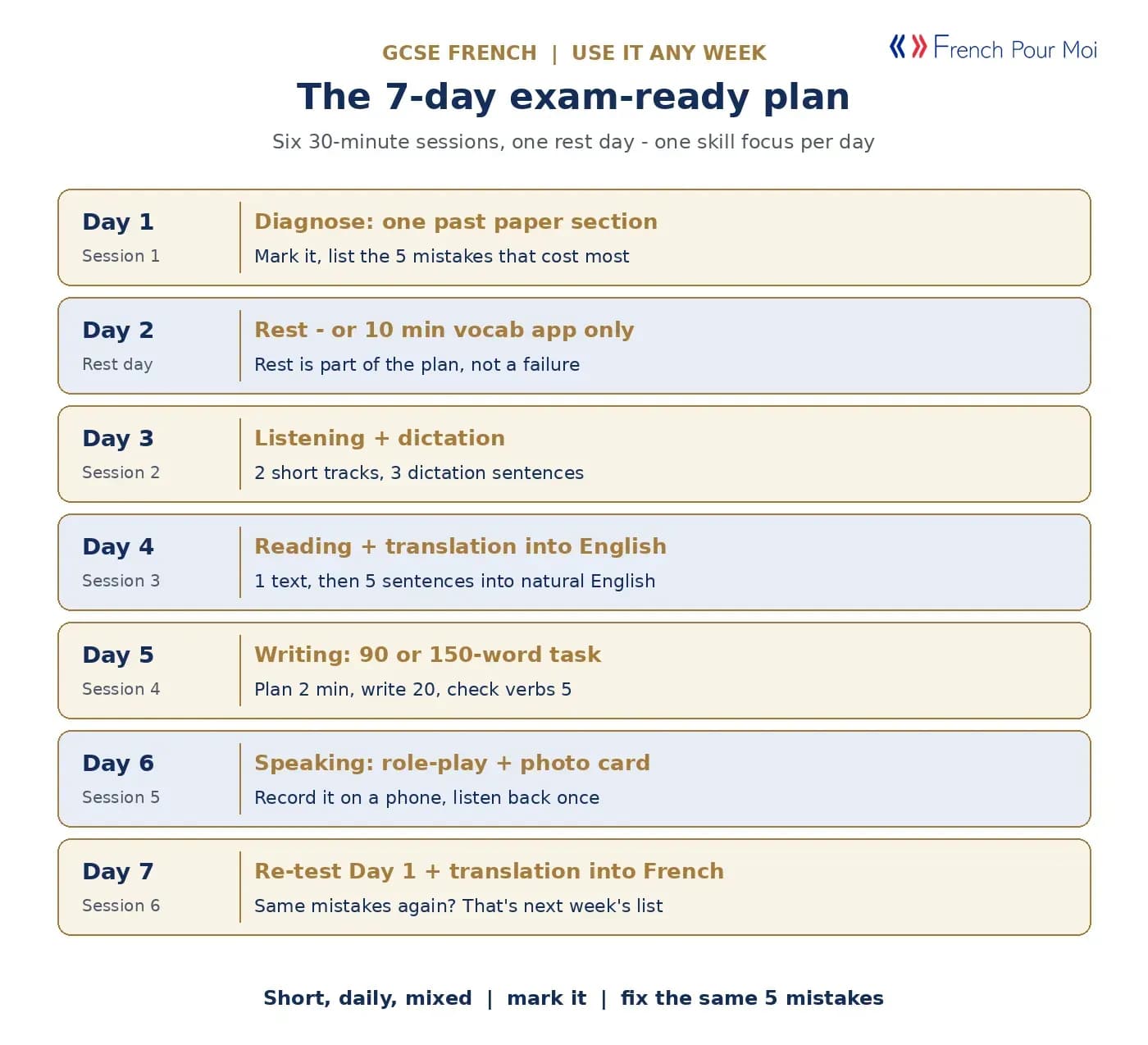
Day 1 - Diagnose
Pick one section of a past paper (not a whole paper - that's two hours of misery). Do it under timed conditions, mark it with the mark scheme, then write down the five mistakes that cost the most marks. This is your child's personal revision list for the week. It matters far more than any generic checklist.
Day 2 - Rest (really)
A day off is part of the plan. If your child wants to do something, ten minutes on a vocab app is plenty. Burnt-out students don't make it to Day 5.
Day 3 - Listening and dictation
Two short listening tracks from a past paper, plus three dictation sentences. If dictation is new territory for your family, my guide GCSE French Dictation: Why Your Child Writes "Say" for "C'est" explains the format and the sound-spelling rules. For the comprehension questions, GCSE French Listening: Why the First Play Feels Impossible has the "gist first, detail second" routine.
Day 4 - Reading and translation into English
One reading text, then five sentences translated into English. The translation is where marks quietly disappear: students write word-for-word English that doesn't make sense. The rule I give every student: if it sounds strange when you read it aloud in English, it's probably wrong.
Day 5 - Writing
One timed writing task - the 90-word or 150-word task at Higher, or the shorter tasks at Foundation. Two minutes planning, twenty minutes writing, five minutes checking verbs. My post GCSE French Writing 2026: Why Control Beats Creativity explains why accurate, simple French beats ambitious, broken French.
Day 6 - Speaking
One role-play and one photo card, recorded on a phone. Your child listens back once - just once - and notes one thing to fix. Recording feels awkward, but it's the closest thing to the real exam pressure. There's more in How to Prepare for the GCSE French Speaking Exam.
Day 7 - Re-test and translation into French
Redo the Day 1 mistakes (a new question of the same type), then five short sentences into French. Did the same mistakes come back? That's not failure - that's next week's list.
What one 30-minute session looks like
The secret to a plan that survives the week is that every session has the same shape. Your child never has to decide how to start, only what today's task is.
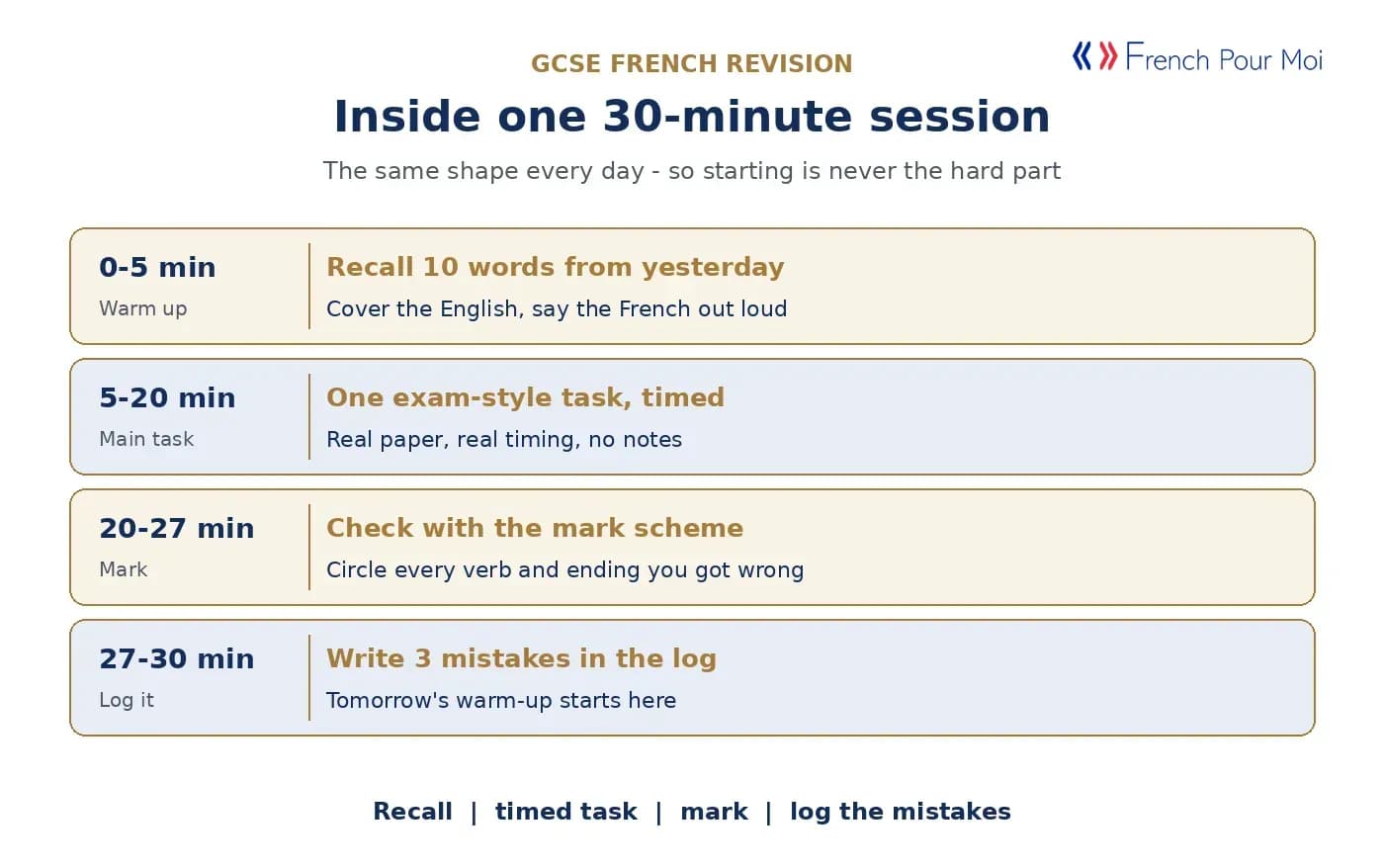
| Minutes | Job | What it looks like |
|---|---|---|
| 0-5 | Warm up | Cover the English, say 10 French words from yesterday out loud |
| 5-20 | Timed task | One exam-style task, real timing, no notes |
| 20-27 | Mark | Check with the mark scheme; circle every wrong verb or ending |
| 27-30 | Log it | Write 3 mistakes in a "mistake log" notebook |
The mistake log is the most valuable thing your child will own by exam day. By the end of the seven days it will hold around fifteen real mistakes - and those fifteen are worth more than a hundred pages of notes.
What a mistake log actually looks like
Here's a real-style example from a GCSE student I'll call Leo, after Day 1:
Wrote: Je suis allé au cinéma avec mes amis et c'était bon.
Problem: "c'était bon" for a film - sounds like he ate it.
Fix: c'était génial / c'était intéressant.
Wrote: Ma mère et moi allons visité Paris.
Problem: after allons, the verb stays in the infinitive.
Fix: Ma mère et moi allons visiter Paris.
Wrote (translation): "I have 16 years."
Problem: word-for-word from j'ai 16 ans.
Fix: "I am 16."
Three lines each: what I wrote, why it's wrong, the fix. That's it. Leo's warm-up the next day is to cover the fix and produce it from memory.
For parents: how to help without speaking French
You don't need any French to make this plan work. Your jobs are:
- Book the slot. Same time every day - straight after school or after breakfast works better than "sometime later".
- Hold the timer. Say "go" and "stop". It sounds silly; it makes the task feel like an exam.
- Ask, don't check. "What were your three mistakes today?" is a better question than "did you do your French?"
- Read the mistake log on Day 7. If the same mistake appears three times, that's a conversation for the teacher - or a tutor.
- Protect the rest day. A relaxed student revises again next week.
What not to do during the plan
- Don't do a full mock paper every day. One section, marked properly, beats two unmarked hours.
- Don't make new beautiful notes. If the notes already exist, use them to test, not to copy.
- Don't learn huge new vocab lists. Revise the topics your child has actually studied so far.
- Don't leave Speaking until the week before. It's the paper students most often avoid - and the one that improves fastest with practice.
After the seven days
Keep the shape, shrink the time: three 30-minute sessions a week until the next exam, each starting from the mistake log. When marked papers come back, the log tells you exactly where the gaps were - so the next plan writes itself. And whenever your child needs a reset, simply run the seven days again. If you want a broader view of where your child stands, our free French level test is a quick place to start, and if you're aiming high, How to Get a Grade 9 in GCSE French is the next read.
And if your child would like a structured revision week with a tutor - someone to mark the tasks, run the speaking practice and build the mistake log with them - get in touch with us. We'd love to help.
À bientôt,
Sophie