


You've found the house. Maybe it has shutters, a fig tree, a view of the church. The removal van is booked. And somewhere in the back of your mind, a small voice asks: But what will I actually say at the bank?
Good news: you don't need perfect French to retire happily in France. You need the right French - the few hundred words and phrases that run your week. The market. The bakery. The bank. The post office. The neighbour over the fence.
This post is about exactly that. Not grammar for its own sake. Daily life, one counter at a time.
Start with the magic word (it isn't "please")
In France, almost every exchange starts with Bonjour. Not "Hi, can I have...", not straight to the question. Bonjour first, then the rest.
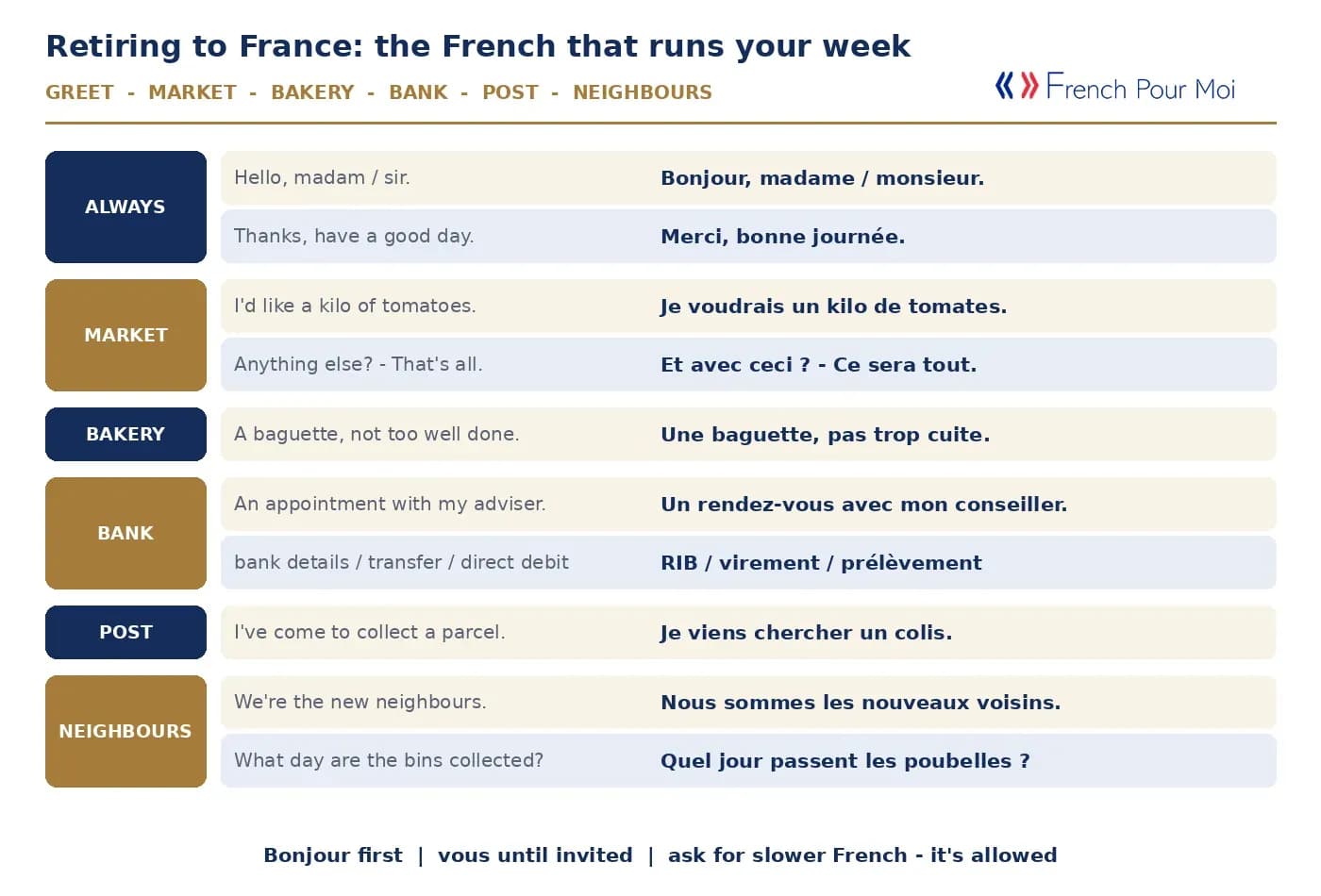
Walk into a shop, a waiting room, even a small lift - Bonjour. Add madame or monsieur and you sound instantly polite: Bonjour, madame. After about 6 pm, many people switch to Bonsoir. On the way out: Merci, au revoir, bonne journée.
Skipping the bonjour can make you seem rude, even if everything else you say is flawless. Getting it right buys you a lot of patience for any mistakes that follow.
Your takeaway: Bonjour before anything. It's the cheapest, most effective French you'll ever learn.
The market: where your French gets its first workout
The weekly market is where many retirees fall in love with their new town. It's also fast, noisy and full of numbers.
The shape of a market exchange is usually the same:
- You greet and ask: Bonjour ! Je voudrais un kilo de tomates, s'il vous plaît.
- The stallholder asks: Et avec ceci ? (Anything else?)
- You add more, or finish: Ce sera tout, merci. / C'est tout.
- You hear a price - and pay.
Useful quantities:
- un kilo / un demi-kilo - a kilo / half a kilo
- deux cents grammes de... - 200 grams of...
- une barquette de fraises - a punnet of strawberries
- une tranche / deux tranches de jambon - a slice / two slices of ham
- un morceau de ce fromage-là - a piece of that cheese
- une douzaine d'œufs - a dozen eggs
And the questions that turn a purchase into a conversation:
- Je peux goûter ? - Can I taste?
- C'est de la région ? - Is it local?
- Qu'est-ce que vous me conseillez ? - What do you recommend?
- Il est bien fait, ce camembert ? - Is this camembert ripe?
Numbers are the hard part. French prices fly past: trois euros cinquante, douze quatre-vingts (12.80). If you didn't catch it, there's no shame in Pardon, combien ? or simply glancing at the scale display. Practise numbers 60-99 especially - soixante-dix, quatre-vingts, quatre-vingt-dix - they're the ones that trip almost everyone up.
Your takeaway: learn the four-step market dance - Je voudrais... / Et avec ceci ? / C'est tout / price - and go back to the same stall every week. Regulars get chatted to.
The bakery and the café: small orders, daily practice
The boulangerie is your free daily French lesson. Short, friendly, the same words every day.
- Une baguette, s'il vous plaît.
- Une tradition, s'il vous plaît. (many bakeries sell a "baguette de tradition" - try it)
- Pas trop cuite / bien cuite. - Not too well done / well done.
- Je vais prendre deux croissants aussi.
At the café, un café gets you a small espresso. Un crème or un café crème is the milky one. Une noisette is an espresso with a dash of milk. And when you want to pay: L'addition, s'il vous plaît, or at the bar, Je vous dois combien ?
Your takeaway: one bakery, every morning, same baker. In a month, you'll be talking about the weather. In three, about her grandchildren.
The bank: words you'll meet on every form
French banking has its own vocabulary, and you'll see it everywhere: on forms, in letters, on your energy contract. Learn these before your first appointment:
| French | What it means |
|---|---|
| un compte courant | a current account |
| un RIB (relevé d'identité bancaire) | your bank details document - everyone will ask for it |
| un virement | a transfer |
| un prélèvement (automatique) | a direct debit |
| une carte bancaire | a bank card |
| un justificatif de domicile | proof of address |
| mon conseiller / ma conseillère | my bank adviser |
| un rendez-vous | an appointment |
French banks often work by appointment with a named adviser, so these phrases do a lot of work:
- Je voudrais prendre rendez-vous avec mon conseiller.
- Je voudrais ouvrir un compte.
- Pouvez-vous m'envoyer mon RIB, s'il vous plaît ?
- Je ne comprends pas ce prélèvement. - I don't understand this direct debit.
- Pouvez-vous parler un peu plus lentement, s'il vous plaît ?
Bring your documents, bring a notebook, and don't be afraid to ask the adviser to write things down: Vous pouvez me l'écrire ? French administration loves paper - you'll be in good company.
Your takeaway: learn RIB, virement and prélèvement now. They'll follow you everywhere - the bank, the electricity company, the phone contract, the mairie.
The post office and the letterbox
Sooner or later, you'll find a little slip in your letterbox: un avis de passage. It means the postman came with a parcel or registered letter and you weren't in. You'll need to collect it - with the slip and ID.
Useful words:
- un colis - a parcel
- une lettre recommandée (avec accusé de réception) - a registered letter (with proof of receipt)
- Je viens chercher un colis. - I've come to collect a parcel.
- Je voudrais envoyer ce paquet au Royaume-Uni / aux États-Unis. - I'd like to send this to the UK / the US.
Registered letters are common in French official life - for contracts, notices and administration. Don't panic when one arrives. It's often just formal, not bad news.
Your takeaway: if you see avis de passage, it's not a fine. It's a parcel waiting for you.
The neighbours: small words, big difference
In a village or small town, your neighbours may become your most important French teachers - and your support network.
Start formal. Use vous and madame / monsieur until they suggest otherwise (On peut se tutoyer ?). A few lines go a long way:
- Bonjour ! Nous sommes les nouveaux voisins. - We're the new neighbours.
- Nous venons d'Angleterre / des États-Unis / d'Écosse.
- Votre jardin est magnifique. - Your garden is lovely.
- Si vous avez besoin de quelque chose, n'hésitez pas. - If you need anything, don't hesitate.
- Excusez-moi, quel jour passent les poubelles ? - What day are the bins collected?
That last question is more useful than it sounds. Bins, recycling days and local rules about noise or garden fires vary by commune - your neighbours and the mairie will know.
If you'll be away for a while and want a neighbour to keep an eye on the house, we have a whole post on that: French for Holiday-Home Owners: How to Ask Your Neighbour to Keep an Eye on the House.
Your takeaway: introduce yourself early. A bonjour at the gate in week one is worth more than an apology in month six.
When things get complicated: phone calls and paperwork
Phone calls are where many retirees freeze: no gestures, no lip-reading, and an automated menu to start. Two lines will save you:
- Je suis anglophone, pouvez-vous parler lentement, s'il vous plaît ?
- Pouvez-vous me l'envoyer par e-mail ? - Can you send it to me by email?
We've written a full guide to this: How to Practise French Phone Calls for Real Life in France.
For the bigger picture - what level of French you may need for residence and how to get there - see A2, B1 or B2? Which French Level You'll Need to Live in France.
Your takeaway: you're allowed to ask for slower French, for email, for writing it down. Asking isn't failing. It's how adults get things done.
A gentle weekly routine
Retirement gives you something most learners don't have: time. Use a little of it, regularly.
- Monday - numbers. Five minutes saying prices out loud: 3,50 € / 12,80 € / 97 €. Especially 70-99.
- Tuesday - market script. Write your shopping list in French, then say each item as a full sentence: Je voudrais...
- Wednesday - bank words. Cover the French column of the bank table and test yourself.
- Thursday - one real conversation. The baker, the market, a neighbour. Just one more sentence than last week.
- Friday - review. Note three words you needed this week but didn't have. Those are next week's words.
Your takeaway: your daily errands are your lessons. You just need to notice them.
How French Pour Moi can help
At French Pour Moi, we work with adults preparing for - or already enjoying - life in France. In lessons, we focus on your real situations: your market, your bank appointment, your neighbour, the letter that just arrived. We role-play the conversations before you have them, so the real ones feel familiar.
Lessons are 1-to-1 or 2-to-1, online, in person in Bristol, or in person in Paris. 2-to-1 lessons are lovely for couples moving to France together - you can practise on each other at the market.
Curious? Get in touch to book a lesson. Or see where you are first with our free French level test.
FAQs
Can I retire to France without speaking French?
Many people start with very little French. But daily life - the bank, the doctor, the mairie, your neighbours - is much easier and more enjoyable with some. And residence rules can include language requirements for some permits, so check what applies to you: our guide to French levels for living in France is a good starting point.
Is it too late to learn French in retirement?
No. Adults learn differently from children, not worse. You bring vocabulary, life experience and - crucially - real reasons to speak every day. Regular, practical practice matters more than age.
Should I use "tu" or "vous" with my neighbours?
Start with vous. Let them suggest tu - and when they do, accept warmly: Avec plaisir !
What's the most useful thing to learn first?
Greetings, numbers and the market/bakery phrases in this post. They come up every single day, so you'll get practice for free.
One last thing
Retiring to France isn't about speaking like a native. It's about walking into the bakery, the market and the bank and feeling at home.
Say bonjour. Learn your numbers. Know your RIB from your prélèvement. And talk to your neighbours early.
The rest comes one conversation at a time.
À bientôt, Lucie - French Pour Moi